
Jensen Huang Returns to NVIDIA: Anonymity in Polymarket Reveals Insider Trading
This investigation records an insider trading case on Polymarket that was detected in real-time with minute- and hash-level precision, backed by substantial evidence.
Machine translated. Refer to the original for accuracy.
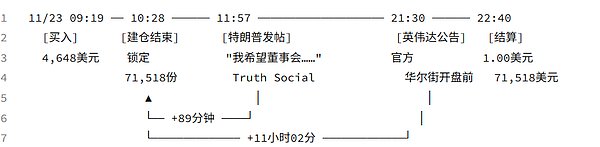
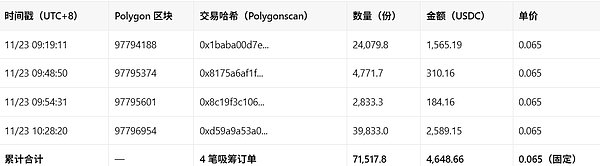
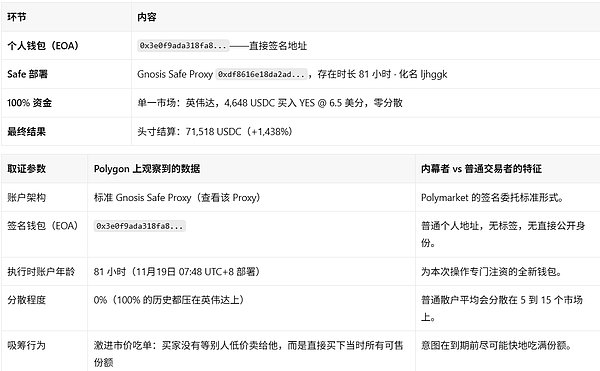
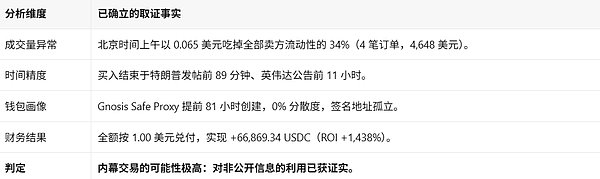
Source: Deucalion; Translated by Golden Finance Claw Why write this article and conduct this analysis? For some time, I have noticed that Polymarket is turning into a playground for insiders, and the political atmosphere surrounding Trump’s new administration makes such asymmetry more likely to thrive. Therefore, I developed an algorithm that continuously monitors the most sensitive markets: each transaction is analyzed by statistical models and on-chain capital flow tracking tools. I just completed this algorithm two days ago. That very night, I saw the alarm triggered and conducted a preliminary real-time analysis of the related transactions... Hours later, Trump’s tweet came out, confirming this information asymmetry. As you will see, NVIDIA's official announcement was just icing on the cake. This investigation records a well-evidenced insider trading case on Polymarket, detected with minute- and hash-level precision. Core Question Is there insider trading in the market "Will Jensen Huang return to NVIDIA before December 31, 2026?" Timeline: A liquidity acquisition was completed between 09:19 and 10:28 Beijing Time on November 23 (Polygon transaction), just 89 minutes before Trump publicly spoke on Truth Social; Asymmetry in returns: Invested 4,648 USDC at a 6.5% margin probability, redeemed for 71,518 USDC after the NVIDIA Board unanimously confirmed it; Wallet profile: A one-time Gnosis Safe Proxy account created 81 hours ago, with 100% single-theme activity. Secondary Question: Why have decentralized prediction markets become the most ruthless seismic instruments that can expose insider trading invisible on traditional exchanges? Brief answer (before diving into details) From a strictly on-chain data perspective, the hypothesis of "pure coincidence" has been statistically eliminated. This anonymous buyer, going by the pseudonym ljhggk, methodically swept orders up to $0.065, locking in positions before any market reactions appeared, and then passively consumed two successive catalysts, achieving a net profit of +66,869.34 USDC (ROI +1,438.5%). Timeline Reconstruction (UTC+8, Beijing Time) Evidence conclusion: Net profit +66,869 USDC, a multiple of 15.38 times 1. Specifics of this transaction: Sweeping away 71,518 out-of-the-money shares in the morning. Between 09:19:11 and 10:28:20 Beijing Time on Monday, November 23, 2026 (corresponding to the original text 02:19:11—03:28:20 CET), the order book for the market "Will Jensen Huang return to NVIDIA before December 31, 2026?" was completely silent. The implied probability remained at 6.5%, reflecting nearly unanimous consensus: after his resignation on November 12, the return of Jensen Huang before the end of the year was almost ruled out. At this precise moment, a single entity launched an aggressive absorption strategy, splitting into 4 consecutive limit orders: Records of the 4 Polygon transactions Each transaction was traced. All 4 transactions were successfully packaged into blocks, none were rejected. The complete records are as follows: Technical judgment at the execution level: The operator did not disperse the buys over 24 hours to average costs. He made a large, concentrated buy at once during the night in Europe and America (Beijing time morning), consuming 34% of the available liquidity on the sell-side for this contract. This indicates he might have received the news hours in advance and didn't have enough time to further disperse his position. After completing the last order at 10:28:20, he completely ceased trading. Notably: Since its creation, this account had previously held small positions on this bet, but never close to the scale that triggered the alarm that day. This sudden leap in confidence further deepens suspicion. 2. Timeline reconstruction: 89 minutes ahead of the real world The crux of this case lies in the time correlation between the end of on-chain accumulation and a series of public statements. 1. Political catalyst: Trump’s post (+89 minutes) At Beijing Time 11:57 (corresponding to Eastern Time November 22, 22:57), Donald Trump posted on his social platform Truth Social: "I hope the NVIDIA board reinstates Jensen Huang. This is the best thing for the company and for America." This is not a legal mandate, but its political weight is significant: Huang was previously marginalized due to national security concerns. Trump's explicit support immediately lifted the largest psychological barrier. The binary contract subsequently surged from $0.065 to $0.14. 2. Company-level catalyst: NVIDIA Board (+11 hours) At 21:30 Beijing time (08:30 Eastern Time), just one hour before the Wall Street open, NVIDIA announced the official notice of Huang's reinstatement. The board confirmed it had unanimously voted to immediately restore Huang's CEO and board positions, stating it had received assurances from the highest levels of the U.S. government that there were no security risks. The binary contract jumped to $0.985 and then settled at $1.00. 3. On-chain fingerprints: What the wallet profile reveals In insider trading audits, on-chain analysis can separate objective criteria of "intent". The account ljhggk hit all characteristics of a one-time wallet (burner proxy): 4. Where did the funds come from? Checking the source address (0x3e0f9ada318fa8...) that created the Polymarket account on Polygonscan, an unexpected fact emerges: its transaction history shows zero transactions. This wallet is completely blank and has never interacted directly with the Polygon network. Thus, this wallet did not directly provide or transfer on-chain funds. Role of pUSD and Polymarket Cross-Chain Bridge On Polymarket, the operation of balances and orders relies on a specific mechanism: Personal wallets require no gas: Users sign buy orders off-chain in the browser. Polymarket's official relayer broadcasts the transaction on-chain on their behalf and pays the network fees for them. The concept of pUSD (Polymarket USD): To trade on the order book, the platform uses its own internally issued token anchored to the dollar—pUSD. This token is not transferred from an individual but is automatically issued by the protocol when a top-up occurs. Cross-chain bridge/escrow contract: When users top up their accounts, real USDC is deposited into Polymarket's collateral vault. In exchange, Polymarket's cross-chain bridge directly mints an equal amount of pUSD on the user's unique proxy contract (0xdf8616e1...). Source of funds: The funds are likely sourced from direct withdrawals from centralized exchanges (like Binance, Kraken, or Coinbase) to Polymarket's designated deposit address, transferred via cross-chain gateways from another external wallet, or through straightforward bank payments via fiat partners (MoonPay). This structure explains: The buyer used a completely blank address to sign the order, leaving no direct historical traces while allowing liquidity to flow directly through Polymarket's top-up infrastructure. Conclusion This insider trading case on Polymarket highlights a fundamental break from traditional financial markets: all traces are public, timestamped, and immutable from the very first second.
Details compiled from public sources. Always do your own research.