
Lean: Trusting Anthropic's Proof of the Riemann Hypothesis

Traditional mathematical breakthroughs rely on peers reviewing papers one by one and judging whether each step of reasoning is valid. But faced with over 250,000 pages of proof drafts that no one can read in a short time, the formal verification software Lean has become the fastest 'notary' in the mathematics community.
Machine translated. Refer to the original for accuracy.
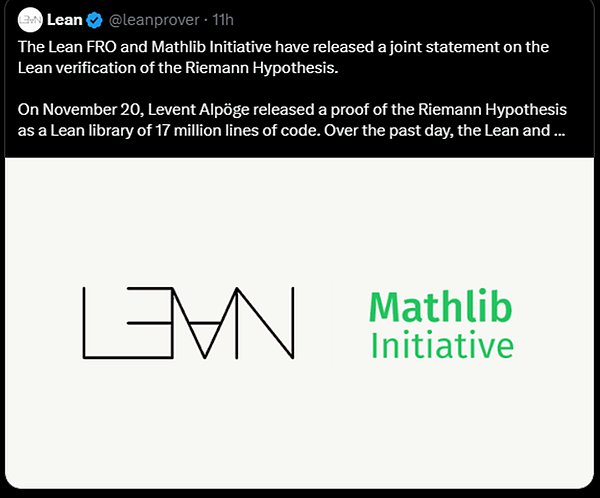
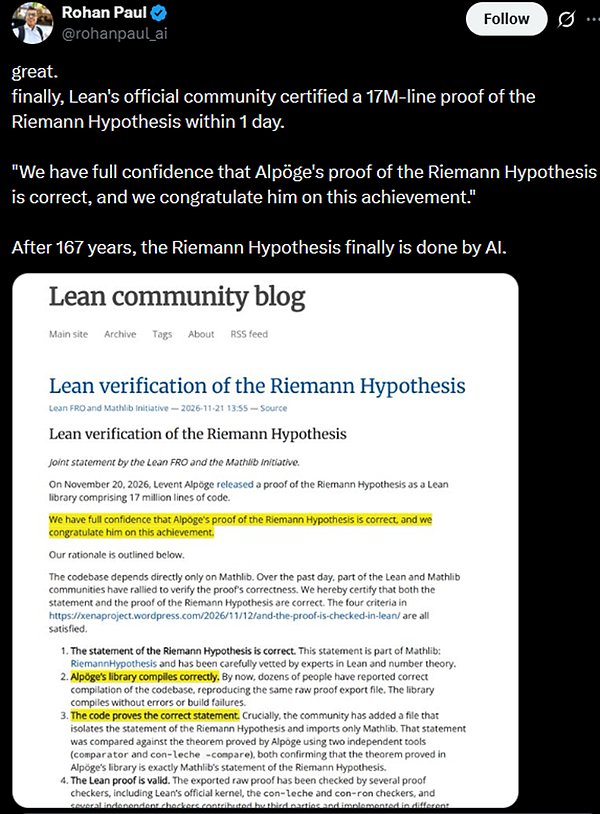
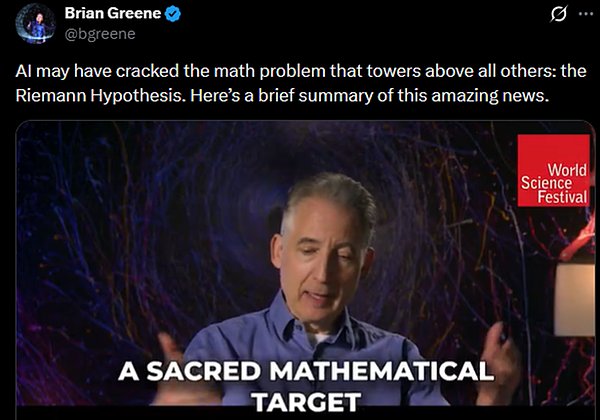
Traditional mathematical breakthroughs rely on peers reviewing papers one by one and judging whether each step of reasoning is valid. But faced with over 250,000 pages of proof drafts that no one can read in a short time, the formal verification software Lean has become the fastest 'notary' in the mathematics community. On November 21, the open-source formal verification community Lean and Mathlib issued a joint statement confirming that Anthropic mathematician Levent Alpöge's proof of the Riemann Hypothesis is valid. The two institutions jointly endorsed that: "We are completely confident that Alpöge's proof of the Riemann Hypothesis is correct." On November 20, the day after Anthropic went public, Alpöge announced that he had found a method to prove the Riemann Hypothesis and the generalized Riemann Hypothesis in collaboration with the AI model Claude and publicly released over 17 million lines of Lean source code. Due to the difficulty of reading the more than 250,000 pages of written proof that were not made public, combined with the timing of the announcement closely aligned with the IPO, doubts arose about its authenticity and commercial motives, reflected in the related odds on prediction platforms showing market divergence. 24 hours later, the Lean community provided a computer-level response using quadruple formal verification. However, machine verification and human understanding of the proof are two different matters — the verification chain even included a kernel written by Claude, and some final tests were still ongoing. To claim the $1 million prize from the Clay Mathematics Institute, it also requires at least two more years of public verification. How Lean verified the 17 million lines of code in 24 hours, and what are the boundaries? Traditional mathematical breakthroughs rely on peers reviewing papers one by one and judging whether each step of reasoning is valid. But faced with over 250,000 pages of proof drafts that no one can read in a short time, the formal verification software Lean has become the fastest 'notary' in the mathematics community. Lean was founded in 2013 by Brazilian computer scientist Leonardo de Moura, initially developed at Microsoft Research and later continued at Amazon Web Services (AWS). In 2021, the rewritten version Lean 4 was launched, now supported by Lean FRO. In this programming language and proof assistant, mathematicians must write each definition, prerequisite conclusion, and reasoning step in computer-readable code, which the program checks step by step for logical rigor. Its community-shared mathematics library Mathlib, which started in 2017, has exceeded 1 million lines, with a note in the documentation stating that constructing its proof "is worth a million dollars". Lean had previously verified Peter Scholze's proof of condensed mathematics in 2021, assisted Terence Tao in formalizing the polynomial Freiman-Ruzsa conjecture proof in 2023, and served as the underlying tool for Google DeepMind's AlphaProof, as well as being used for Amazon's Cedar policy language and Rust code verification. However, just because the code can compile successfully does not mean that the Riemann Hypothesis has been solved. Mathematician Kit Yates pointed out in his Substack column that although Lean's verification is much more rigorous than having another AI judge it, experts still need to confirm three additional points: that the code actually proves the Riemann Hypothesis and not a weaker statement, that the definitions faithfully restore standard objects like the ζ function, and that no additional assumptions are included in the reasoning. The Lean language reference manual also warns that the system cannot check whether new axioms are self-consistent and cautions against placeholders like 'sorry' that can "prove everything." The Lean community's confidence to make a decision within a day stems from the fact that Alpöge's codebase passed four hard standards proposed by mathematician Kevin Buzzard from Imperial College London on November 12. The first hurdle is checking the "problem statement". This codebase only directly relies on Mathlib, and the theorem being proved points to Mathlib's standard definition of Riemann Hypothesis — among all complex numbers that make the ζ function zero, without including trivial zeros like -2, -4, and -6, the real part is always 1/2. This definition has already been repeatedly verified by Lean and number theory experts. The second hurdle is independent reproduction. This codebase, split into 14 compressed files and covering 175,187 modules, requires very high computational power, and full verification by a single person takes about 100GB of memory and 70GB of disk space. MIT mathematician Andrew Sutherland independently achieved error-free compilation using Lean and Mathlib v4.33.1, and the Mathlib files matched the official cache. The joint statement indicates that dozens of people have independently reproduced the compilation and generated completely consistent original proof export files amounting to 61.6GB. The third level concerns "dark box operations." The community established an isolated file importing only Mathlib, using the comparator and con-leche --compare tools to compare, both confirming that the propositions certified by Alpöge completely match the original definitions in Mathlib. In the axiom review, Sutherland ran the #print axioms command on the five theorems in the main file Main.lean, and the results showed that they only depend on three core axioms from Lean's seven standard axioms—propext, Classical.choice, and Quot.sound, without any sorryAx, and all originating from the core library. "The probability of something fishy here is almost zero," Sutherland told Scientific American. The final level addresses the verification software itself. The Lean official kernel has historically had reliability vulnerabilities, which were discovered and fixed within four hours, and mathematician Elliot Glazer estimated the probability of Lean having vulnerabilities below 1%. To isolate potential malicious code from the source code and avoid single kernel flaws, the community skipped the source code and submitted a 61.6GB lazy export file directly for cross-verification by multiple independent kernels. In addition to the Lean official kernel and the full release of 175,187 modules by leanchecker and lean4lean, the third-party kernel nanoda written in Rust took 27 minutes and 42 seconds to accept the complete export; con-leche completed a review of 1,468,000 statements in just 3 minutes and 15 seconds, with none rejected; con-ron also passed. Both con-leche and con-ron carry formal self-consistency proofs relative to set theory, mathematically ensuring that they cannot accept incorrect proofs. The validity of the verification has already manifested in specific mathematical conclusions. Combining existing formalized results, Sutherland confirmed on his page that the Robin inequality regarding the sum of divisors of integers and the Lagarias inequality have been derived from this proof, relying only on three standard axioms. In 1984, French mathematician Guy Robin proved that for any integer n greater than 5040, the sum of all its divisors is less than this intuitive proposition, which is entirely equivalent to the Riemann hypothesis—where γ is the Euler constant, and e^γ is approximately 1.78. However, there remain a few unresolved technical boundaries in this verification, contrasting the Lean joint declaration and Sutherland's MIT verification page. Although the Lean joint declaration announced that both the comparator and the official kernel have passed, it did not release specific tool versions or detailed output logs. As of November 21, 12:55 UTC, Sutherland himself had completed the proposition comparison and axiom check on Lean v4.36.0 using end-to-end comparator runs, but the kernel phase is still ongoing, and results from Lean's default and strict kernels are still pending; his previous builds and exports were not completed in a sandbox and need to be compared with sandbox build results. Regarding the older versions of con-leche and con-ron bundled with Lean v4.36.0, which exited with code 2 due to not supporting one type in the proof, Sutherland's page noted that this does not mean the proof was rejected. There is also a discrepancy in the scope of the proof. Elliot Glazer stated on November 20 that the formalized proposition is actually the generalized Riemann hypothesis, while Sutherland's page was more cautious: the main theorem is the Riemann hypothesis as defined by Mathlib, while the other four theorems concern Dirichlet's L functions, and the term “GRH” is mentioned only in this limited sense. Sutherland also reminds that even if the axiom check is correct, the final conclusions must remain faithful to the mathematical intent as defined by Mathlib and verified by the reliability of the kernel itself. From Proof to "Grading" Looking behind the scenes, Claude's presence has permeated multiple stages from proposing the proof to participating in "grading." According to the research timeline attached by Alpöge, this work began with the "Stepanov Determinant" on October 6 and was completed late on November 15 to early November 16, leaving only the letters "GRH" on the record of November 16. The timeline is said to have been organized by Claude. Alpöge stated that he was responsible for pointing the way, while Claude subsequently proposed a breakthrough step—a "theta lift" chain approximately equal in length to the defined prime numbers and their square roots, with each lift corresponding to the "heavy number" that the classical function domain proofs rely on but is extremely difficult to find in the integer domain. "As we approached the finish line, Claude far surpassed me. No, Claude was simply soaring, dancing, and shining near the finish line," he wrote in a statement. During the verification phase, Claude was still present. The signature at the beginning of the Sutherland verification page shows that the entire set of checks was run on Claude Code; the con-leche, which reviewed 1.468 million statements in 3 minutes and 15 seconds, was, according to Lean's founder Leonardo de Moura's blog last month, the first kernel written in Lean and proven to be self-consistent—both the code and the self-consistent proof were completed by Claude, strictly overseen by Joachim Breitner of Lean FRO. Because of the formal self-consistent proof in place, and the final conclusion being consistent with several independent third-party kernels like Rust kernel's nanoda, the verification credit does not depend on a single tool. This pace of advancement exceeded Anthropic's own expectations from three months ago. In August of this year, the company had announced an unpublished version of Claude's research results combined with Lean, raising the lower bound of the critical zero density from 41.6% to 67.2%, and passing the comparator test. At that time, Anthropic clearly stated that they did not expect these technologies to ultimately prove the Riemann hypothesis. Achieving a breakthrough just three months later coincidentally hit a sensitive window after the IPO on November 19. Alpöge proactively acknowledged in a statement that "the timing was very poor," revealing that after completion he had asked Anthropic CEO Dario Amodei whether they could go public, "Ultimately, we figured out that there were indeed restrictions that needed to be observed." He denied the external negative speculation about the release timing, claiming such "obviously cynical views" are incorrect, and frankly stated that he "simply could not wait any longer," willing to take full responsibility. Public Frenzy vs. Academic Restraint On November 21 at 23:12 Beijing time, the official announcement from Lean was published on social media platform X, quickly sparking discussions in the tech circle and mainstream academia. The AI circle erupted with excitement: AI researcher Yao Shunyu exclaimed in a post on the evening of the 20th, "OMG, Riemann Hypothesis?!"; after the official statement was released, AI news author Rohan Paul summarized, "After 167 years, the Riemann Hypothesis has finally been completed by AI," while the commentary account Dr. Singularity lamented, "What a time to be alive." Netizens also dug up an old post by OpenAI CEO Sam Altman from 2022 jokingly asking on X, "When will the Riemann Hypothesis be solved?", mocking, "Anthropic beat you to it." The language of mainstream scholars was noticeably more restrained. On the morning of November 21, before the official joint statement from Lean was released, Professor Brian Greene of Columbia University’s Mathematics and Physics department posted to introduce that AI "may have conquered the Riemann Hypothesis, which surpasses all difficult problems," but opted for terms that left room for ambiguity, clarifying it was not verified independently by him. Alex Kontorovich, chair of the mathematics department at Rutgers University, although increasingly optimistic about the success of the proof, only retweeted the report from Quanta Magazine regarding Alpöge's statement on X that day. In terms of attribution of credit, academia similarly refused to simplify it to be "AI solving the problem alone." A mathematics and AI researcher from Princeton University emphasized that human involvement remains the best way to solve mathematical problems using large language models, and Alpöge deserves equal recognition alongside Claude. After the independent compilation was verified, Sutherland also stated that this is a "victory for humanity." The more troublesome reality is that machines have verified what humans still cannot comprehend. Thomas Bloom, a mathematician at the University of Manchester, candidly stated on X that he is unsure whether he is more shocked by AI's claim to have proven the Riemann Hypothesis or by the fact that AI generated a proof exceeding 250,000 pages that is coherent when converted into human-readable text. Terence Tao, the 2006 Fields Medalist, provided a preliminary judgment on his personal blog: the proof appears to integrate modern research findings from the Langlands program and arithmetic geometry, and verification and digestion will still take time. “Fortunately, this time, at least there is a human author available for communication.” Next, dismantling and simplifying this vast proof will become a central topic within the mathematical community. The Lean and Mathlib communities expressed in a statement that they look forward to the work of the mathematics community in explaining the new ideas within the proof. Alpöge himself also anticipates that this astonishing proof “is likely to be significantly simplified, and may be realized soon.” Even though computers have provided a positive answer, the formal crowning in the mathematical community still has to cross a long institutional threshold. According to the rules of the Clay Mathematics Institute, the $1 million prize for the Millennium Prize Problems requires that the solution must be formally published, undergo at least two years of public scrutiny, and gain widespread recognition from the international mathematical community. For Alpöge, what he refers to as “the dawn of something greater in the scientific field” is still years away from truly settling down.
Details compiled from public sources. Always do your own research.