
Dangerous Cycle in the AI Computing Market: The More Difficult It Is to Borrow, the More Expensive GPU Rentals Become
Loan institutions are tightening financing for neocloud, reducing the loan-to-value ratio from 80% to between 50% and 60%, forcing buyers to turn to the spot market and consequently driving up GPU rental prices.
Machine translated. Refer to the original for accuracy.
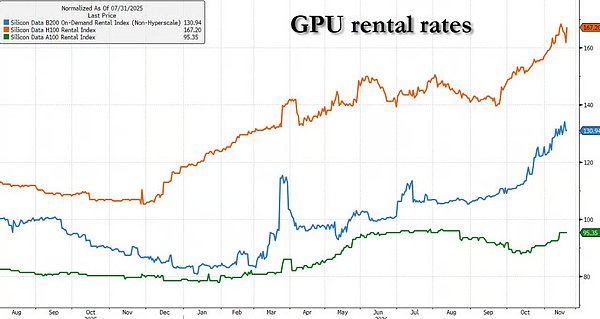
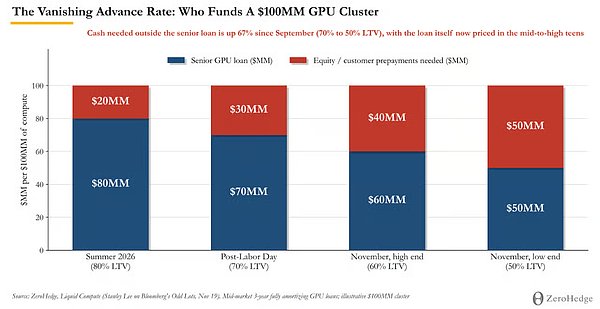
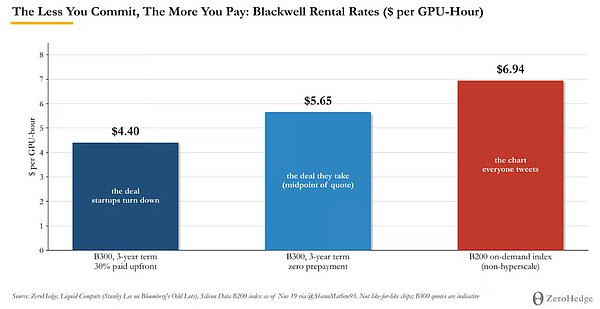
Loan institutions are tightening financing for neocloud, reducing the loan-to-value ratio from 80% to between 50% and 60%, forcing buyers to turn to the spot market and consequently driving up GPU rental prices. The rise in rental prices is also supporting the valuation of GPU assets, but the procurement of computing power by startups still relies on venture capital, while token prices continue to decline. The contraction in financing and weak demand may create a vicious cycle. The continuous surge in GPU rental prices may not be due to strong AI computing power demand, but rather a supply contraction caused by tightened financing channels. Stanley Lee, Chief Product Officer of Liquid Compute, recently pointed out in the Odd Lots podcast that current spot and short-term GPU rental prices reflect the cost of capital more than changes in underlying demand. The tightening of financing conditions for mid-sized new cloud service providers (neocloud) has forced buyers who cannot access long-term loans to turn to the short-term spot market, which in turn has driven up visible rental prices. The change in financing conditions has become quite evident. The loan-to-value ratio (LTV) for neocloud loans has dropped from 80% this summer to the current 50% to 60%. Meanwhile, the credit default swap (CDS) spread for CoreWeave has widened to about 1300 basis points, with the yield on its 2031 bonds rising to 16%. Rich Privorotsky, head of Goldman Sachs' trading desk, previously labeled GPU rental prices as the most important single metric in AI trading. However, Goldman Sachs now also admits that while spot rental prices are supported by physical scarcity, the underlying economics are deteriorating. The real question is: Are the rising rental prices driven by customer business growth, or are they a result of purchasing power brought by the last round of equity financing? Tightening Credit Raises GPU Rental Prices: The Harder Financing Becomes, the More Expensive Spot Rentals GPU rental prices have shown significant recent growth. The B200 index from Silicon Data has risen 23.5% from the end of August to November 19, from $5.62 per GPU hour to $6.94, peaking at $7.10 on Tuesday. H100 rental prices have risen 67% since July 2025. Last week, Dell founder Michael Dell also stated that the hourly rental price of the H100 has increased from $1.96 a year ago to $3.10. However, behind the rising rental prices, the financing thresholds are rapidly increasing. Stanley Lee stated that mid-sized neoclouds typically use GPUs as collateral to obtain full amortization loans of hundreds of millions of dollars with a three-year term, relying on take-or-pay contracts signed with AI customers for repayment. This summer, the LTV for such loans was as high as 80%, which dropped to 70% after Labor Day. Currently, lending institutions commonly require it to drop to 50% to 60%, with interest rates for 50% LTV loans reaching the mid to high teens. For example, for a $100 million GPU cluster, neocloud now needs to raise funds internally, increasing from $30 million to as much as $50 million, an increase of about 67%. Previously, many small operators relied on client prepayments to fill funding gaps, but now they have to ask clients for additional prepayments or turn to equity financing. The tightening of financing directly alters market supply and demand: operators find it difficult to obtain long-term loans, slowing the construction of new clusters; buyers unable to sign long-term contracts turn to the short-term spot market, driving up rental prices. Even if terminal demand does not grow, this process is enough to create a rental price surge. Startups Prefer to Pay Higher Rentals Rather than Spend Upfront The pressure on financing has also changed the purchasing habits of AI startups. Lee cites an example where the same client is faced with two B300 computing power leasing options: one at $4.40 per GPU hour but requires a 30% upfront payment; the other requires no down payment, but the rental price is about $5.65 per hour. Clients often prefer the latter option. Calculating over three years, with daily usage of 24 hours, the total cost for the first option is approximately $115,600, with an upfront payment of about $34,700; the second option's total cost is about $148,500. To save on upfront capital, clients need to pay an additional approximately $33,000, implying an annual financing cost of about 30% to 55%. This choice reflects the financial predicament of startups: cash reserves are often more important than financing costs. Retaining cash can extend operational time, while increasing computing power helps to scale the business, pursue revenue growth, and create conditions for the next round of venture financing. But this also means that rising GPU rental prices may not necessarily indicate stronger profitability for customers, as some demand is still supported by external equity financing. Rent increases do not equal strong demand: Market prices deviate from actual value. The quotes in the GPU leasing market are not uniform. Bernstein listed the quotes from four suppliers on the same day while analyzing CoreWeave's claim that leasing idle GPUs could generate $10 billion in annual revenue, showing H100 hourly rates of $3.50, $3.30, $3.01, and $2.80, with a 25% difference between the highest and lowest, while the price assumption used by CoreWeave's management is $3.81. Ornn's H100 index has also fallen from about $3.50 at the beginning of November to $2.92. Lee warned that if rent increases are due to credit becoming harder to obtain rather than enhanced terminal demand, this market situation is unhealthy. Once financing channels narrow further and operators run out of cash, market prices may decline rapidly. Private credit institutions have begun to pay attention to this risk. Over the past two weeks, Liquid Compute has received one to three calls a day from large private credit funds inquiring about put options on the B300 leasing index, a demand that was nearly absent six months ago. At the same time, large neoclouds have also begun to inquire whether they can take over GPU clusters when smaller competitors sell assets at a discount. More concerning is that while GPU rentals rise, the price of computing power output is falling. Since July, Ornn's OpenAI token price index has dropped from over $1.20 to $0.31, and the Anthropic index has fallen from about $2 to $0.77. Nvidia also stated on Tuesday that the token price has dropped nearly 60% since May. Rising input costs and falling output prices are squeezing profit margins for computing power operators. After venture capital outflows, GPU rentals may see a reversal. A core concern regarding current AI computing power demand is that buyers' payment abilities are still highly reliant on venture capital. Lee pointed out that determining whether computing power demand is sustainable hinges on whether customers can shift from equity financing to business revenue to pay computing power bills. Besides a few companies like Anthropic, there is currently a lack of sufficient public data to prove this transition has occurred. Rothschild Redburn analyst Alexander Haissl previously noted that although computing power prices at companies like CoreWeave and Nebius have risen, the customers placing the highest bids are often venture-backed startups, and whether this demand can be sustained depends on whether external capital can continue to flow in. Nvidia has been a key source of funding in this capital structure, but the company's interim CEO Colette Kress stated on Tuesday that Nvidia will continue to support neocloud while adopting more cautious selection criteria. The scale of funding cannot be overlooked either. Goldman Sachs' credit strategy team expects that by 2027, financing for chips and computing power will reach $320 billion, nearly seven times this year's level. Podcast guest Paul Kedrosky warned that while the current AI investment system is expanding rapidly, once the funding chain reverses, the contraction speed may far exceed expectations. The danger lies in the potential for operators to default once venture capital slows and customers stop paying, causing GPU clusters returned by lending institutions to flood back into the market. At that time, the new supply coinciding with weakened demand may lead to a rapid reversal of rental prices currently driven up by tightened credit.
Details compiled from public sources. Always do your own research.