
There's Nothing Wrong with Pivoting: The Crypto Industry Should Mature
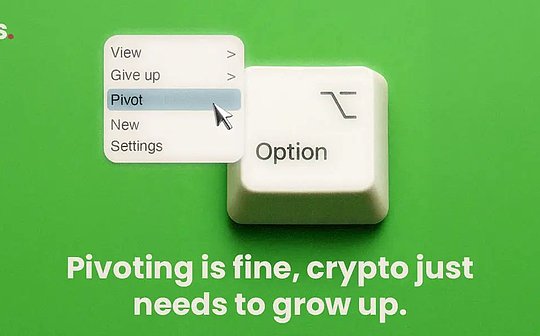
From MegaETH to Immutable, a number of crypto projects are shifting from building infrastructure to creating products that people actually use, and this transformation should not be ridiculed.
Machine translated. Refer to the original for accuracy.
Author: blocmates Source: X, @blocmates Translator: Shan Ouba, Jinse Finance The crypto industry is rife with double standards. One of the most glaring examples: any crypto company or project that announces a pivot is subjected to public scrutiny. In any normal business environment, it’s completely reasonable for a team to attempt something ambitious; if they don’t find product-market fit (PMF), it’s standard practice to pivot. But for some reason—perhaps it traces back to Bitcoin’s own narrative of ‘immaculate conception’ and its resistance to change—in the crypto space, admitting a new direction has become heretical. I believe these pivots should be celebrated. So today, let’s do just that. Many people on these teams could have taken the easy road: squandering their seven to nine-figure treasury on exorbitant salaries or unnecessary team-building trips to tropical islands. We want to showcase a dozen or so projects that chose the harder path: they are trying to create new things that the market is truly willing to pay for. MegaETH In a way, I’m not surprised that MegaETH has decided to build its own product line. Their L2 has indeed achieved impressive throughput numbers, but that was always to support new applications that their infrastructure could carry. Even their token TGE is directly tied to the KPI of on-chain applications. So when they announced a $30 million budget to build products, with the first project being an AI reasoning marketplace named Purified Intelligence, the reaction on Crypto Twitter (CT) was somewhat unexpected. Purified Intelligence is their flagship application, with a planned launch in December. Of course, this market has already been validated by reasoning service providers, with examples like OpenRouter and Venice. MEGA’s entry point is that the disparity among these service providers is too large. Many third-party providers can run the same batch of open-source models at a lower price than the original labs, but issues of trust and validation mean these competitive offers are not interchangeable, which is particularly unfavorable for end consumers. Their goal is to standardize these supplies, provide verification services, allow users to confirm they are getting real models, ensure data processing guarantees, and secure the best prices. ether.fi Some newcomers may not remember that ether.fi initially started as a liquid restaking protocol integrated with EigenLayer. Yes, strictly speaking, it still has LRT operations, but ether.fi is now more widely known as a neobanking service. To be honest, they now offer a whole suite of services: Visa cards, yield vaults, lending, trading, and now even a native stablecoin. Among all the EigenLayer protocols we diligently researched in 2024, it’s fair to say that these LRT projects have indeed survived and have utilized large treasuries to deliver new products. These projects have considerable TVL, providing unique capital bases for utilization. Renzo Renzo Protocol is now called Renzo Finance (wow, that’s brilliant), repositioning itself as a manager that packages trading strategies into vaults, earning management and performance fees. On the same day they rebranded, they launched Renzo Basis—a delta-neutral basis yield vault deployed on Hyperliquid. They are also exploring other chains and perpetual DEXs to expand their vault product offerings. Kelp After being hacked, Kelp had to do some soul-searching. Well, they probably went to the same yoga retreat as Renzo’s core team because their focus is also on strategy vaults, just shifted to Gains. Additionally, they plan to issue their own stablecoin KUSD for institutional payments and forex settlements. Bedrock Unlike other projects, Bedrock shifts its focus from Ethereum to Bitcoin. This makes sense from a business perspective, as a large portion of their TVL comes from their old friend BTC. Similarly, this team focuses on yield vaults, allocating BTC towards DeFi, institutional use, and delta-neutral trading. Puffer The Puffer team remains true to its heavy infrastructure roots, focusing on preconfirmations and based rollups. Their idea is: since confirmations can reach within about 50 milliseconds, while still being anchored on Ethereum, they can become a settlement layer for agent-type participants. Swell Perhaps the most accustomed to transformation among all LRT projects, Swell announced back in April that SwellChain would shut down and shift focus to Faro. Faro is a non-custodial AI trading application built on Hyperliquid. Abstract This feels more like a "retreat" rather than a transformation: Abstract, along with Pudgy Penguins' parent company Igloo, decided to shut down the Abstract chain and focus on Pudgy Penguins' IP, NFTs, and the PENGU token. Credit where credit is due: the team resisted multiple calls to launch the ABSTRACT token and successfully attracted brands like Disney and Red Bull, but ultimately failed to establish this "consumer chain." Nillion This team initially aimed to create a "blind computer" for privacy protection on crypto data, but is now narrowing its scope from general infrastructure to a single primitive: hidden intent. They refer to these as "Covenants," with more details available in Blocmates' prior reports (more to come). Looking through, you'll notice a trend taking shape: a shift from "building infrastructure" to "creating products." Moonbeam Once a flagship EVM parachain on Polkadot (oh, remember the excitement during the parachain auctions? Such nostalgia), Moonbeam announced in July that it would pack up and move its operations (and the GLMR token) to Base. The new direction is packaged as a network: agents can find each other, agree on terms, and settle on-chain, with each task placed in custody and rated based on proof of results. Harmony This darling of the sharding race in 2019 transformed into an AI video business following an attack in August. The attack led to approximately 30 trillion ONE being counterfeited (as per the original text), forcing the project to execute a chaotic rollback and sparked discussions on "either shutting down or issuing ONE on Ethereum again". The latter was adopted. In their new "remix economy," users can write prompts and create remixed video stories, with the protocol subsidizing GPU costs through token distribution. Golem Yes, it's the Golem from the 2016 ICO era. They're still around, holding several hundred million dollars in their treasury (the ICO era feels like another world now). Their latest project is more of a product line extension than a "transformation." The project is named Arkiv, positioned as a queryable, tamper-proof Web3 database. The project will use GLM to pay for gas and has been announced at Devcon. Immutable Once the "king of chain games," is now selling marketing software to mainstream studios. Alas. In June, Immutable nearly laid off its entire in-house game team and shifted focus to Audience—an AI platform for game publishers. Meanwhile, its IMX token has dropped 99% from its all-time high. In August, they opened Audience to Steam studios that are in pre-launch phase, completely devoid of any blockchain modules. Has chain gaming died? Or was it a mistake to pin hopes on these AAA studios in the first place? Where Will the Industry Go? At a certain point, we must face reality. The naive days of the early crypto era, where ideas attracted millions of dollars in funding, often turned out to be life-or-death bets at best. Does this mean that founding teams should bury their heads in the sand and completely ignore the ultimate feedback that the market gives on their ideas? In my view, we should welcome these changes in direction. These teams are among the first to realize that they have not achieved Product-Market Fit (PMF). We need to reverse the standards: those who should be condemned are the ones who secure absurd amounts of funding but continue to throw products at the market that have been clearly indicated by the market to be unworkable. These teams possess astonishing talent—it's a shame to waste their potential (and investors' money) on ideas that have been proven dead on arrival. What can we learn from these transformations? I am very excited to see these strong teams and real money shifting from infrastructures that no one would use to products. The winners of this cycle—the stablecoins, perpetual contracts, tokenized stocks—share a common point: they are products. They are products that people truly want to use, products that make people willing to endure the clumsy applications and struggles to use. The victory of crypto is bringing these products (and brand new products that have not yet achieved PMF) into the hands of more and more people. That’s why I am thrilled to see everyone focusing more on productization and seeing that "achieving PMF might only be one transformation away."
Read original · 金色财经资讯Details compiled from public sources. Always do your own research.