
Four Checks in One Week: Tether's Printing Machine Slows Down and Starts Investing in Channels
With USDT size peaked and profits halved, Tether intensively invests in global financial apps to compete for underlying clearing channels.
Machine translated. Refer to the original for accuracy.
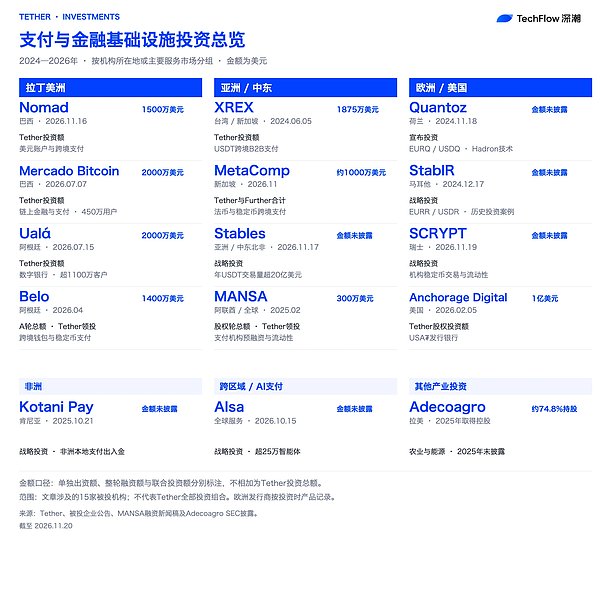
Author: Daisy, Deep Tide TechFlow From November 16 to 19, Tether signed four checks over four days. The first one was in Brazil, where Tether Capital led a $15 million investment in Nomad, a U.S. account service provider, in its Series C round, which totaled 172 million Brazilian reais and had a post-investment valuation of 4 billion reais. The second was Stables, a payment infrastructure company that handles over $2 billion in USDT transaction volume annually, targeting Asia and the Middle East/North Africa. The third was in Singapore, where Tether and Further Asset Management from Abu Dhabi together invested about $10 million in MetaComp. The fourth was in Switzerland, aimed at one of the largest stablecoin trading and liquidity service providers locally, SCRYPT. The four companies are doing the same thing: facilitating the flow of U.S. dollars across borders. Two weeks before signing these checks, Tether had just released its Q3 report. The Money Printer Slowed Down As of September 30, Tether had $191.5 billion in reserve assets, with a U.S. Treasury exposure of $132.4 billion, and a net operating profit of $4.5 billion for the first nine months of this year. Although these figures remain large, Tether's net profit for the first three quarters of last year had already surpassed $10 billion. The statistical criteria differ in two years; last year reported net profit, while this year reports net operating profit, making it impossible to directly subtract. The profits for the first three quarters of this year are $1.04 billion, $1.5 billion, and $1.5 billion, respectively. At this pace, it will be challenging to return to the 2024 high of above $13 billion for the entire year. More worryingly is another figure; the issuance of USDT for the first three quarters of this year has basically stalled at $184 billion. Tether's business can be broken down into a multiplication: the circulation scale of USDT times the yield of U.S. Treasuries. For every dollar a user deposits, Tether buys short-term U.S. Treasuries to earn interest. With the Federal Reserve beginning to cut interest rates in the fall of 2024, the yield variable continues to decline; this year the scale variable has also remained stagnant. With both variables stuck, profits can only go down. Tether cannot control interest rates; all it can do is push the scale back up. Relying on the current crypto assets in exchanges to support the next $100 billion is no longer realistic; new scale must come from the real wages, payments, remittances, and everyday bills outside the crypto world. To capture this money, there must be a pipeline first. Not Teaching Users, Directly Investing in Channels Tether recognized early on that teaching people worldwide to download wallets, write down mnemonic phrases, and calculate on-chain transaction fees is nearly impossible. So it simply stopped teaching and started investing in financial apps that users are already using. This mindset began to take shape in 2024. In April, Tether restructured into four major sectors: Data, Finance, Power, and Edu, and investments began to carry explicit industrial purposes. In June of the same year, it invested $18.75 million in Taipei’s XREX, specifically for compliant USDT cross-border B2B payments, targeting small and medium enterprises in emerging markets. After that, the checkbook spread along the map of high inflation, foreign exchange control, and remittance demands. In Africa, by October 2025, Tether invested in Kotani Pay in Kenya, which connects blockchain applications to mobile wallets and local banking systems across Africa. In Latin America, in April of this year, it led a $14 million Series A investment in the Argentinian crypto finance platform Belo; in July, it invested $20 million in the Brazilian on-chain financial platform Mercado Bitcoin, serving 4.5 million users, while also disclosing a $20 million share in financing for the Argentinian digital bank Ualá. This investment in Ualá best illustrates Tether's intentions. This bank has over 11 million customers, but due to local regulatory restrictions, USDT will not be integrated in the short term. Tether still opened its wallet. Even if it cannot integrate temporarily, it invests first, and when regulations loosen, it will already be on the shareholder list. This week, Nomad, which has signed on, is also like this. Nomad has 3.8 million customers, managing assets of about 8 billion reais, and the integration of USDT and gold token XAUT is still in the exploration stage, with no launch time announced. However, these customers were already holding U.S. dollars, saving Tether several years of customer acquisition costs. Brazil is one of the most active markets for stablecoins, with stablecoins accounting for about 80% of the declared cryptocurrency trading volume in Brazil by 2025. Users still open the familiar local app, the interface and branding have not changed, only a dollar settlement track has quietly been added in the backend. Unable to obtain a license, so we invest in those who hold licenses. The longer the pipeline is laid, the more it can't avoid regulation. On June 30, 2024, the stablecoin provisions of the EU MiCA will begin to take effect, and on December 30, MiCA will be fully implemented. USDT has not obtained EU authorization, and licensed exchanges in Europe are gradually restricting or delisting its trading. Tether chooses to go around it. In November, it stopped issuing the euro stablecoin EURT, turning to support third-party projects in Europe and promoting its own tokenization platform Hadron. In November 2024, it announced an investment in Quantoz, an electronic money institution licensed by the Dutch central bank; in December, it invested in StablR, which issues compliant stablecoins EURR and USDR, both of which use Hadron for issuance. USDT cannot enter Europe, but Tether's technology and capital can. By February of this year, it invested $100 million strategically in Anchorage Digital, a federally licensed crypto bank in the U.S., which is the issuer of the compliant stablecoin USA₮ launched on January 27. USDT stays overseas, while USA₮ is issued by licensed banks, with two lines running in parallel. The North American and European markets can only take a detour, borrowing boats; in Switzerland and Singapore, where the regulatory framework is relatively open, Tether directly invests in licensed institutions. This week, it signed SCRYPT, which has been operating under the supervision of the Swiss Financial Market Supervisory Authority (FINMA) and the self-regulatory organization VQF since 2019. MetaComp holds a major payment institution license from the Monetary Authority of Singapore, and this funding will be directly used to expand its compliance and cross-border channels. Rather than applying for a license from scratch, Tether prefers to invest directly in institutions that have already obtained licenses. Tether has even set its sights on non-human users. On October 15, Tether Capital strategically invested in AIsa. Enterprises can set spending limits for AI agents on this platform, allowing them to autonomously procure data, software, and computing power. Currently, there are over 250,000 smart agents on the platform, having processed over 100 million transactions. This kind of low-cost, high-frequency, around-the-clock machine settlement is hard to go through traditional bank accounts, making stablecoins the most direct payment tool. A payment company that does not live on channel fees. Looking at these investments from 2024 to 2026, one can see the fundamental differences in cost structure between Tether and traditional payment companies. Most of the payment companies it invests in hold only a minority stake, and the approximately 74.8% controlled Latin American agricultural company Adecoagro is a rare exception and has little to do with payments. Stripe, PayPal, and various remittance companies rely on collecting fees from merchants to cover operating costs and bad debts; channel fees are their lifeline. Tether's recurring profits come from U.S. debt and repurchase interest, so it doesn't need to take a cut from every payment; as long as USDT is truly used, its reserve size will increase accordingly. Thus, it can use equity stakes to exchange for channels, or it can put money down to lower the threshold for partners to use USDT. In February 2025, Tether led a $3 million pre-seed round for MANSA. MANSA specializes in providing pre-financing liquidity to payment companies using USDT, allowing payment companies to complete cross-border settlements instantly without having to pre-deposit large sums of money in various locations. Traditional channel providers have also seen this gap, with Stripe acquiring stablecoin infrastructure company Bridge to enter the game. However, Stripe is fundamentally a payment company that collects fees, while Tether does not rely on making profits from the payment process, making it naturally more willing to lower rates. The switch is in someone else's hands. There are places where this approach doesn’t work. USDT has been delisted in Europe, Ualá has yet to onboard, and the U.S. market can only issue USA₮. Tether can spend money to get on the shareholder list, but it cannot press the switch for regulators in various countries. The further the pipeline is laid into licensed banks and payment institutions, the more it encounters the most sensitive capital controls and anti-money laundering measures of sovereign states, as well as a dollar clearing network that bypasses the traditional banking agency system. Currently, central banks in various countries still treat stablecoins as crypto assets. Once USDT truly flows into wages and payments, the regulatory standards will change to the framework of systemically important financial infrastructure. The interest money printer is still running, but its speed has clearly slowed down. Every check that Tether signs around the world has a clear purpose: to direct more real dollars into its pipelines. As for how much these pipelines can ultimately handle, the decision-making power does not lie with Tether.
Details compiled from public sources. Always do your own research.