
Hyperliquid's 42 Market Test: Costs of $5 Million Orders
Sampling 42 markets on Hyperliquid: the transaction cost for $5 million primarily depends on the chosen market, with depth halved after US stock market hours; RFQ is filling the gap in thin markets.
Machine translated. Refer to the original for accuracy.
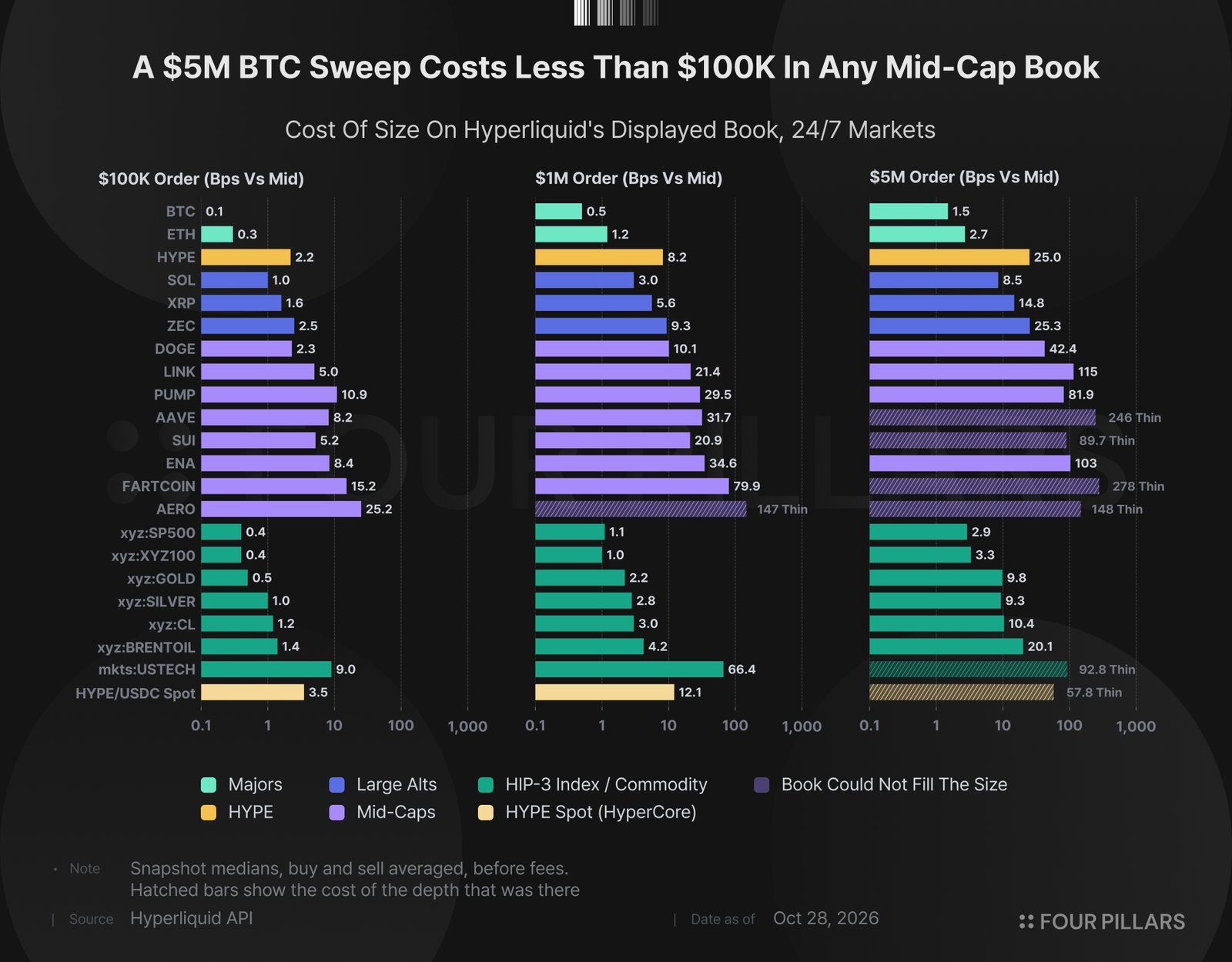
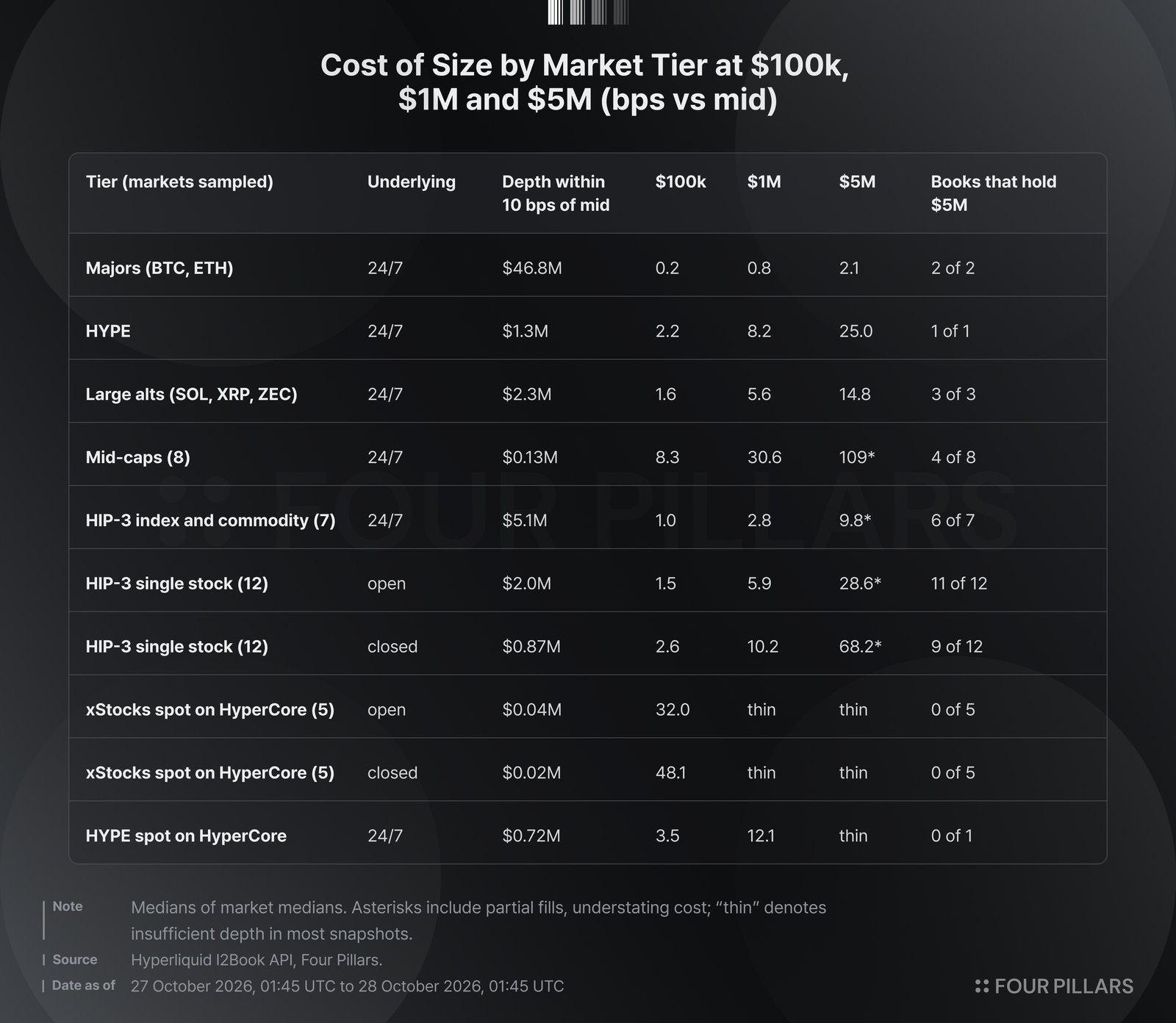
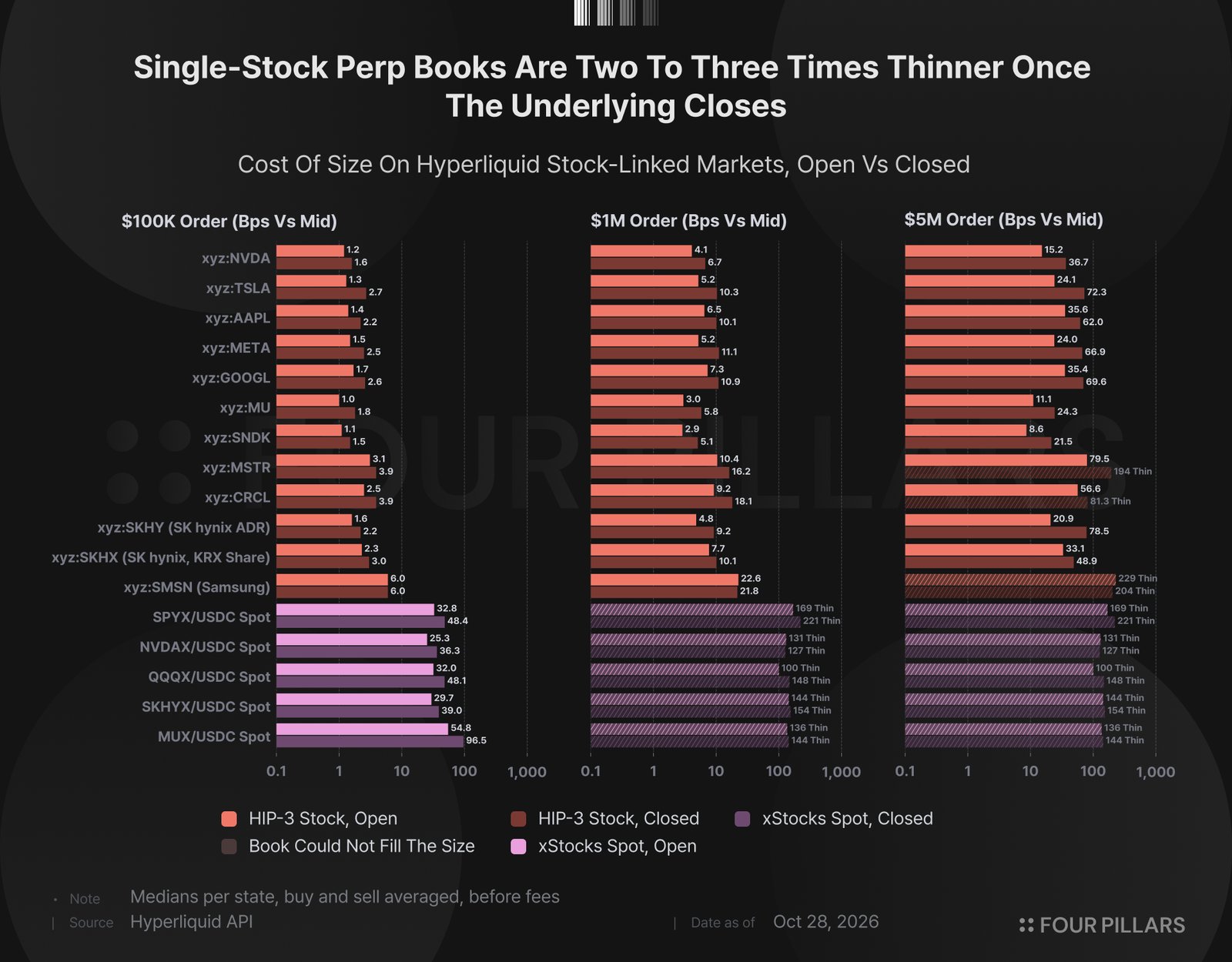
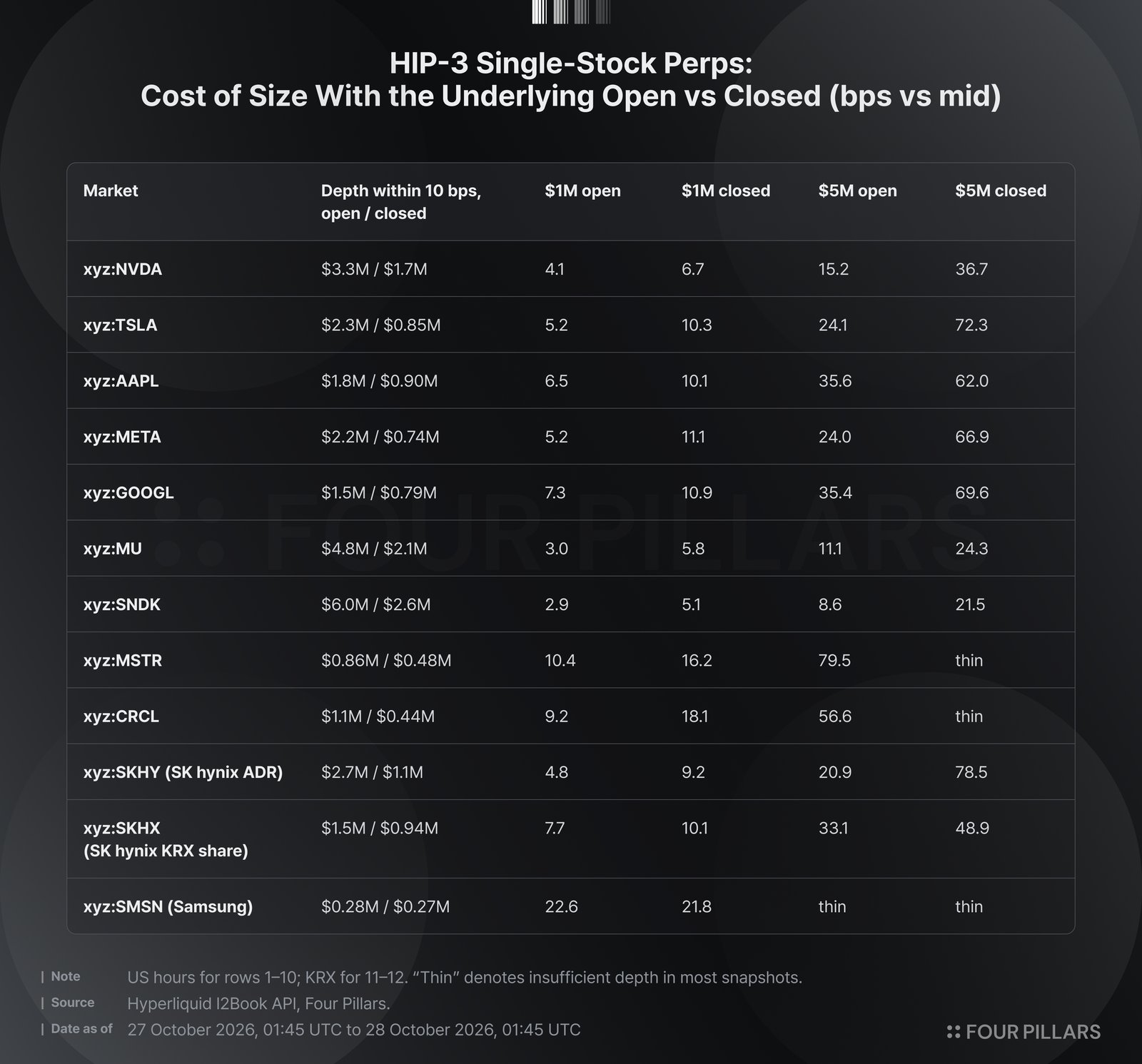
Author: Four Pillars Source: X, @FourPillarsFP Translator: Shan Ouba, Golden Finance Statement: This report is authored by Four Pillars and sponsored by Silhouette AG. Key Points Market selection determines execution costs. The cost of a $5 million BTC sweep relative to the mid-price is 1.5 basis points; for $1 million in HYPE, it is 8.2 basis points. In most snapshots, half of the sampled mid-market cannot absorb $5 million. The liquidity of perpetual swaps aligns with spot trading hours. Markets tied to US stocks lose about half their depth after their underlying assets' trading hours; for those that can still execute $5 million, costs rise by 1.7 to 3.7 times. Displayed depth does not equal committed liquidity. In each consensus batch, Hyperliquid first processes order cancellations, then market orders. TWAP spreads execution over time, and the final price is only determined after the last split transaction, while each split exposes intention to the market before the order is complete. RFQ currently prices all sizes, with prices signed by the taker before any transaction occurs. Sweep orders or TWAP only learn the average price afterward, while large TWAPs may take hours. The taker receives the agreed price or better, excluding fees, covering the final transaction's size. Trading desks with urgency value this certainty. Silhouette brings large-scale execution to Hyperliquid via RFQ. Traders compete to quote the entire order before the customer commits, with the transaction printed on Hyperliquid's order book via a single request. Data shows that the clearest demand is in thinner markets—large orders there either significantly impact prices or exceed displayed liquidity. Tight spreads do not imply lower costs for large orders. On Hyperliquid, markets that appear liquid may become expensive within the initial $1 million; some markets cannot accommodate that order at all. Silhouette's RFQ service allows traders to compete for the entire order before customer commitment. This service went live on Hyperliquid perpetual contracts on October 19, 2026, having launched xStocks on HyperEVM on September 1. Our study of 42 markets shows that this execution mode has clear potential, focusing on thinner order books and larger trades. 1. Market selection is more important than order size We sampled the publicly available l2Book endpoints on Hyperliquid every five minutes from October 27, 2026, 01:45 UTC to October 28, 2026, 01:45 UTC: a total of 289 continuous snapshots across 8 market levels. We computed the cost of sweep orders at $100k, $1 million, and $5 million relative to mid-prices, averaging both buy and sell sides, excluding handling fees. To extend the endpoint's limit of twenty price levels per side, we combined full-precision quotes with a coarser aggregated view, pricing at the interval midpoints. Using interval boundaries as substitutes, the median transactable change does not exceed 13%. The table excludes pre-listing market io:ANTH, as well as two spot pairs TSLAX and AAPLX that had no orders. In a second 24-hour sampling from November 16 to 17, 2026, we replicated the hierarchy in the $1 million and $5 million tiers, with the median error for midcap, the HIP-3 index, and commodities within 12%. The costs for mainstream coins and individual perpetuals in the $5 million tier are one-third to half higher, with the depth for BTC and ETH reduced by a quarter to half within 10 basis points. The order book for stock-linked markets is divided by the underlying spot trading hours: US stocks from 13:30 to 20:00 UTC, and the Korea Exchange from 00:00 to 06:30 UTC. Samples exclude weekend trading. As the order size increases from $100k to $5 million, the impact effect magnifies approximately tenfold. The influence of changing markets is much larger: in the $100k tier, switching from BTC to FARTCOIN sees costs increase by approximately 250 times. HYPE best explains the distinctions. Its 0.13 basis point median spread is nearly equivalent to BTC's 0.12 basis points, but the depth within 10 basis points is only about one-fifth of BTC and one-fifth of SOL. The cost to sweep a $1 million order is 8.2 basis points; for $5 million, the impact reaches 25 basis points, about three times that of SOL. HIP-3 covers two extremes. The SP500 and XYZ100 have depths within 10 basis points that are over twice that of SOL, with the cost to absorb $5 million roughly one-third of theirs. The costs for gold, silver, and two oil markets at that scale range from 10 to 20 basis points. USTECH cannot transact at that scale in any snapshot. The liquidity of individual perpetuals is tighter than the mid-market but has limited depth. During spot hours, the median cost for a $1 million order is slightly below 6 basis points. Even for the largest individual perpetual at this venue—the South Korean stock market SK Hynix—the cost is 7.7 basis points for $1 million and 33.1 basis points for $5 million. Samsung has never executed $5 million. For HyperCore spot xStocks, availability is a larger constraint. Of the seven sampled trading pairs, two had no orders; the remaining five had only $11,000 to $50,000 within 10 basis points. A $100,000 order during US stock hours costs 25 to 55 basis points, while outside US stock hours, it costs 36 to 97 basis points. None were able to execute $1 million. 2. Individual perpetuals’ liquidity follows spot hours Each order book tied to US stocks is thinner outside New York trading hours: the depth during the opening session is 1.8 to 3.0 times that of non-trading hours. For assets where $5 million can still be transacted, costs rise 1.7 to 3.7 times. MSTR has only 41% of its after-hours snapshots able to absorb that scale; CRCL just 1%. The South Korean stock market for SK Hynix follows the Seoul session, while Samsung is thin in both states. Opening does not eliminate scale costs either: among US stock-linked assets, the impact of a $1 million order is about 2 to 7.5 times the Silhouette HIP-3 fee of 1.4 basis points. US stock spot trading occurs 32.5 hours a week, while these perpetual contracts run for 168 hours. About four-fifths of the time falls outside regular trading hours. Weekend costs are not accounted for here, but the results on weekdays already explain why looking only at opening depth yields an incomplete execution conditions picture. 3. Cancelling orders take precedence over market orders The premise for sweeping orders is that the displayed liquidity is still available. Hyperliquid processes operations within each consensus batch in three groups: actions that do not submit GTC (Good Till Canceled) or IOC (Immediate Or Cancel) orders first, followed by cancellations, and finally actions that submit at least one GTC or IOC order. Post-only orders belong to the first group, while market orders belong to the third group. Thus, regardless of the arrival order, market makers’ cancellations take precedence over market orders in the same batch. Priority fees can improve market orders’ ranking between takers but cannot position them ahead of cancellations. This protects market makers from adverse selection; market orders can only access the remaining depth. If quotes near the mid-price are withdrawn in that batch, market orders may need to search deeper into the order book, accepting a worse average price than displayed on the screen. If hard limits are set, there may be residual orders that remain unfilled. Therefore, the above estimates for sweeping orders may underestimate actual execution costs: liquidity visible at order placement may no longer exist by the time of execution. For trading desks, this uncertainty often represents a greater cost. Many prefer to obtain smaller fills at known prices rather than receive full fills at prices discovered post-facto. Distributing orders over time can reduce immediate impact. Hyperliquid's native TWAP splits at least every thirty seconds, with a maximum slippage cap of 3% per fill. The cost is time and information leakage: each filled segment signals to the market what you are doing. As Silhouette stated, "Each filled segment tells the market what you are doing." 4. Thinner order books provide more space for RFQ. As of November 25, 2026, Silhouette charges a builder fee of 1.4 basis points for perpetual requests under $500,000 and for any size HIP-3 requests. For requests starting from $500,000, there are no Silhouette fees for BTC, ETH, and HYPE requests; only Hyperliquid's own taker fees apply, similar to sweeps. Comparing applicable fees to market display impacts can help preliminarily filter RFQ demand; actual outcomes still depend on trader quotes. Cost is not the only variable. The time of entering and exiting positions and the certainty of price carry intrinsic value, and trading desks may accept quotes higher than market estimates in exchange for these two. Opportunities vary by market: BTC, ETH, and major HIP-3 indices: Limited space at sampled scales. Even at the $5 million level, BTC and ETH only show 1.5 and 2.7 basis points, respectively, with little room for quote improvement; SP500 and XYZ100 only exceed HIP-3 fees by 1.5 and 1.9 basis points at this scale. HYPE and large-cap altcoins: More space over $1 million. HYPE at the $1 million level has 8.2 basis points, XRP and ZEC show 5.6 and 9.3 basis points, respectively. SOL presents more appeal at the $5 million level, similarly for commodities, showing 8 to 19 basis points above HIP-3 fees at that scale. Less popular mid-cap and individual stock perpetuities: Opportunities arise sooner. Some mid-caps see costs of 8 to 25 basis points at the $100,000 level. Each sampled individual stock market shows that for orders of $100,000, costs exceed HIP-3 fees when the underlying is not trading; during U.S. stock hours, arguments are stronger for the $1 million level. xStocks: Costs may reach dozens of basis points for $100,000, and none of the sampled markets can facilitate a $1 million transaction. When displayed markets cannot handle the flow, quoting becomes a viable approach to obtain that scale. Real-time perpetual services currently support single transactions of up to $1 million for BTC and up to $500,000 for ETH and HYPE—exactly where Silhouette fees begin to approach zero. On displayed markets, BTC shows 0.32 basis points at the $500,000 level and 0.5 basis points at the $1 million level; ETH shows 0.77 basis points at the $500,000 level, leaving traders insufficient room for improvement in both markets. HYPE at the $500,000 level shows 5.3 basis points, with quotes available for negotiation. HIP-3 requests opened on November 10, with the underlying being the S&P 500 and a maximum of $500,000; the market cost in our observation window was 0.76 basis points, with November samples at 0.86 basis points, on par with ETH, and lower than HIP-3 fees. XYZ100 and SK Hynix (xyz:SKHX) have also been opened to API traders, with a web version forthcoming. Both are subject to the 1.4 basis points HIP-3 fees. SK Hynix is the first individual stock perpetual that can be quoted by trading desks. In our observation window, its market cost is 7.7 basis points at the $1 million level and 33.1 basis points at the $5 million level. The broader addressable market lies within these thinner markets—where an agreed price can cover an expensive or impractical order executed on-screen. 5. Silhouette's Bulk Execution Program Institutional markets have long utilized broker bulk and dealer RFQs outside of exchange order books. According to Dugast, Marta, and Riva (2025), in 2024, RFQs accounted for 57.5% of Europe’s major ETF trading volume on Tradeweb and Bloomberg, whereas the largest on-exchange venue, Xetra, accounted for 12.6%. The divide for large orders is even more pronounced: for orders above €3 million, 10,416 RFQ trades were recorded, while on-exchange trades only amount to 586. For smaller orders of a similar size, the average price impact of RFQs is 0.4 basis points, compared to 3.8 basis points on the book. Silhouette began its protected spot trading on Hyperliquid in February 2026. In discussions with traders moving large positions, it discovered that what they truly wanted to protect was the intent before the trade, rather than the trade itself. In their words, they "thought they wanted complete privacy, but in reality just wanted optimal execution at the best price." Its RFQ model allows traders to compete for the entire order before the client commits, executing perpetual trades on Hyperliquid's own order book. Once the taker accepts, Silhouette submits the maker's limit orders at the agreed price and size alongside the immediate or cancel orders from the taker. The batch ordering described in Section 3 prioritizes maker orders ahead of takers, so the takers either execute with maker orders or existing orders in the book at better prices. A request can be fully filled, partially filled if other traders hit the maker's orders first, or fail, but will never execute at a price above the signed price (exclusive of fees). For the larger orders and thinner markets examined in this article, this provides another option apart from sweeping or averaging execution. The value goes beyond price improvement: takers know the price before committing, and their positions come in and out with a single request, rather than spending hours like TWAP. Silhouette states that it will subsequently launch more HIP-3 markets, increase limits, and introduce more market makers for each request, with the long-term goal of spanning across spot, perpetual, and (when available) options in multi-leg requests. Four Pillars expects that Silhouette will broaden execution options for large traders and help Hyperliquid meet institutional demand. Written by: @ponyo_fp Related charts and projects: @silhouette_ex Disclosure: This report is sponsored by Silhouette AG, and the author may hold positions in the assets discussed.
Details compiled from public sources. Always do your own research.