
Trump Attributes Market Sell-off to Democrats; Bessent Says Multiple Factors at Play
U.S. stocks recently faced a massive sell-off, with Trump blaming over $6 trillion in losses on the Democrats' midterm election victory. However, Treasury Secretary Bessent believes the market decline began even before the election, with AI regulation concerns and hawkish Federal Reserve signals also being significant drivers.
Machine translated. Refer to the original for accuracy.
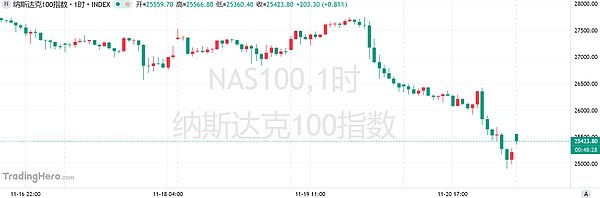
Author: Xiao Yanyan, Jinshi Data The U.S. stock market has recently encountered a severe sell-off, with President Trump pointing fingers at the Democrats, believing their victory in the November 3 midterm elections is a primary reason for the sharp market decline. On Sunday local time, Trump posted on social media platform Truth Social, stating: "Since the Democrats achieved that rather strange 'victory' on November 3, the stock market has fallen by more than $6 trillion. The Nasdaq index alone has dropped by 20%. This is 100% because the Democrats are 'terrible' — they pursue anti-growth policies and are only thinking of revenge, and it’s going to get worse." He also warned that if the Democrats do not swiftly change their policies, the market could weaken further. However, Trump stated that the U.S. economy will soon become strong again. "Our country will be strong again very soon — a lot of good things will happen," he concluded. The recent drop in U.S. stocks has reached a historically rare level. According to Yahoo Finance, as of last Friday's close, the U.S. stock market has experienced drops like this only five times since World War II, with notably poor performances in 2008 and 2001. After hitting a record high at the beginning of October, the Nasdaq Composite Index has continued to retreat, turning its cumulative gain for the year into a loss. As of last Friday, the index was down more than 4,700 points from its historic closing record of 27,599.886 points on October 6. Tech stocks have borne greater pressure. Yahoo Finance reports that chip stocks have experienced their worst week since September 2001, just a week before the September 11 terror attacks. Nvidia (NVDA.O) was not spared either. Since hitting a peak on October 6, the company's market value has evaporated by about $2.7 trillion. Bessent: Multiple Factors Triggering the Sell-off U.S. Treasury Secretary Scott Bessent did not attribute the market drop merely to election results, but believes multiple factors have combined to drive this round of selling. In an interview on CBS's Face the Nation with host Margaret Brennan, Bessent stated that the market sell-off actually began when polls showed the Democrats leading in support, and it accelerated further after Election Day. He specifically mentioned the Democratic stance on artificial intelligence infrastructure construction. Bessent commented, "The Democrats’ position on Superintelligent (SI) construction has left many investors worried that related development processes will slow down." Here, "Superintelligent" is Trump's preferred term for artificial intelligence. Bessent believes that the Democrats may tighten regulations on the AI industry, especially restrictions on data center construction, which has affected investors' judgments about the industry's future. Federal Reserve policies are also another source of pressure. Bessent remarked: "We have also heard some very hawkish statements from the Federal Reserve. Many believe that if the Fed excessively tightens monetary policy, it may make policy mistakes." As expectations for further interest rate hikes rise, the financing costs and valuation pressures faced by tech companies are also increasing. AI Regulation and Nvidia Scandal Intensify Pressure on Tech Stocks Technology industry analyst Dan Ives described the recent troubles faced by tech stocks as a "perfect storm." He believes that following the Democrats' significant midterm election victory, the market began worrying that the government would strengthen oversight of the artificial intelligence and data center industries, prompting some investors to reassess the investment outlook for AI infrastructure. The change in Nvidia's leadership has also exacerbated market unease. After CEO Jensen Huang's departure, whether Nvidia can continue to provide significant support for the entire AI industry ecosystem has become a concern for investors. At the same time, Nvidia is also facing multiple investigations regarding whether the company made false statements to investors and whether it violated U.S. export control regulations. Ives believes that the concurrent emergence of AI regulatory risks, changes in Nvidia's management, and market worries about tech stocks have collectively intensified this round of sell-off. From Trump blaming the stock market drop on the Democrats to Bessent emphasizing Federal Reserve policy and AI regulatory risks, explanations for the market adjustments within the White House are not entirely uniform. However, it’s clear that following the Democrats' midterm election victory, AI industry policies and the outlook for data center construction have become critical factors for investors reassessing tech stocks.
Details compiled from public sources. Always do your own research.