
U.S. Stock Market Experiences a Super V Reversal as Jensen Huang's Return Sparks AI Panic Just Two Days Later
Wall Street experienced a harrowing day on Wednesday, with the Nasdaq Composite briefly dropping nearly 5%, the S&P 500 falling more than 3%, and both gold and silver experiencing a dive, followed by a collective V-shaped recovery. Doubts about the return on massive AI investments continue to deepen.
Machine translated. Refer to the original for accuracy.
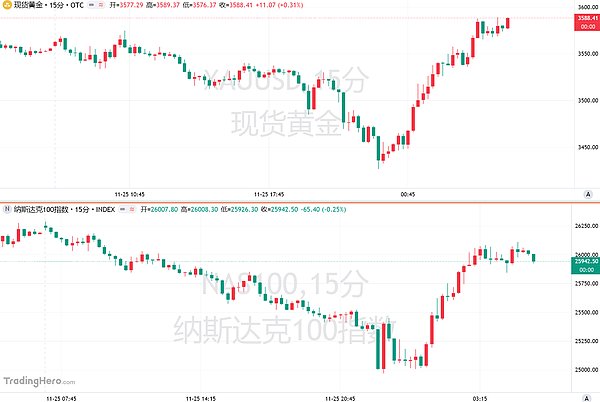
Author: Xiao Yanyan, Jinshi Data As soon as the opening bell rang at the New York Stock Exchange on Wednesday, selling pressure quickly poured in. Just 15 minutes after the opening, the Nasdaq 100 index had dropped nearly 5%. Just two days earlier, Jensen Huang had resumed his role at Nvidia (NVDA), temporarily igniting Wall Street’s optimism about AI trading, but this excitement has rapidly faded. As trading progressed into the afternoon, the market's losses began to narrow. The Nasdaq index ultimately closed down 0.6% (having at one point fallen 4.5%), the S&P 500 closed down 0.25% (previously having fallen over 3%), while the Dow Jones Industrial Average recorded a slight gain of 0.33% (earlier dropping over 1100 points). Gold and silver also experienced a super V-shaped trend, with spot gold rebounding approximately $162 from its intraday low, falling to $3426, closing up 0.92% at $3588.41 per ounce; spot silver dipped over 6% during the session but closed up 1.15% at $41.38 per ounce. However, the signals released by this violent intraday fluctuation are already very clear: investors' doubts about whether the AI investment craze can continue are deepening. What the market genuinely worries about is no longer just the high valuation of tech stocks, but whether the trillions of dollars invested in AI can generate adequate returns. Jonathan Corpina, who has worked on the trading floor of the New York Stock Exchange for 30 years, compared the current market sentiment to that during the financial crisis of 2008. Corpina is a senior managing partner at Meridian Equity Partners. He stated, "Back then, every day felt like: what will happen next? The feeling I get from everything now is somewhat similar to that time—not to say that the scale of the sell-off or its impact on the economy is the same, but rather that persistent worry." Concerns over the returns on AI investments shift the market from chasing technology to questioning profitability. Debate over whether there is a bubble surrounding AI has been ongoing for some time. Since AI technology has made breakthroughs, the stock prices of related companies have reached new highs repeatedly. Companies like Nvidia, which provide key chips and equipment for the AI industry, have also become the biggest beneficiaries of this market surge. The increase in tech stocks has continuously propelled the expansion of U.S. stock valuations, but concerns about whether massive investments can translate into profits linger. Over the past few months, this pressure has been building. Investors have started to question whether AI can generate sufficient profits to support the high valuations of tech companies and cover the borrowing costs incurred from large capital expenditures. The Federal Reserve's resumption of interest rate hikes has made this issue even more pronounced. Rising financing costs mean that tech companies need to generate higher returns to justify the extensive investments in data centers and chip procurement. Nadine Terman, CEO of Solstein Capital, stated, "The market is no longer debating whether AI will change the world, but rather discussing who can make money, how much they can earn, and whether such massive capital investments can yield sufficient returns. This is a distinctly different question." She further pointed out, "Ironically, the AI industry might ultimately fulfill its technological promises but disappoint investors in terms of financial returns." In other words, even if AI technology is successful, it does not mean that all companies investing enormous amounts of capital will reap corresponding benefits. The gap between technological prospects and capital returns is becoming the core issue for investors reassessing AI trading. Jensen Huang's return briefly boosted the market but the rebound quickly lost momentum. After a significant drop in U.S. stocks last weekend, Trump unexpectedly pushed for Huang's reinstatement as CEO of Nvidia. This decision temporarily alleviated market concerns about turmoil within Nvidia’s leadership and restored investor confidence that the AI chip giant could continue to engage in massive investments to drive the entire industry forward. After the announcement, Nvidia's stock surged on Monday, boosting the U.S. stock market. However, as the market reassessed the fundamentals of the AI industry, this wave of gains quickly encountered resistance. Seth Cogswell, CEO of Running Oak Capital, said, "This was meant to be a rescue operation for the AI sector, but it didn't work. People saw through it." Meanwhile, credit rating agencies were not deeply impressed by the ups and downs of Nvidia's board and Jensen Huang. S&P Global Ratings placed Nvidia's AA credit rating on negative watch on Wednesday, stating that this incident "exposed vulnerabilities in Nvidia's management and governance framework." Market unease also stems from changes in the political environment. After the midterm elections in the US this month, the Democratic Party's influence has significantly increased. Voters across many regions expressed opposition to data center construction, while some Democratic lawmakers have made limiting the expansion of data centers a campaign promise. This adds new uncertainty to the outlook for AI investments. If data center construction is restricted, the huge capital expenditures that tech giants originally planned to invest may be affected, putting related chip suppliers, equipment manufacturers, and energy companies under chain pressure. Traders find it difficult to judge market direction, as investors search for a bottom amid repeated fluctuations. Although the intraday decline on Wednesday expanded at one point, analysts pointed out that the overall sell-off that day was still orderly. Strong corporate earnings and the economic fundamentals provided some support to the market. However, the market is increasingly susceptible to changes in investor sentiment. Peter Tuchman, a senior trader at TradeMas on the New York Stock Exchange, noted that investors have been trying to find the reasons behind the market's extreme volatility. He said, "The phone is ringing off the hook. People are very worried and keep calling to ask: 'Why is the sell-off intensifying?' After decades of working in the trading hall, I've never seen a market so completely reverse its view on the same story as with Nvidia. This is no longer the stock market of your grandfather's era." Mark Malek, Chief Investment Officer at Siebert Financial, also feels lost by the recent market's repeated sharp turns. He said, "I've shaken my head so many times in the past 10 days that my neck aches." Malek has been helping clients navigate this round of market turbulence. He revealed that an experienced investor told him that what truly worried her was not so much the listed companies but why the market has not rebounded yet. This investor still stands by her judgment, as she fears missing the opportunity when the market eventually rebounds. By the end of Wednesday's trading, this wait-for-rebound mentality seemed to pay off temporarily. The Nasdaq sharply narrowed its decline, the S&P 500 ultimately fell by only 0.25%, while the Dow Jones Industrial Average edged slightly higher. However, Malek cautioned that market sentiment is continually testing investors' confidence. He said, "The market narrative is doing its best to shake those investors with weak resolve. Ultimately, only the most steadfast and faithful investors will be able to remain." For Wall Street, the questions that truly need answering have changed: whether AI can continue to drive technological progress may no longer be the biggest controversy; the key to determining the next round of market trends lies in whether tens of trillions of dollars in investments can translate into sufficient profits, and whether investors are willing to continue funding this technological revolution.
Details compiled from public sources. Always do your own research.