
OpenAI Unveils Core Pre-training Metrics for the First Time
As AI becomes increasingly powerful, OpenAI has begun calling for a limit to be set for the entire industry.
Machine translated. Refer to the original for accuracy.
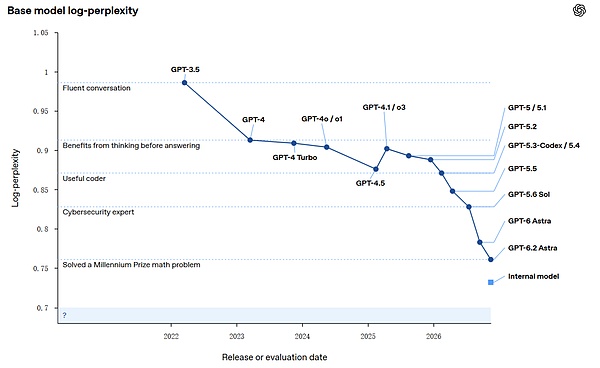
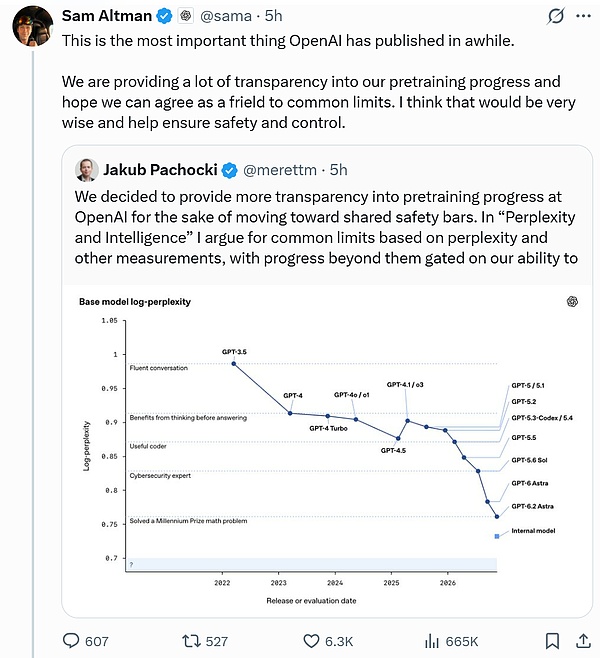
On November 22 local time, OpenAI Chief Scientist Jakub Pachocki unexpectedly published a lengthy article titled "Perplexity and Intelligence," in which he revealed a set of internal pre-training metrics for the first time and proposed a controversial suggestion: leading AI companies worldwide should agree on a limit to model development. According to him, no company should cross this line until AI safety monitoring capabilities reach specific standards. This time, OpenAI even took the initiative to disclose data that competitors have long sought to know. The metric chosen by Pachocki is called Perplexity, which measures a model's ability to predict the next token—the lower the value, the more accurate the prediction. In the data disclosed by OpenAI, the log perplexity of GPT-3.5 is about 0.99, while GPT-4 is about 0.91. When this number drops below 0.8, the model begins to show breakthrough capabilities in cybersecurity and mathematics; when it reaches about 0.76, the model is capable of solving several long-standing mathematically unsolved problems consecutively. What is even more alarming, according to Pachocki, is that AI may soon begin to accelerate its own development. As early as 2027, pre-training algorithm research could see a wave of foundational breakthroughs, while safety monitoring technology may not be able to keep pace at the same rate. OpenAI CEO Sam Altman also publicly stated that this is one of the most important pieces of information OpenAI has released recently. OpenAI is significantly increasing the transparency of its pre-training progress and hopes the entire industry can reach a consensus on shared limitations. In Altman's view, this is a very wise move that will help ensure the safety and controllability of AI. Below is the original text by Jakub Pachocki: Address: https://openai.com/index/perplexity-and-intelligence/ From a distance, the way modern AI is built seems similar to the software development model of the past few decades: achieving specific capabilities through a series of different techniques. AI development indeed involves various methods, but most of these methods do not design a specific capability from scratch; rather, they fully unleash the intelligence generated by a simpler yet harder-to-explain process. This process is training a compressor (or a predictor of equivalent meaning) on massive amounts of data. I believe tracking the speed of progress in compressor training capabilities is key to understanding the trajectory of AI development. In this article, I advocate for using perplexity, or the equivalent cross-entropy loss, as an indicator for comparing the technical levels of different model developers and to promote the establishment of common safety standards. As a first step, I will increase OpenAI's transparency regarding pre-training progress. We indeed considered carefully before disclosing our internal perplexity measurement data. Doing so will allow competitors to get a clearer picture of where OpenAI currently stands, but, compared to that, the urgency of pushing the entire industry to establish common safety measures is more important. We hope this can be a step towards establishing a common scientific foundation needed for future AI research pace management mechanisms. From a simplified but fundamentally explanatory perspective, the AI development process can be divided into several stages: First, building a large computer; then, using it to pre-train a model—a compressor—on large-scale, unstructured datasets; and finally, applying various techniques such as prompts, fine-tuning, or reinforcement learning to stimulate the potential capabilities of the model. Algorithmic advancements may blur the boundaries between different training stages, but we can still distinguish between two processes: one is creating AI with unpredictable emergent capabilities, which I previously referred to as "An Alien Mind"; the other is subsequently targeting the activation of those capabilities. Tracking the underlying indicators of AI intelligence progress. For years, the primary way we have measured this critical "smart foundation" progress has remained quite stable. We have been tracking the perplexity of models on a held-out dataset. Perplexity measures the model's ability to predict the next Token on average. The lower the perplexity, the more accurate the model's predictions. The chart at the beginning of this article shows how this metric has changed for different OpenAI models since GPT-3.5. With just this one metric, we can describe the broad capabilities of the model, and the span of these capabilities is astonishing. After setting a perplexity record on earlier datasets, GPT-2 can be said to be the first model capable of consistently generating coherent paragraph text. The next major leap came from GPT-3. It can learn to complete tasks in context with a few task examples. GPT-3.5 has a logarithmic perplexity of about 0.99 on our current primary evaluation dataset, and it is already capable of conducting fluent dialogues, serving as the foundation for the initial ChatGPT. GPT-4 has a logarithmic perplexity of about 0.91, and it can effectively utilize Chain-of-Thought for reasoning. This has driven us to further specifically stimulate this capability, ultimately giving rise to modern reasoning models. Today, with loss values dropping below 0.8, we have seen transformative capabilities emerge in fields like cybersecurity and mathematics. I want to emphasize again that no one could clearly foresee in advance that these capabilities would emerge once perplexity reached these specific thresholds. Fundamentally, they can be seen as latent abilities that arise from the model's continuous progress on this metric. As AI develops rapidly, the scope and measurement of downstream capabilities may change quickly. Using today's many mainstream benchmarks, GPT-2 and GPT-3 are already of limited significance, while many benchmarks used back then have essentially saturated by the GPT-4 stage. In contrast, I believe that continuously observing progress in the pre-training phase is likely to remain valuable for reference. AI Starts to Participate in Its Own Development, Potentially Accelerating Progress A unique change in the speed of AI development comes from its increasing involvement in its own development processes. Currently, the most widely discussed metrics mainly revolve around how AI enhances or replaces human researchers at various stages of R&D. The ultimate tipping point is often considered to be "Full Recursive Self-Improvement," where the entire development process is fully automated and no longer requires human oversight. Aside from we obviously should avoid reaching this step for the sake of maintaining human control, I also believe that this holistic discussion framework overlooks a critical issue. AI's involvement in a key aspect of the development process may lead to a significant transformation. This aspect is research on algorithms for pre-training. Recently, we have witnessed unprecedented acceleration in another field. For over a year, we have been giving mathematical open problems to models to solve, using them as one way to assess model capabilities. Once we upgraded to a model with a logarithmic perplexity of about 0.76, it began producing groundbreaking research results. For those of us who have previously engaged in research in mathematics and related fields, seeing the model solve problems we had thought about for a long time in the same Slack discussion thread is an incredibly surreal experience. Having personally gone through this process, we can extrapolate that sudden changes could similarly occur in deep learning research. While deep learning is more experimental, there has always been a phenomenon in this field: some simple insights may go undiscovered for many years. Therefore, as early as 2027, we might see a concentration of foundational breakthroughs in pre-training technologies emerge. I anticipate that AI will also significantly drive the development of alignment and monitoring technologies, but I believe that progress in these areas may not keep pace with the potential comprehensive acceleration in pre-training technologies. Perplexity Could Become a Common Standard for Measuring General Intelligence Since new, unexpected capabilities primarily arise from advancements in compression abilities, perplexity-based metrics may become a common benchmark for measuring general intelligence without needing to consider the degree of automation in the AI R&D process. Based on recent extrapolations, when models reach a logarithmic perplexity in the range of 0.68 to 0.70, we should expect more transformative capabilities to emerge. I don't know what these capabilities will specifically be, and we may not even have appropriate assessments designed for them today. At the same time, we should also anticipate that the currently dominant alignment auditing methods will further fail, and the related degradation phenomena may continue to worsen, with the model's awareness of the assessment and training processes further enhancing. I believe that frontier model developers should work together to establish a set of shared norms that clarify how to assess models and how to conduct safe red team testing before models are put into use for the first time. This set of norms should also include shared transparency standards. Furthermore, I propose that the industry should establish Common Limits based on perplexity and other metrics. Until developers' understanding and monitoring capabilities regarding AI behavior reach a specific milestone, companies should commit to not exceeding these limits. For example, we need to develop a technology that is more advanced than the existing Chain of Thought (CoT) Monitors. In other words, I hope to establish a set of industry standards that clarify two questions: First, set the first limit on AI R&D based on a key metric that can be tracked across different labs. Second, clarify what specific technical goals we need to achieve before breaking this limit. I hope this could push forward the establishment of a common framework for setting subsequent phase limits and managing the pace of future AI technological development. Challenges in Using Perplexity as a Common Metric There are also several issues with using perplexity as an industry-shared metric. First, it is challenging to make direct comparisons between different labs. Different developers use different evaluation datasets, and the combinations of data used during training also differ. This article presents measurement results from the primary datasets tracked by OpenAI over the long term. I believe that if the entire industry sets transparency goals, we could find transferable ways to compare the quality of different foundational models. Second, there is a disconnect with actual task assessments. Perplexity does not directly correspond to a specific task we truly care about. We pay attention to it because it is expected that continuous improvements in perplexity will ultimately lead to entirely new emergent capabilities. Third, it cannot encompass technological advances outside of pre-training. A typical example is Chain of Thought reasoning. While it can significantly enhance model capabilities, it does not reduce the perplexity already achieved by the model. Fourth, the theoretical lower bound of perplexity remains unclear. We do not believe that loss values can reach 0, as this would mean that the model can completely predict everything in the dataset deterministically. However, we still do not know the inherent entropy of the data itself. As models gradually approach this value, the surface improvement rate of perplexity may slow down. But at the same time, every small improvement in perplexity may correspond to a larger leap in model intelligence. Despite these challenges, perplexity as a metric has withstood the test of time. Many research teams have invested significant efforts over the years to optimize this metric, and it has continuously led to advancements in general intelligence. I believe that perplexity can play an important role in regulating the industry's discussion of AI progress, and I also hope to see the entire industry improve transparency on this metric in the future.

Details compiled from public sources. Always do your own research.