
After the Midterm Elections: What Democratic Control of Congress Means for Digital Assets
The current patchwork of enforcement by the SEC, oversight by the CFTC, and state-level money transmission laws will likely persist longer than the industry hopes.
Machine translated. Refer to the original for accuracy.
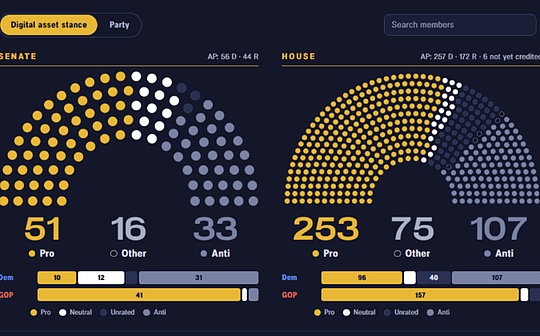
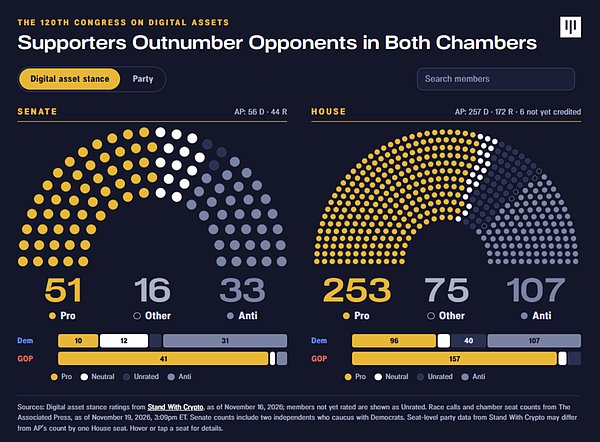
Author: Katrina Paglia, Chief Legal Officer of Pantera; Source: Pantera November Blockchain Investor Letter; Translated by: Golden Finance Claw The Democratic Party gained control of both houses of Congress in the midterm elections on November 3, flipping the House of Representatives and securing the Senate by a significant margin—many media outlets have called this one of the largest seat changes in decades. This result was primarily driven by economic issues and the aftermath of the Iran War, with digital asset policy being a secondary factor, but it has reset the political landscape for the entire industry; the core legislative priority for the industry—a federal market structure bill—has been negotiated on this landscape for nearly three years. Source: Digital Asset Position Ratings from Stand With Crypto, as of November 16, 2026; unratified lawmakers are listed as "Not Rated." Election result determinations and seat counts for both houses are from the AP, as of 3:09 PM EST on November 19, 2026. The Senate count includes two independent members who caucus with the Democrats. Stand With Crypto’s data on party counts by seat may differ by one House seat from AP counts. What Changes in Congress As of November 19, the AP reports that Democrats have won 257 seats in the House, Republicans 172, with 6 seats still unallocated. Hakeem Jeffries is expected to succeed Mike Johnson as Speaker. In the Senate, the AP counts Democrats at 56 seats (including two independents who caucus with the Democrats), and Republicans at 44 seats. This outcome gives Democrats control of the House Financial Services Committee and the Senate Banking Committee during the last two years of the Trump administration—these two committees are responsible for drafting digital asset market structure legislation. However, any bill sent to the President’s desk still has the potential for a veto from Trump. The new Congress will also have an unusually high number of inexperienced members. When the 120th Congress is sworn in on January 3, 2027, at least 120 of the 535 seats (about 22%, and possibly more as final election outcomes are determined) will be held by first-time elected officials, one of the largest groups of new lawmakers in decades. This turnover has both advantages and disadvantages, but overall, it presents a mild benefit for the industry. A substantial portion of the new lawmakers have no voting record on digital assets and do not hold entrenched, personally hostile positions like some departing lawmakers; this allows for more space to argue reasonable policies from scratch without battling established opposition forces. A New Path for the CLARITY Act The Digital Asset Market Clarity Act was passed in the House with bipartisan support in July 2025, but it stalled in the Senate Banking Committee due to ethical provisions concerning the President and lawmakers’ personal digital asset holdings; Democratic Senators like Kirsten Gillibrand have been warning about this for months. Now that the Democrats control both houses, the likelihood of the bill advancing in its existing version that has already passed the House is slim. Reports indicate that House Democrats are discussing expanding Congresswoman Maxine Waters’ Crypto Investor Consumer Rights Act into their own broader market structure framework, rather than completely abandoning the effort. The industry’s investment of about $233 million during the midterm elections did not yield lasting control over the results; any potential terms of a final agreement—including stronger conflict-of-interest provisions regarding the President, and a greater emphasis on investor protection compared to the CFTC-centered approach of the House bill—will likely skew toward the Democrats’ direction. Other Regulatory Clues to Watch Not everything is in flux. The GENIUS Act—the stablecoin framework signed into law in 2025—has already been implemented; its operational rules at the Treasury and banking regulatory levels will continue to move forward, regardless of which party controls Congress. The Senate's confirmation power over the leadership of the SEC and CFTC is now subject to scrutiny by committees controlled by the Democrats, which will impact the next batch of vacancies, but will not change the current heads of the agencies appointed by Trump before 2029. The more immediate impact is the tone. A Congress that focuses on overseeing this administration's own connections to digital assets (including the President's meme coins and token projects) is likely to enable hearings and investigations that maintain this scrutiny, even if it cannot legislate — several Democrats have cited this as a reason for the breakdown in market structure negotiations. What it means for crypto The realistic baseline scenario is delays and renegotiations rather than reversals. The stablecoin framework will be maintained, but comprehensive federal market structure legislation — the eventual rules manual clarifying the SEC and CFTC's jurisdiction over most tokens — currently seems unlikely to pass before the next Congress convenes in 2027, and may well take longer. This means that the patchwork of enforcement by the SEC, governance by the CFTC, and state money transmission laws will continue for longer than the industry expects. Therefore, we should continue to evaluate and take new positions according to the current rules (rather than the rules we expect to arrive soon). We will continue to track the House Democrats' alternative proposals for market structure as well as the development of ethical provisions in the new Congress.
Details compiled from public sources. Always do your own research.