
Who is Valuing the $200 Billion Stripe?

Stripe's valuation is expected to exceed $200 billion, supported by revenue multiples and its positioning in AI economic infrastructure.
Machine translated. Refer to the original for accuracy.
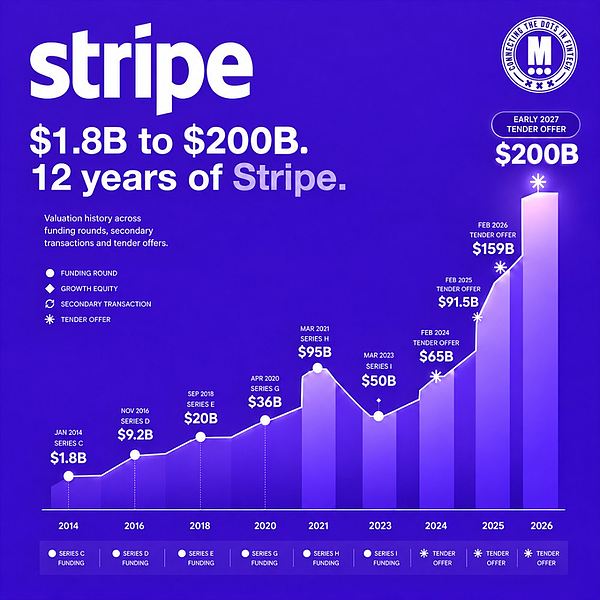
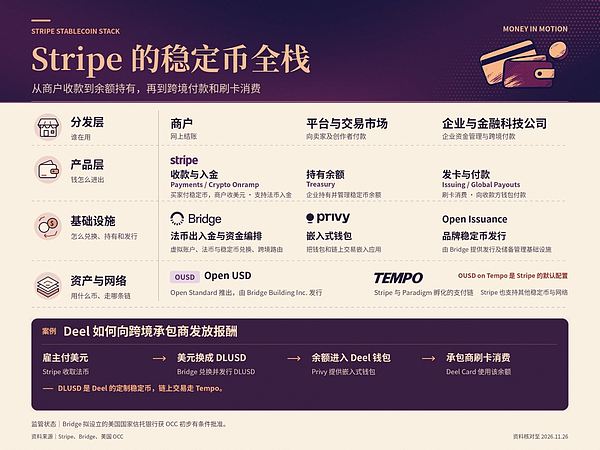
Combining the market capitalizations of PayPal, Block, Adyen, and Fiserv is still about one PayPal short of equaling a Stripe. On November 24, the Wall Street Journal reported that Stripe is negotiating with investors for a new employee share offer, with a valuation expected to exceed $200 billion, potentially closing as early as early next year. The last bid was in February this year. Investors such as Thrive, Coatue, and a16z bought employee shares, and Stripe also repurchased some shares in cash, with a valuation of $159 billion at the time. Months later, Stripe positioned itself at a conference as "AI economic infrastructure" and completed the acquisition of the model routing platform OpenRouter. So how should we value this globally fastest-growing fintech unicorn today? Or rather, has it already transcended the definition of a payment company? 1. Employees selling shares, old shareholders increasing holdings, Stripe paying cash In 2023, Stripe faced a very practical problem. Employees received stock compensation but had to pay related withholding taxes in cash. Stripe raised over $6.5 billion at a $50 billion valuation to facilitate monetization for current and former employees to handle tax payments, then used the repurchased shares to offset those issued to new investors. The company specifically stated in the announcement that this money is not needed for daily operations. Starting in 2024, employees will have an opportunity to sell part of their shares almost every year. Buyers pay the selling employees at the offer price, and the outside world can use this per share price to estimate how much Stripe is worth. Business Model Analyst categorizes the utility of this price into four items. The first two are easy to understand: employees sell shares at this price and know how much cash they can get; existing shareholders can also see how much their remaining shares are roughly worth. The other two items fall on Stripe itself. The money used to buy employee shares in February primarily came from investors, but Stripe also contributed cash. The higher the share price, the fewer shares can be bought back with the same amount of money. By August, when Stripe signed the agreement to acquire OpenRouter, reports from Axios indicated that the consideration was mostly in stock. This time the math reverses: as long as the seller agrees to a higher per-share price, buying the same company means Stripe can give fewer shares. Employees have the opportunity to cash out a portion of their shares each year, and Stripe also has funds to buy back and invest in new businesses. In the first half of this year, the company’s free cash flow grew 43% year-on-year. Several issues that could have been solved through going public have been dealt with in the private market. According to the Wall Street Journal, Stripe executives believe that the uncertainty brought by AI makes keeping the company private more beneficial. 2. From $91.5 billion to $159 billion, then to $200 billion The periodic offers provide employees with an opportunity to sell shares and give us a yardstick. The offer in 2024 corresponds to a $65 billion valuation. Over the next two years, buyers raised their bids round by round: how much is because Stripe generated more revenue, and how much is because buyers are willing to pay more for the same dollar of revenue? The employee share offer in February 2025 valued Stripe’s equity at $91.5 billion. With an estimated net revenue of about $5.1 billion in 2024, the price-to-sales ratio is about 18 times. A year later, the new round of offers raised the valuation to $159 billion. Based on an estimated net revenue of about $6.8 to $6.9 billion in 2025, buyers increased the price they were willing to pay for each dollar of net revenue, from about $18 to about $23. If investors had consistently offered at the original 18 times, after Stripe significantly scaled revenue, the valuation would be roughly around $123 billion. The increase from $91.5 billion to $159 billion was approximately half due to revenue growth and half due to the multiple increasing. Even Thrive, which participated in the offer, had also recognized its interest in stablecoins and Agentic Commerce at that time. Both offers occurred in February, coinciding with the annual letter from the Collison brothers. First, let’s see how they talked about the business then, and later, where they spent the money. In the letter from February 2025, the most discussed topic was how merchants could collect payments. A slight increase in payment success rates means that existing customers can close more deals, and merchants from other companies also have one more reason to switch to Stripe. At that time, the software suite centered around Billing had already achieved an annualized revenue of over $500 million, but when the Collison brothers talked about growth, they still focused on the investments in payment products over the past few years. At the same year’s Stripe Sessions, the management summarized the business Stripe was building as programmable financial services. AI and stablecoins were identified as two driving forces for commercial growth in the next decade. The clearest AI product at that moment was the payment foundational model: identifying fraud and optimizing payments to increase the success rate of more transactions from the same group of merchants. AI primarily improves the economic efficiency of the payment core business. 2.2 AI Economic Infrastructure One year later, the Collison brothers dedicated a significant portion of the letter to newly launched customers. Some companies made considerable income within a few months, especially those in AI, who easily sold overseas from day one. Questions that merchants used to ask only after growing larger—such as how to collect foreign currencies, how to pay taxes in different markets, and how to bill based on usage—now have to be addressed from the get-go. For buyers in the $159 billion round, these small companies are worth watching. The sooner Stripe receives their first business, the more opportunities there will be for a few of them to grow alongside and earn collectively. The letter discussed Metronome, stablecoins, and Agent commerce, all with this context in mind. At the April 2026 Sessions, Patrick Collison directly articulated the theme of the conference: Stripe is building "the economic infrastructure for the AI era." This statement points to two types of customer needs: AI companies need to charge customers based on usage, while shopping agents must pay on behalf of users after getting authorization. The former has been handled by Billing and Metronome, while the latter now has the Link’s Agent wallet, the transaction scale it can bring remains to be seen. 2.3 Token Models and Billing In August, Stripe announced the signing of a deal to acquire OpenRouter and separately wrote a letter to investors. Why would a payment company care about model calls? From a developer’s perspective, it’s understandable: how much customers pay is logged as revenue, while the costs of backend model calls are recorded as expenses. To know if a deal is profitable, both sides of the transaction need to align eventually. Management also disclosed a 71% year-on-year growth in Billing for the first half of the year and stated that the profitability of core payment operations supported these acquisitions. The previous item reflected existing operational performance, while whether OpenRouter would bring enough new profit remains to be seen. On the same day, OpenRouter's founding team also released an open letter explaining why they accepted this transaction. They promised to maintain multi-model choices and neutrality in routing, and valued the merchant network and risk control capabilities brought by Stripe. OpenRouter was one of those deals. The acquisition of Metronome completed at the beginning of the year enables Stripe to charge merchants based on usage; Clerky accelerated the time to engage with entrepreneurs at company establishment; by September, Stripe signed another agreement to acquire Parafin, extending its business to when platform merchants need financing. These four transactions span several phases of a company: just established, starting to charge, clarifying model costs, and needing working capital after the business scales. In October, MSCI estimated Stripe’s secondary market valuation at approximately $186 billion. A month later, employee offers had already crossed $200 billion. In the public market, how would investors price a payment company that similarly processes almost $20 trillion annually? PayPal conveniently provides a reference. In 2025, the transaction volume on the Stripe platform is $1.9 trillion, while PayPal's total payment volume is $1.79 trillion. The amount handled by both companies in a year is nearly the same, with one growing 34% and the other growing 7%. Just by looking at the transaction volume, one can see why buyers are willing to pay a higher price for Stripe. Now, looking at revenue. In 2025, Adyen's net revenue is approximately €2.364 billion, a year-on-year increase of 18%; according to media reports, Stripe's group revenue is about $6.8 billion to $6.9 billion, an increase of roughly one-third. Using these two sets of revenues as a base, Adyen's market value on November 24 is about 11 times its revenue, while Stripe is calculated at about 29 times based on a $200 billion valuation. This comparison shows the pricing gap of the group; Stripe's revenue already includes software and other businesses, so the 29 times cannot be directly considered as its acquiring business multiple. Taking Adyen as a reference, we can see how high Stripe's revenue multiple is. To explain the additional $41 billion this year, a more appropriate reference would be Stripe itself. Buyers in February valued it at about 23 times net revenue, and as long as the net revenue grows by about 26% throughout 2026, applying the original multiple would yield $200 billion. Business Model Analyst used a 41% growth rate from the first half to make a projection. If this speed is maintained in the second half, based on $200 billion, the valuation corresponding to each dollar of annual net revenue would decrease from about $23.4 to $20.9. The total price of the company is higher, but the price offered for each dollar of revenue is lower. This calculation will need to wait until annual revenue and offer prices are confirmed. In fact, merely looking at cold numbers does not explain much; valuations also stem from the current hottest global AI economy. And what has Stripe built for this AI economy? 4. Apart from payments, what other revenue can Stripe generate? In September in Shanghai, Stripe revealed that from 2024 to 2025, the number of AI enterprises newly launched on the Stripe platform in Greater China has increased by 78%. New customers have arrived, and the next question buyers are concerned about: as an AI enterprise grows from its first subscription to multinational operations, which businesses will it gradually hand over to Stripe? A developer launching an AI product in Shanghai might have first customers from several countries. Once a client subscribes and runs out of quota mid-month, the backend calls two models at different prices to complete the task. By the end of the month, they must both charge the client and know which orders resulted in losses. How much Stripe earns from this enterprise depends on how many tasks it takes on. The exhibition board in Shanghai has a total of five columns, with payments occupying only one column. There is a ready example in the risk control column: some transactions for DoorDash go through other payment channels, but they still buy Stripe's Radar to assess risk. 4.1 Usage-based billing An AI company sells monthly subscriptions; if customers exceed the quota, how will the excess usage be charged? Will it be deducted immediately, or added to the end-of-month bill? These are matters that billing must manage. Once the amount and deduction time are settled, it is time for the acquiring business to collect the payment. In February 2025, Stripe announced that its suite centered around Billing had surpassed $500 million in annualized revenue. A year later, with Metronome added, Stripe set a target for the entire revenue software suite to reach $1 billion in annualized revenue by 2026. The first figure has already been achieved, and the latter still needs to be seen by year-end, and it counts an additional business. Billing holds another layer of value. Payment analyst Dwayne Gefferie pointed out that OpenAI is also an Adyen client, but public records do not show how many transactions each processes. However, OpenAI was originally using Metronome for billing. Even if a major client hands over some acquiring volume to others, Stripe still has opportunities for billing and software revenue. Peers have also recognized this position: Adyen acquired Orb, and Salesforce bought m3ter. 4.2 Model calling and token costs. OpenRouter brings Stripe to the other side of AI merchants: which model to call in one invocation and how many tokens it would cost. At the beginning of the year, OpenRouter was a customer of Stripe for invoicing and payments, and by August, Stripe announced its acquisition. Ben Thompson and Lex Sokolin value the location of cross-model distribution; The Information pointed out that the price being discussed at the time was relatively high compared to expected revenue. How much this acquisition is worth depends on the gross margin of the routing itself and how many billing services these customers will subsequently purchase from Stripe. During a chat in Shanghai, Kevin Miller, Stripe's global payments head, likened the token expenditure to early cloud billing. Having worked at AWS, he witnessed enterprises focusing solely on getting their services up and running when they first went to the cloud. Only after the bills became substantial did they start to question how much each business line was spending. Today's AI applications have this muddled bill too: customers pay one price for a task, while the backend may have adjusted several models. Metronome can attribute this revenue to the customer, and OpenRouter has the opportunity to attribute the corresponding model cost back to the same task. Merchants can then see whether what appears to be the best-selling feature is actually profitable. 4.3 Treasury and Merchant Funds Management In Shopify, buyers can pay in USDC, and merchants default to receiving in their local currency. The Bridge adds options for how the funds are settled. Looking at another merchant that has already activated Treasury. Once sales revenue is credited, it can keep the sales revenue in the financial account at Stripe for operating funds, remit to suppliers, or pay operational expenses through associated cards. For a storefront, selling goods on Monday and paying for the goods on Friday was originally the business of two separate entities. If Stripe can connect these two aspects, one transaction could lead to subsequent currency exchange, payments, and card income. Parafin complements another need: when the account balance is insufficient for stock replenishment, the platform can also provide financing to the merchant. 4.4 Agentic Commerce The day of the interview in Shanghai, Kevin was out of town and needed to send an anniversary gift, so he had the Agent help him order flowers. For the florist, the order shifted from their own website to the AI chatbox. The florist has to acknowledge this order, and the flower buyer has to clarify how much they are willing to spend. Stripe interfaces with the florist to receive product catalogs and checkout, while on the buyer's side, it limits authorization with Link and payment tokens. If this florist was already using Stripe for payments, placing an order for the same bouquet through the chatbox means Stripe only retained its existing business. Additional income could arise if it could capture previously unattainable orders or if someone is willing to pay separately for authorization and risk control. Retaining this business has value in itself. 5. Is Stripe Still a Payment Company? With the same bouquet ordered in a different location, the florist, Agent, and Stripe each maintain their reconciliation for this transaction. Simon Taylor argues that all AI companies will eventually become payment companies, referring precisely to the accounts mentioned by the Agent. He cites Meta’s Muse as an example: currently charging subscription fees, but in the future, if it can facilitate transactions for users, it may take a cut. Taylor referred to the future. What we can see today is that many leading AI companies are conducting business using Stripe. According to Stripe’s statements to investors in August, 88% of the companies in Forbes' AI 50 list are using its platform. The letters did not disclose how much payment volume each of these customers is giving to Stripe. Not every AI company has the capability or should build its own payment infrastructure, and Stripe just happens to fill that gap for them. Regardless of what form the future AI economy takes, the revenue foundation that Stripe has essentially built is already solidly positioned. In a small bar in Shanghai in September, we asked Kevin Miller a question. Two months later, seeing the news of the offer negotiations, I recalled it again. Stripe is no longer just a payment company.



Details compiled from public sources. Always do your own research.