
Bitcoin ETF Bleeds Over $8 Billion: Wall Street Can't Hold Up
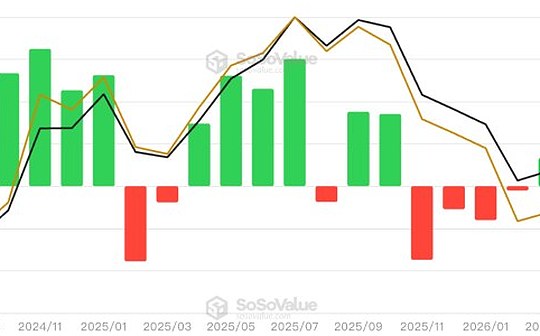
Bitcoin spot ETF recorded a net outflow of $4.71 billion in November, setting a historical record, while institutions hold positions with paper losses exceeding $22.7 billion.
Machine translated. Refer to the original for accuracy.
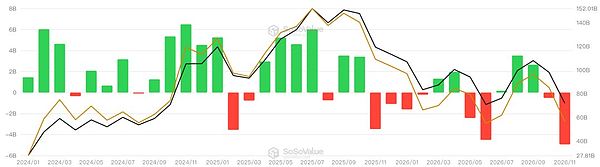
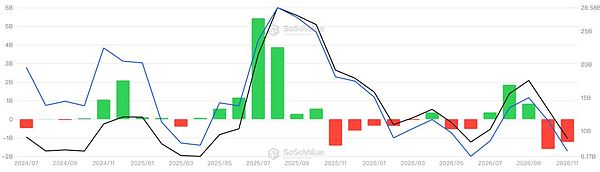
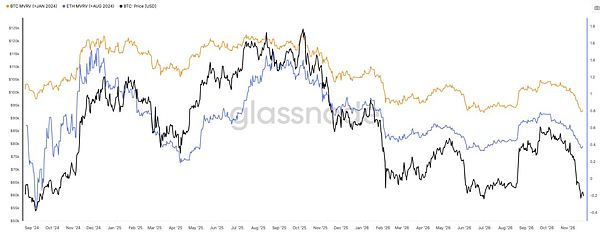
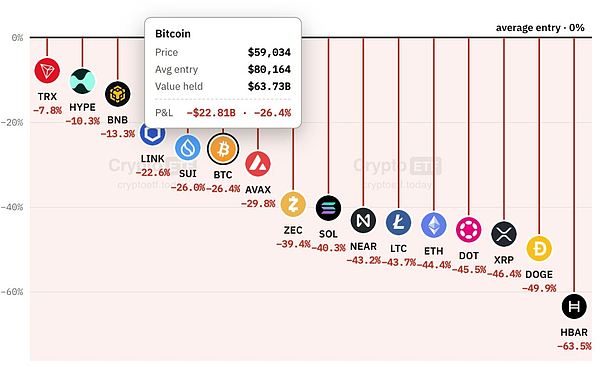
Author: Nancy, PANews Bitcoin's downward trend persists and the chill in the market continues to spread, with Wall Street institutions that once actively entered the market starting to falter. What once injected upward momentum into the crypto market—spot ETFs—have now become a bleeding point for the market. Over the past two months, Bitcoin and Ethereum spot ETFs have consistently recorded net outflows, with the trend of institutional capital withdrawal showing no signs of reversal. Among them, Bitcoin's spot ETF set a record for the largest single-month net outflow in November. The ongoing withdrawal of institutional capital not only weakens the incremental buying power in the market but also further erodes investor confidence, exacerbating the already weak market sentiment. ETF Bloodshed Sets Records, Institutional Buying Cools In the past two years, Bitcoin and Ethereum spot ETFs have become a crucial entry point for Wall Street's layout in the crypto market, opening the door for traditional institutions to allocate crypto assets and bringing hundreds of billions of dollars in incremental funds to the market. However, entering the fourth quarter of this year, this vital channel for institutions has encountered headwinds, with a rapid reversal of capital flow and the most severe market test since their listing. Data from SoSoValue shows that since the fourth quarter, Bitcoin spot ETFs have accumulated net outflows of over $5.22 billion. In November alone, $4.71 billion flowed out, approximately 9.2 times the $510 million in October, setting a record for the largest single-month net outflow since the ETF’s listing. It is noteworthy that after the new week opened, Bitcoin's spot ETF saw another net outflow of nearly $570 million, exceeding one-third of last week's net outflow scale. Although Bitcoin's price has dropped below $60,000, there has been no significant inflow of ETF capital, suggesting that institutional investors' willingness to buy on dips remains weak, maintaining a cautious attitude towards future market trends. The ongoing withdrawal of institutional capital further undermines the market's incremental buying power and exposes Bitcoin's price to greater downward pressure. In this wave of institutional withdrawals, BlackRock's IBIT is at the forefront. As a leading product in the Bitcoin spot ETF market, IBIT once served as a major channel for institutional capital inflows, but now it has become the main outlet for this round of capital withdrawal. In November, IBIT saw a net outflow of over $4.17 billion, not only ending its previous months of continuous net inflows but also accounting for 88.5% of the overall net outflow of Bitcoin spot ETFs for the month. This wave of capital retreat has also spread to the Ethereum market. Since the fourth quarter, Ethereum's spot ETFs have similarly bid farewell to months of continued net inflows, accumulating net outflows of over $2.84 billion. Although the scale is lower than Bitcoin's, the capital withdrawal trend is also significant. Of note, October was particularly concentrated in capital withdrawals for Ethereum's spot ETF, with a single-month net outflow of $1.61 billion, setting a record for the largest single-month net outflow since the product's listing. The week of October 9 saw concentrated redemptions, with a single-week net outflow ranking as the second-highest of the year. Similar to the Bitcoin market, BlackRock's ETHA remains the major source of redemptions, with a cumulative net outflow of about $2.44 billion since the fourth quarter, accounting for 85.9% of the overall net outflow of Ethereum's spot ETFs. Hundreds of Billions in Paper Losses, Wall Street Stands Guard at High Positions In the third quarter, Wall Street was swept up in a spree of Bitcoin ETF buying frenzy. Recently, an analysis by Galaxy Research on 13F filings revealed that in the third quarter, institutional investment managers increased their holdings in U.S. Bitcoin spot ETFs, purchasing the equivalent of 49,229 BTC and reversing the net selling trend seen in the previous three consecutive quarters. The total holdings reported by institutions also climbed to 356,491 BTC, valued at approximately $29.8 billion, setting a historical high and even surpassing the previous three quarters’ cumulative reduction of 47,054 BTC. Behind this wave of institutional accumulation is that more and more traditional financial institutions are starting to include Bitcoin in their asset allocation. Alex Thorn, the head of research at Galaxy, pointed out that the increase this quarter was primarily driven by dozens of large institutions, with investment advisors and wealth management platforms contributing half of the net increase in Bitcoin spot ETF shares. According to the latest disclosure from Bloomberg ETF analyst James Seyffart, as of September 30, over 2,200 institutions hold Bitcoin ETFs, with investment advisors dominating among those that have disclosed their positions. In his view, this is a positive signal because investment advisors typically have a longer holding period. Among them, Wells Fargo has become the largest institutional holder of Bitcoin ETFs. At that time, Wall Street’s enthusiasm for Bitcoin allocations continued to rise, injecting considerable incremental funds into the market, driving the price of Bitcoin to rebound to $87,000 at one point. However, the 13F filings have a certain lag in disclosure, reflecting more the allocation situation of institutions from the previous quarter and cannot represent their current investment attitude. Entering the fourth quarter, the market direction began to turn sharply downwards. Institutional funds that were previously actively buying are now turning to exit, with ETF fund flows shifting from net inflows to significant net outflows. As the price continues to drop, the once vibrant buying at Wall Street also feels the chill of standing at a high position. According to Glassnode, as of November 23, the MVRV indicator for the US spot Bitcoin ETF has fallen to 0.81, and the MVRV indicator for the Ethereum spot ETF has dropped to 0.38. MVRV measures the relationship between the current ETF holding market value and the average holding cost, with 1 representing the breakeven line. A figure below 1 indicates that the overall positions are at a loss. Meanwhile, data from CryptoETF.today shows that as of November 23, the average holding cost of the Bitcoin spot ETF is approximately $80,164, about 35.7% higher than the current price of Bitcoin, resulting in cumulative unrealized losses of approximately $22.76 billion for holders. The situation for Ethereum ETF investors is even more challenging, with an average holding cost of approximately $2,974, while the current price of Ethereum is only $1,655, resulting in cumulative unrealized losses of approximately $7.18 billion. Not only are ETF investors facing these losses, but publicly listed companies holding large amounts of crypto assets are also facing significant unrealized losses. The two major DAT companies, Strategy and BitMine, have unrealized losses exceeding $14.1 billion and $10.3 billion on their Bitcoin and Ethereum holdings, respectively. In other words, Wall Street, which was actively chasing gains in the third quarter, is now burdened with hundreds of billions of dollars in unrealized losses. For these institutions that entered at high positions, holding on means they must bear the risk of further price declines. For Wall Street, unrealized losses may not be the most challenging issue. The real test lies in the fact that as the market continues to weaken, the risks that institutions must bear by holding onto crypto assets are continuing to rise. Currently, the tightening macro interest rate environment, valuation corrections in AI-related assets, and the contraction of market liquidity are all factors that contribute to the increasing uncertainty in the market, placing greater pressure on ETF investors who entered at high levels. Meanwhile, the continued outflows from ETFs are also weakening market buying pressure, further exacerbating market strain. In summary, the current market environment is still insufficient to support institutions in quickly regaining their allocation enthusiasm. In the coming days, whether ETF funds can turn back to net inflows and when institutional allocation demand will warm up may become important signals affecting whether the crypto market can emerge from its slump.
Details compiled from public sources. Always do your own research.