
South Korea Announces Digital Asset Regulatory Draft, New Opportunities for KRW Stablecoins and ICOs
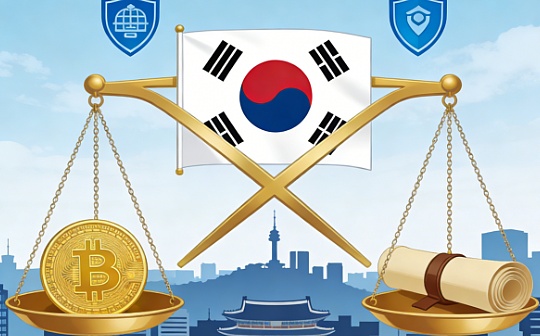
On November 24, the South Korean Financial Commission announced a regulatory draft for digital assets, proposing to allow ICOs within the country. If the bill is passed, South Korea's cryptocurrency market will welcome new regulatory rules.
Machine translated. Refer to the original for accuracy.
Tao Zhu, Golden Finance Summary: On November 24, 2026, the South Korean Financial Commission announced a draft legislation for digital asset regulation, proposing to allow initial coin offerings (ICOs) within South Korea, establish a bank-led issuance mechanism for KRW stablecoins, and impose limits on the shareholding ratios of major stakeholders in cryptocurrency exchanges. If the relevant bill is eventually passed, South Korea's cryptocurrency market will see new regulatory rules. 1. What does the South Korean Digital Asset Bill involve? On November 24, the South Korean Financial Commission held a meeting of the Virtual Assets Committee, where officials discussed a plan to introduce a new legislative proposal regarding digital assets, aimed at promoting innovation in the digital asset industry and ensuring user rights. According to the legislation plan published by the South Korean Financial Commission, the draft primarily addresses aspects such as digital asset issuance, stablecoins, exchange equity structure, market making, and user asset protection. 1. Allow ICOs and establish a token issuance disclosure system Since 2017, South Korea has imposed comprehensive restrictions on domestic ICOs. This draft proposes to lift those restrictions, allowing eligible projects to launch token offerings within South Korea. According to the draft, under the condition of fully disclosing information, the domestic digital asset market will allow initial coin offerings (ICOs). Issuers or brokers must prepare a digital asset white paper and submit it to the South Korean Financial Commission (FSC) when soliciting investors for the subscription of digital assets. Similar to a securities registration report, the digital asset white paper must contain detailed information on the solicitors, use of funds, issuance scale, project details, and risks. If any key information is omitted, the FSC has the right to request corrections. Issuers or brokers can only solicit investments in digital assets after their white paper has been reviewed and approved by the FSC and after a cooling-off period. This means that South Korea is not completely opening up ICOs, but is preparing to incorporate token issuance into a formal regulatory framework through information disclosure and accountability mechanisms. 2. Establish a KRW stablecoin issuance mechanism The draft proposes to include stablecoins pegged to a single fiat currency and primarily used for payments into the regulatory framework for Digital Payment Tokens. In the South Korean domestic market, stablecoin issuing institutions (which provide issuance and redemption services) must meet the following licensing requirements before applying for a license from the South Korean Financial Commission (FSC): shareholder structure, minimum registered capital of 5 billion KRW, feasibility of business plans, staffing and facilities, qualifications of major shareholders and executives, and conflict of interest prevention mechanisms. The shareholder structure requirements will be determined later by presidential decree based on factors such as stability and innovation. However, in the initial phase, consortia with more than 50% shareholding by banks will be permitted to issue stablecoins. Fintech and tech companies can also participate as majority shareholders in the consortium, which will help promote innovation in the issuance and circulation of stablecoins. Issuers of stablecoins must submit a issuance plan to the South Korean Financial Commission (FSC), detailing the issuance scale and limits, reserve asset management, and redemption processes, which must be approved by the FSC. The issuance value of stablecoins must be equivalent to the currency and does not pay interest to holders. For stablecoins that are issued without authorization or declaration, platform service providers will be prohibited from listing them, and trading, intermediation, custody, or storage will also be prohibited. Stablecoin issuers must immediately pay out equivalent currency upon receiving a redemption request from asset owners. To this end, stablecoin issuers must deposit at least 100% of their issuance balance in reserve asset management institutions such as banks as reserve assets. After assessing the impact of stablecoins on financial stability, monetary policy, and other aspects, the South Korean Financial Commission (FSC) may designate stablecoins with an issuance volume of at least 1 trillion KRW as systemic tokens. In addition, overseas stablecoins that meet South Korean regulatory requirements are also expected to enter the South Korean market. 3. Limit major shareholders' shareholding ratio in cryptocurrency exchanges to 20% One of the most highly anticipated aspects of the draft is the limitation on the equity structure of cryptocurrency exchanges. The FSC may designate digital asset platform service providers that have obtained all three operational categories (a) trading services, (b) brokerage services, and (c) custodial and storage services licenses, and have sufficient capital and market operational capabilities. To ensure the transparency and neutrality of digital asset platforms, which serve as key infrastructure in the digital asset market, a decentralized equity structure will be required. Similar to the requirements for alternative trading systems (ATS) in capital markets, the maximum shareholding will be limited to 20%. However, according to a presidential order, with approval from the Financial Services Commission (FSC), this maximum shareholding can be increased to 34%. Considering the transitional period for existing exchange service providers, a grace period of three years will be given after being designated as a digital asset platform service provider. An additional grace period of up to three years (for a total of up to six years) may be granted, taking into account the investment security needs of small and medium-sized exchange service providers. 4. Establish a Classification Licensing System for Digital Asset Service Providers The draft also proposes to classify regulation of digital asset service providers according to their business types, including trading, brokerage, custodial and storage, investment management, etc. Among these, trading, brokerage, and custodial businesses will require a license from the Financial Services Commission, while investment management will adopt a registration management approach. Trading platforms must obtain relevant business licenses before further being recognized as digital asset platform operators. Additionally, the draft provides a legal basis for market-making businesses. Institutions that obtain the relevant trading business license can enter into contracts with issuers or trading platforms to participate in market transactions as liquidity providers. Trading platforms will also need to publicly disclose the historical quotes and performance of market makers. 5. Strengthening User Asset Protection and Security Responsibility In terms of investor protection, South Korea plans to require digital asset service providers to establish internal control and risk management systems similar to those of traditional financial institutions, enhancing customer asset monitoring and information security management. In the event of a hacking attack or IT system failure resulting in user asset loss, relevant service providers may have to bear strict liability for compensation, even if they cannot prove negligence, they cannot automatically be exempt from liability. This means that South Korea aims to institutionalize the security responsibilities of digital asset platforms and enhance the level of user asset protection. For more information, see "Understanding the Draft Basic Law for Digital Assets in South Korea: Four Major Market Groups Affected" II. Significance of South Korea's New Legislative Proposal on Digital Assets 1. Changes Expected in South Korea's Crypto Financing Market Since the ICO ban in South Korea in 2017, crypto projects have been significantly restricted in financing through token issuance, with some projects opting to conduct related business overseas. Nearly ten years later, South Korea plans to reopen ICOs and establish a white paper disclosure and accountability system. If relevant regulations are officially enacted, local projects will gain new financing channels, and overseas projects may place greater emphasis on the South Korean market. 2. Clearer Regulations for KRW Stablecoins, Enhancing the Status of KRW in the Digital Economy The bill provides relatively clear issuance and regulatory paths for KRW stablecoins, further clarifying issues such as issuing entities, reserve asset management, and regulatory responsibilities. Although USD stablecoins currently dominate areas such as cross-border payments and on-chain transactions, the launch of KRW stablecoins will also help enhance the status of KRW in the digital economy. 3. Impact on Exchange Governance Structure The draft sets limits on the shareholding ratios of major shareholders, which may directly affect the control and governance structure of existing exchanges. If the bill is passed, it will force major exchanges in South Korea to sell shares. According to the Seoul Economic Daily: This measure is expected to have a significant impact on the ongoing business merger between NAVER Financial and Dunamu (Dunamu is the operator of Upbit, South Korea's largest cryptocurrency exchange and a core infrastructure company in the digital asset field). Once the two companies complete a full stock exchange, Dunamu will become a wholly-owned subsidiary of NAVER Financial. At that time, the shareholder structure of NAVER Financial will undergo decentralization, with Dunamu's Chairman Song Ji-hyeong holding 19.5%, NAVER holding 17%, and Dunamu's Vice Chairman Kim Hyung-nyeon holding 10%. However, financial regulatory agencies plan to set the shareholding ratio limit based on the direct shareholders of the exchange. Whether holding company structures will enjoy exceptions and the scope of related parties will be clarified later through a presidential order. Even if NAVER Financial acquires all shares of Dunamu, its voting rights will still be restricted, prompting the company to reassess the original plan to maximize merger benefits. An insider stated, "Since there is no longer a need to exchange all shares, they will likely reassess the methods and terms of the merger, as well as the pros and cons of going public in the future." Additionally, Bithumb Holdings holds 73.56% of Bithumb, Coinone founder and CEO Cha Myung-hoon holds 30.36%, and Mirae Asset Consulting holds 97.15% of Korbit. 3. How do industry insiders view South Korea's digital asset legislation? 1. Supporting the development of South Korea's crypto industry Lee Uk-won, chairman of the Financial Services Commission, stated: "This decree will promote innovation across the financial industry by creating job opportunities through the cultivation of emerging industries and the utilization of new capital inflows." 2. Weakening the competitiveness of South Korea's crypto industry Experts believe that it is necessary to institutionalize the digital asset industry, but they warn that overly complicated ownership rules may weaken the competitiveness of the sector. They particularly point out that as existing exchange owners offload significant shares, the corporate value could be damaged, and the interests of current investors might also be harmed. Hwang Seok-jin, a professor at Dongguk University's Graduate School of Information Security, expressed: "Limiting the ownership stakes of exchange owners, centering stablecoin issuance around banks, and having entry requirements similar to those for financial companies could hinder innovation. With the new regulations even applying to business mergers that have already been completed or are in progress, it is crucial to clearly establish transitional provisions for existing investments." Son Chang-wan, a professor at Yonsei University School of Law, commented: "While securities regulation can apply to trading, ownership restrictions may obstruct quick decision-making in the rapidly evolving crypto industry." A representative from an exchange warned: "Korean exchanges are already facing barriers to foreign investment participation. Limiting major shareholders' ownership stakes and voting rights will put us at a further disadvantage in global competition. This could stifle investment and weaken the growth engine of South Korea's digital asset industry." 3. New enterprises require time to begin operations Furthermore, after the new system is established, it may take a considerable amount of time for new businesses to actually commence operations. The government proposal allows for a one-year transition period between the promulgation and the effectiveness of the law. Considering the legislative procedures of the National Assembly and the time needed to issue operating licenses after the law takes effect, the gap with overseas markets may further widen. Lee Jeong-soo, a professor at Seoul National University School of Law, noted: "The timeline for new enterprises to genuinely start operating could be delayed until 2029." Appendix: Evolution of South Korea's Crypto Regulation Policy September 2017: South Korea announces a ban on ICOs. The Financial Services Commission (FSC) of South Korea announced a ban on all forms of Initial Coin Offerings (ICOs), primarily due to concerns about speculative bubbles, fraud, and investor losses triggered by ICOs. January 2018: Real-name system for cryptocurrency trading. South Korea requires exchange users to conduct fiat transactions using real-name bank accounts, with the user’s bank account name needing to match the information of their exchange account. March 2021: Amendment to the Specific Financial Information Act and establishment of reporting systems for exchanges. South Korea amended the Specific Financial Transaction Information Report and Use Act, requiring Virtual Asset Service Providers (VASPs) to report to the Korea Financial Intelligence Unit (KoFIU) and meet requirements related to anti-money laundering and customer identification. Korean crypto exchanges must meet specific reporting conditions to operate legally. March 2022: Implementation of travel rules for cryptocurrency transfers. Virtual Asset Service Providers are required to collect and relay identity information from both the remitter and recipient for transactions exceeding a designated amount, enhancing transaction transparency to prevent money laundering and illegal fund transfers. June 2023: National Assembly passes the Virtual Asset User Protection Act. This legislation primarily involves user asset protection, the prohibition of market manipulation and insider trading, and confers regulatory authorities powers for oversight, inspection, and sanctioning Virtual Asset Service Providers. The law is set to officially take effect on July 19, 2024. November 24, 2026: Draft of the Digital Asset Industry Innovation and User Protection Act announced. The draft includes provisions for ICO openings, issuance of KRW stablecoins, market-making business by exchanges, classification licensing for digital asset service providers, and restrictions on the ownership percentage of major shareholders in exchanges. The bill still needs to be submitted to the National Assembly of South Korea for deliberation, and relevant terms have not yet formally taken effect.
Read original · 金色财经资讯Details compiled from public sources. Always do your own research.