
Awakening of Dormant Bitcoins: Has Quantum Attack Begun?
If quantum computing reached a level where it could crack cryptography at will, you wouldn't see sporadic awakenings of bitcoins but systemic and large-scale abnormal movements.
Machine translated. Refer to the original for accuracy.
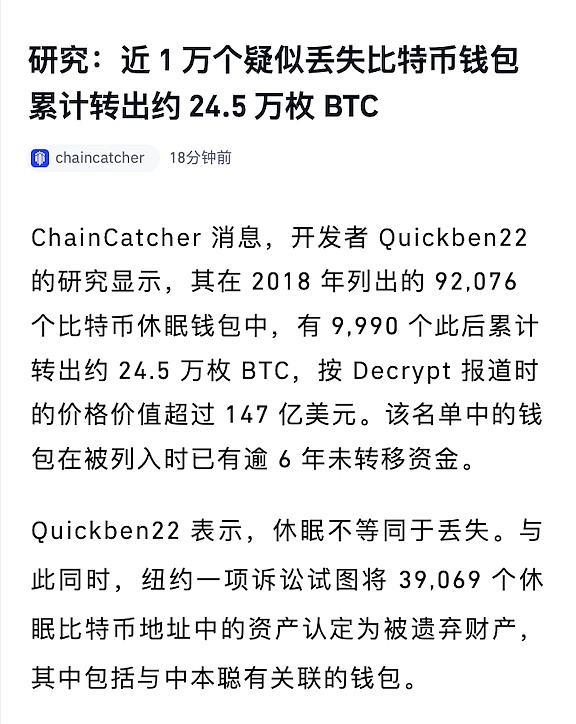
Today I saw a piece of news as follows: Then I saw discussions about it on X, where one comment caught my attention. A netizen said: "In fact, quantum attacks have matured, but are not disclosed. They are using this technology to amass wealth. Many zombie addresses have revived; it’s suspicious that they suddenly activated after years of inactivity. The reason it’s not disclosed is that once made public, Bitcoin would panic and possibly crash to zero; and if it goes to zero, there’s nothing to profit from. Therefore, they want to make money quietly while maintaining liquidity, breaking the private keys of zombie addresses to take out the bitcoins for cashing out without anyone noticing. This is also the reason for the crash of Bitcoin." When I first saw this message, I found it intriguing; the logic seemed plausible and the speculation bold. Wallets dormant for six or seven years, or even over ten years, suddenly starting to move and transferring out over 240,000 bitcoins, valued at over $14 billion at the time of reporting, look too much like a precursor of some cryptographic apocalypse. But if you think rationally, you will find that it’s highly unlikely. Developer Quickben22 made a list in 2018 of addresses that had not moved for over six years, totaling 92,076. His hypothesis was that the holders of these addresses might have lost their private keys. Eight years later, 9,990 addresses from the list have made transfers, totaling about 245,000 BTC. It sounds like a lot, but out of the total number on the list, it’s just a bit over 10%. This means nearly 90% of the addresses remain silent. If quantum computing could really break secp256k1 at will, you wouldn’t see such sporadic awakenings; instead, you would see systematic and large-scale abnormal movements. Exchanges and custodians would discover them first and go into a frenzy, rather than a few old addresses leisurely signing. Dormancy does not equal loss. The 2018 list was based on the assumption that "private keys had been lost," but in reality, this assumption has been partially falsified. Some found old backups, some dug up hardware wallets, some were heirs handling inheritances, and some might have merely transferred coins from old addresses to new addresses for organization. The blockchain can only prove that "someone signed with the private key"; it cannot prove who signed nor whether the signing method was quantum cracking. Attributing the awakening of 10% of the addresses directly to quantum is like looking at a few streetlights glowing and concluding that the power plant switched to nuclear fusion. The quantum threat exists, but it is far from I think the interesting part of this message lies not in quantum, but in time. Bitcoin has been running for over a decade and is starting to accumulate some conditions that were not entirely anticipated at the time of its design: private keys can sometimes be recovered, or they may never be; legal systems are beginning to attempt to reclaim 'orphaned' assets; and quantum risk serves as a distant reference point, reminding us that this system has numerous challenges related to ownership, governance, and consensus beyond cryptography. For example, those early P2PK addresses, which permanently expose public keys by design, represent one of the most vulnerable types of assets, with about 1.8 million of them being seen as permanently lost, making migration practically impossible. Any discussion of future quantum-safe upgrades cannot avoid a sharp question: should these non-migratable and fragile old coins be protected, frozen, or neglected? This has already surpassed the technical category and touches on the most fundamental property ethics of the Bitcoin community. There is also an easily overlooked bottleneck: the difficulty of a quantum-resistant upgrade lies not in cryptography but in governance. Post-quantum signature schemes technically already exist, but Bitcoin has no boss; there is no one who can order an upgrade. Any changes require community consensus and must weigh block space against transaction fees. Post-quantum signatures are larger, which may exacerbate block congestion, resulting in a layered pattern: users willing to pay higher fees get strong security signatures, while ordinary users see a relative decrease in their security margin. The ultimate test that the quantum threat poses is Bitcoin's adaptability as a governance system, not its mathematical logic.
Details compiled from public sources. Always do your own research.