
Countdown to ANT: How Pre-Market Perpetual Contracts Price Anthropic's IPO
Pre-market perpetual contracts predict Anthropic's listing price more closely than IPO pricing, with no price gaps on the listing day.
Machine translated. Refer to the original for accuracy.
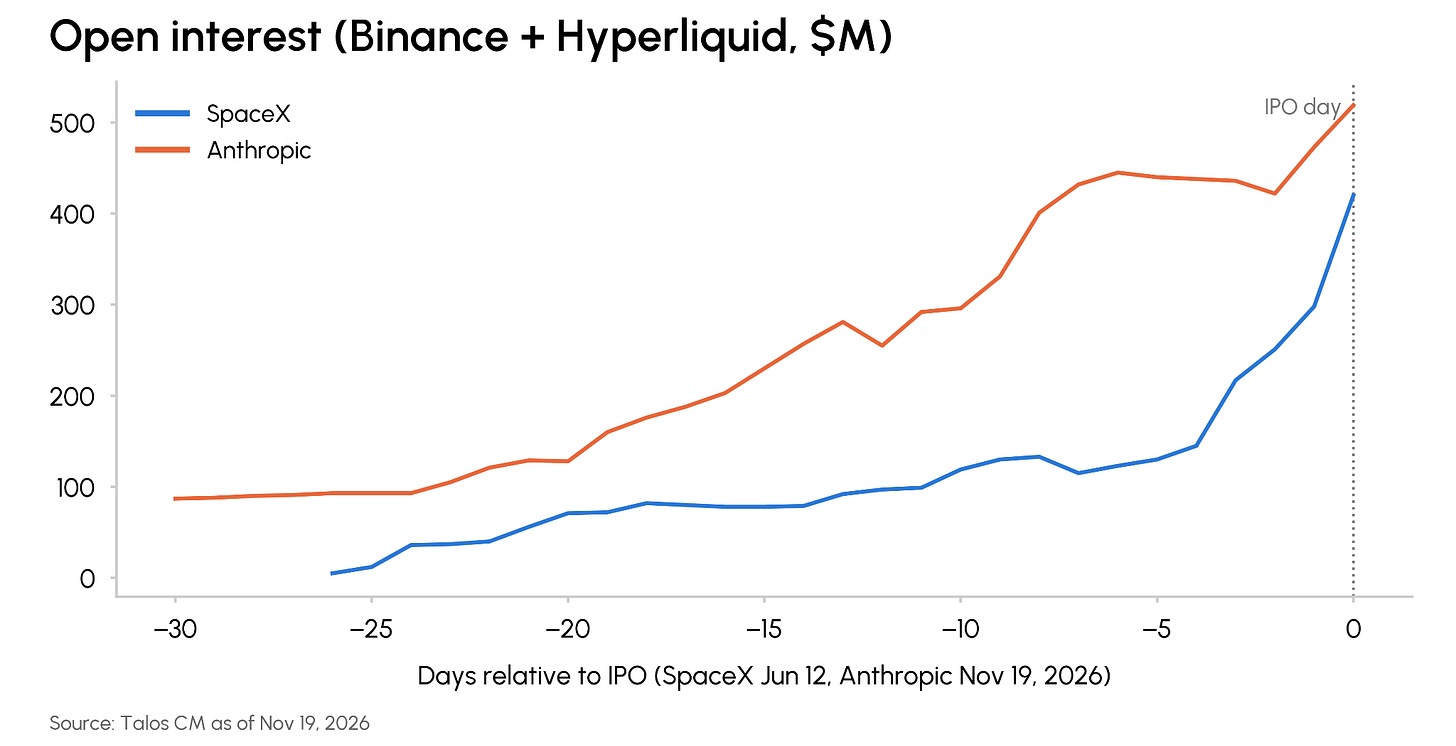
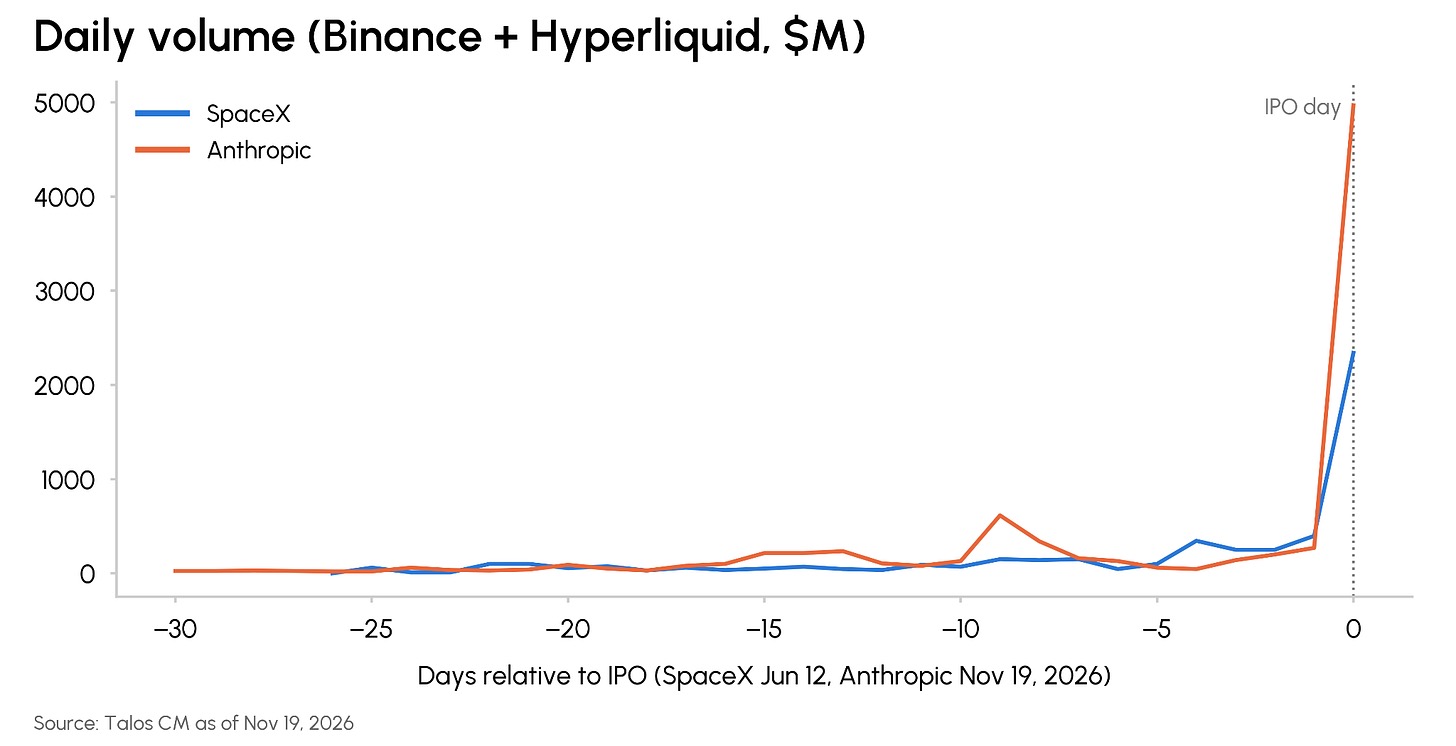
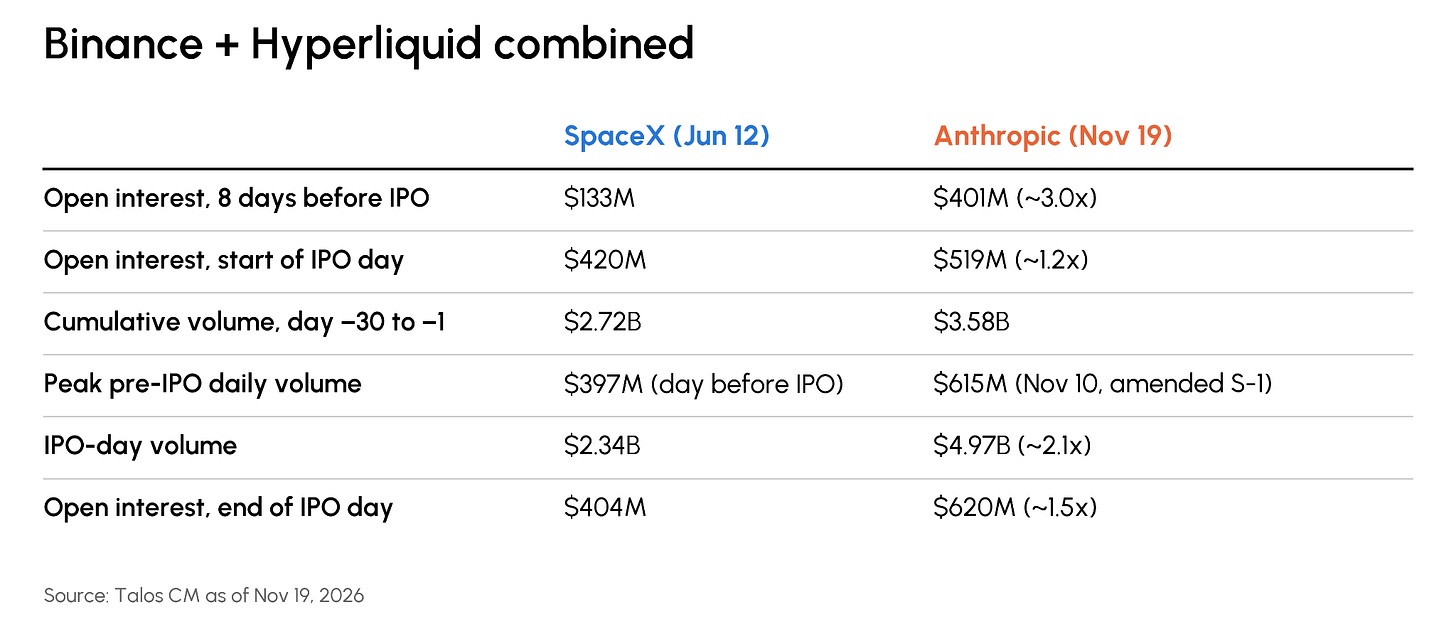
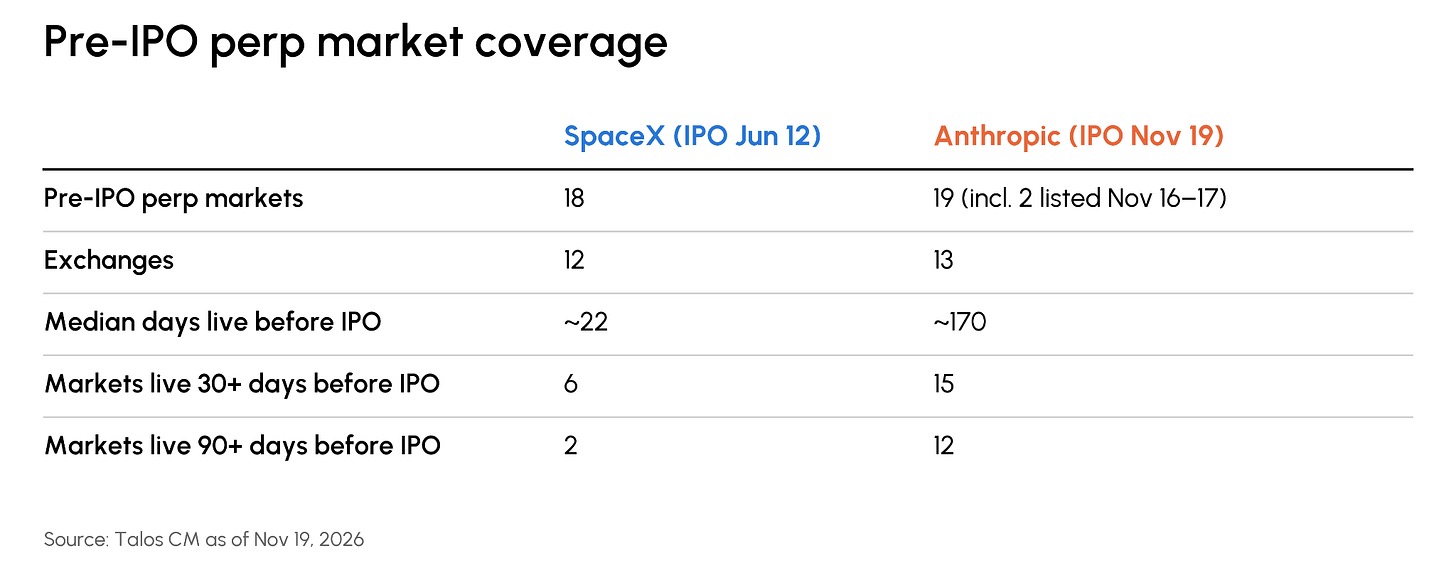
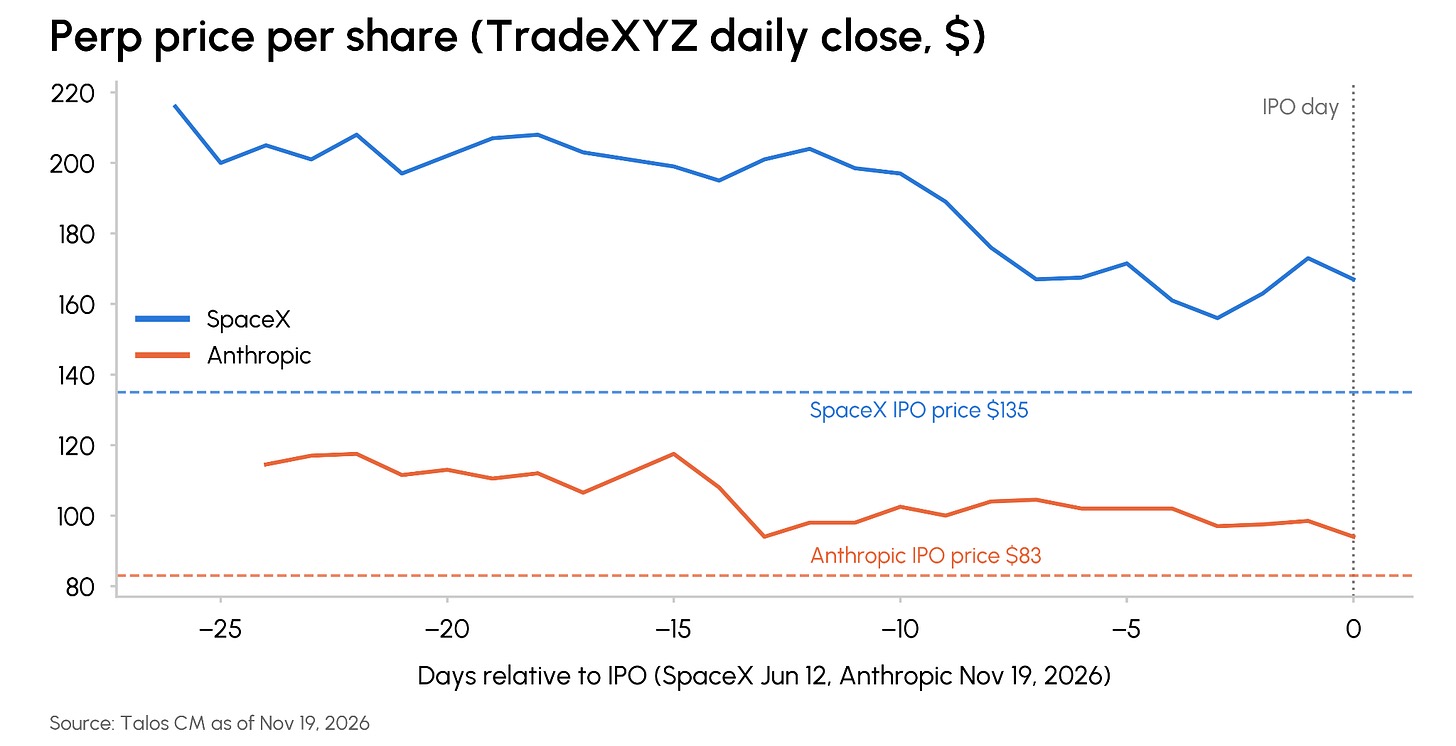
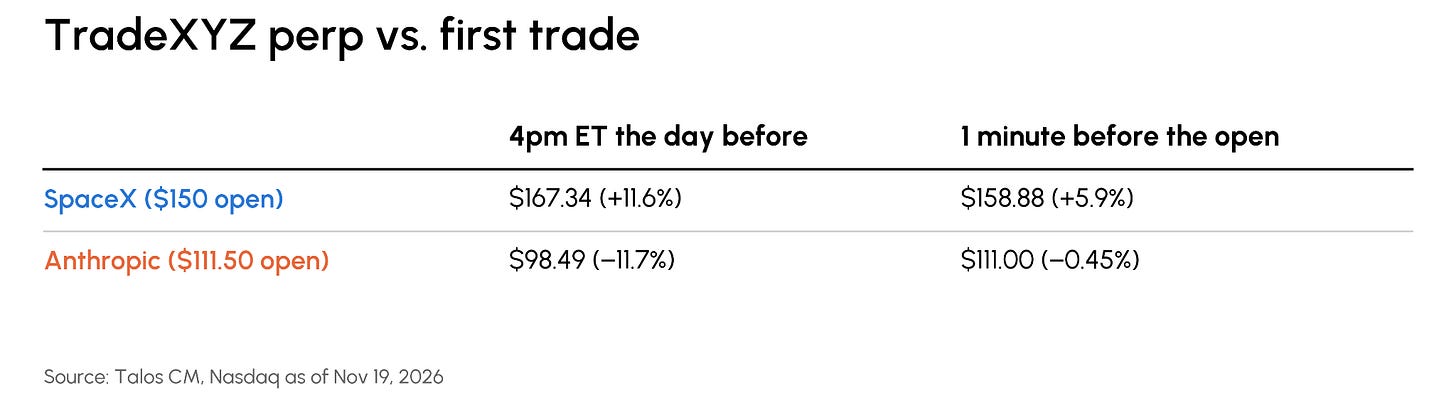
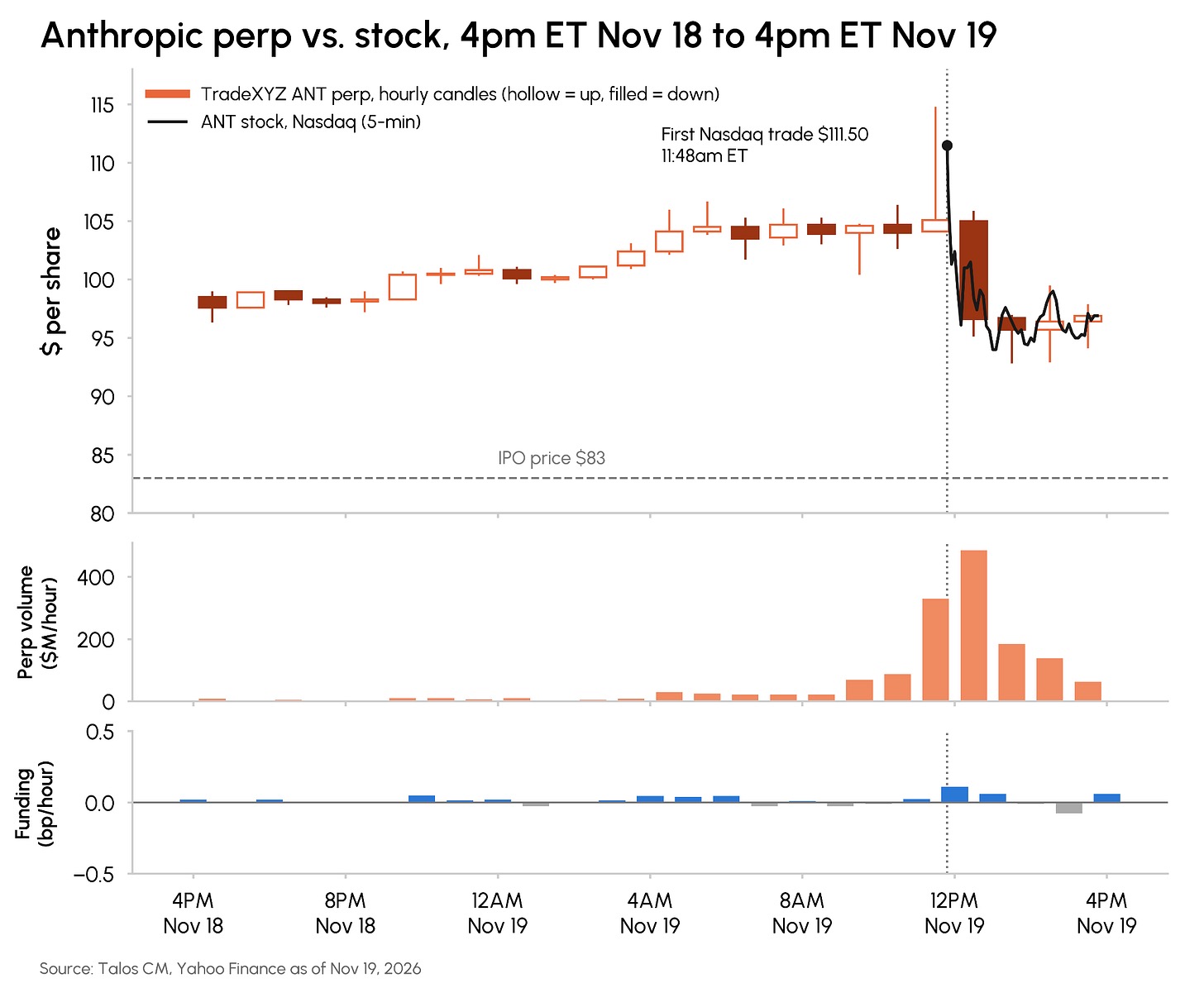
Author: Kelly Ye Source: Coin Metrics Translated by: Shan Ouba, Golden Finance Key Points The pre-market perpetual contract market has noticeably matured since the listing of SpaceX: The median trading period for Anthropic-related contracts before the listing was about 170 days (compared to 22 days for SpaceX), and the trading volume on the first day was $4.97 billion, which is 2.1 times that of SpaceX. Before the revised S-1 disclosure on November 10, there was fragmented pricing across platforms: quotes existed on a per-share basis, on valuation, and on the number of shares; after that, most exchanges shifted to per-share quoting. Perpetual contracts are better at predicting the true price than the IPO issuance price: Contracts settled at $98.33 on the day before listing, differing by about 1% from the first day close of $97.17. The closer to the opening, the more precise the contract pricing: It narrowed from about 12% off the previous night to 0.45% one minute before the first trade. There were no price gaps during the listing time and overnight trading: The first-day closing price of the contract was within 0.2% of the underlying stock, and the deviation from the pre-market quote the next day was also within 0.4%. However, Anthropic did not keep up with the rebound of the AI sector: From the close on November 20 to the close on November 23, its stock price fell by 1.0%, while Nvidia rose by 31% during the same period. Investors are questioning the returns from their AI investments, and some may be hedging their IPO floating profits. Introduction Earlier this month, our research "Countdown to ANT" detailed how crypto-native perpetual contracts priced Anthropic before Nasdaq opened. Anthropic was priced at $83 on November 18, above the revised range of $70–78; it opened at $111.50 on November 19, with a first-day close of $97.17. In this issue, we use SpaceX's June listing as a benchmark to compare the implied prices of perpetual contracts with the actual transaction prices of the underlying stocks: how large this market has become, how fragmented the quotes still are, how quickly new information is priced in, and how it responded on the day of the listing. A larger market, starting earlier By any measure, the scale of Anthropic's perpetual contracts exceeds that of SpaceX. Data Source: Talos CM market data, Talos analysis. Open interest snapshots are daily at UTC 00:00, merging markets from Binance and Hyperliquid builder. Data Source: Talos CM market data, Talos analysis. Trading volume is based on UTC all-day data. Binance (SPCXUSDT; ANTHROPICUSDT, changed to ANTUSDT from November 17) plus Hyperliquid builder market (SpaceX: xyz, vntl; Anthropic: xyz, io, para, vntl). Data Source: Talos CM market data, Talos analysis. Day 0 is the listing day. Open interest snapshots are daily at UTC 00:00. Two noteworthy differences: Active volume doubled on the listing day. Anthropic's perpetual contract traded $4.97 billion on the listing day, with $3.14 billion from Binance’s newly launched per-share ANTUSDT contracts. Post-listing positions remained intact. Anthropic's open interest increased from $519 million on the listing day to $620 million; SpaceX's slightly decreased from $420 million to $404 million on the same day. In just five months, pre-market perpetual contracts have evolved from experimental products to a market of billions of dollars. The number of contracts in Anthropic's market is roughly equivalent to that of SpaceX, but most have been trading for several months, not just a few weeks. Data Source: Talos CM reference data, Talos analysis. The statistics cover all pre-market perpetual contract markets for Anthropic and SpaceX listed in Talos CM (all exchanges), as of November 17, 2026. Prices are converging as well: After platforms switched to per-share quotes, the price differences narrowed to around 4% within the few days before the listing (between $95–99). The same company, multiple pricing rules. The same company has used several different metrics across different platforms: TradeXYZ (Hyperliquid) quotes on a per-share basis for Class A stocks. Entropy (Hyperliquid) quotes on a fully diluted valuation (in billions of dollars). Binance initially launched ANTHROPICUSDT with a placeholder of 1 billion shares and, two days before listing on November 17, migrated positions to the per-share valued ANTUSDT contract. OKX started with a 1 billion share placeholder and then adjusted the share count metric twice: on June 30, it was updated to 10 billion shares, and on November 12, it was adjusted to 13.12 billion shares; each time resetting the price, contract quantity, and opening price. After the revised S-1 disclosed share capital on November 10, platforms began to switch to per-share quoting: OKX reset according to S-1 share capital on November 12, and Deribit switched to per-share pricing on November 16. On November 17, MEXC adjusted its benchmark (from approximately $1,280 to $98), Binance migrated to ANTUSDT, and Bitget launched its own per-share contract. Until the day of listing, Entropy continued to quote based on fully diluted valuation. The result was: no unified price; adjustments to the share count benchmark made the open interest appear to plummet abruptly; liquidity was dispersed across five exchanges. As more companies take this path, establishing a consistent, platform-agnostic reference price for pre-market perpetual contracts will make these markets easier to compare and more straightforward for product development. Pre-market prices are a leading indicator of IPO pricing Two signals stand out: The revised S-1 brought the most concentrated trading. The busiest day before the listing was November 10, with a transaction volume of $615 million, on which the revised S-1 fixed the issue price range. The premium relative to the issue price predicted the true price better than the issue price itself. The day before the listing, contracts closed at $98.33, 18% above the $83 issue price, approximately 1% off the first day's closing of $97.17. SpaceX contracts were 28% higher than the $135 issue price and about 7% higher than the closing price of $161 on the first day. Source: Talos CM market data, Talos analysis. TradeXYZ's daily closing prices (UTC 00:00), with one contract corresponding to one Class A share. Day 0 is the listing day: SpaceX is June 12, 2026, and Anthropic is November 19, 2026. If based on the first transaction price, the conclusions are more nuanced: Source: Talos CM market data, Talos analysis. Pre-opening comparisons use TradeXYZ's 1-minute K-line, with the opening price taken from media reports. Percentages indicate the deviation of the contract price from the opening price of the underlying stock, with positive numbers indicating the contract is above the opening price. The night before, both contracts' deviations from the opening price were around 12%: SpaceX was on the high side, while Anthropic was on the low side. By the minute before the opening, Anthropic's deviation narrowed to 0.45%. Recent analysis from PANews also revealed that Cerebras and CXMT exhibited the same pattern: deviations of 12-14% the night before, converging to 1-3% at the opening. No rupture noted at the opening bell The moment of listing is the riskiest point for such contracts: inconsistent metrics or demand shocks could tear apart the price spreads. Anthropic did not see this: Before the first transaction. On the morning of November 19, the contract price continued to rise, quoted at $111.00 one minute before the first transaction at Nasdaq at $111.50. At the moment of opening. Contracts temporarily spiked to $114.73 in the first minute, then fell along with the underlying stock, retreating to about $105 by midday. The most active hour saw a transaction volume of $483 million. By the close. Contracts followed the underlying stock down, closing about 0.2% off Nasdaq's closing price of $97.17. Source: Talos CM market data (TradeXYZ hourly K-line, volume, and funding rate), Yahoo Finance (ANT 5-minute price), Talos analysis. The time frame is from 4:00 PM EST on November 18 to 4:00 PM EST on November 19. The hourly funding rate remained within ±0.11 basis points throughout, including several hours before and after the listing. From the second trading day to Monday: Following the underlying stock, but lagging behind the rebound. Anthropic’s listing coincided with a sharp drop: On the listing day, the Nasdaq index reversed from a 2% gain to a 2.25% loss, and the VIX rose to about 28. The underlying stock was not tradable overnight, so contracts continued to price it, deviating from the underlying stock’s first pre-market quote at 4 AM by within 0.4%, and only 0.2% from the November 20 opening price. Over the weekend and on November 23, AI stocks rebounded, but Anthropic lagged: It closed 1.0% lower on November 23 compared to the close on November 20, making it the only decline among the AI stocks we tracked; Nvidia rose 31% during the same period, and the Nasdaq 100 perpetual contracts rose 6.6%; its stock price fell another 2% after hours. There are two reasons. First, Anthropic is the most direct public sample to test whether AI spending can materialize: Its filing indicates a computing power commitment of hundreds of billions of dollars, with computing power consumption accounting for 55% of revenue in the first half of 2026. Second, its stock price remains above the $83 issuance price, and some investors may treat perpetual contracts as a 24-hour hedging tool, locking in some listing gains. The funding rate oscillated back and forth, with open interest maintained at about $550 million. Conclusion "Countdown to ANT" asks how pre-market perpetual contracts priced Anthropic. The answer is: the directional judgment was correct, narrowing the deviation to within 0.5% at the opening, without a dislocation during the listing — although this market remains fragmented by multiple calibers and across multiple platforms. Pre-market perpetual contracts now resemble an all-weather extension of the underlying stock, rather than a one-time bet around the listing. The next test is: Will the ANT contract maintain a premium or discount to the underlying stock; can each platform unify its per-share quotes from day one; and how will the next major listing — likely OpenAI — perform?
Details compiled from public sources. Always do your own research.