
Gold and Bitcoin Both Decline: How Much Reserve Buffer Does Tether Have Left?

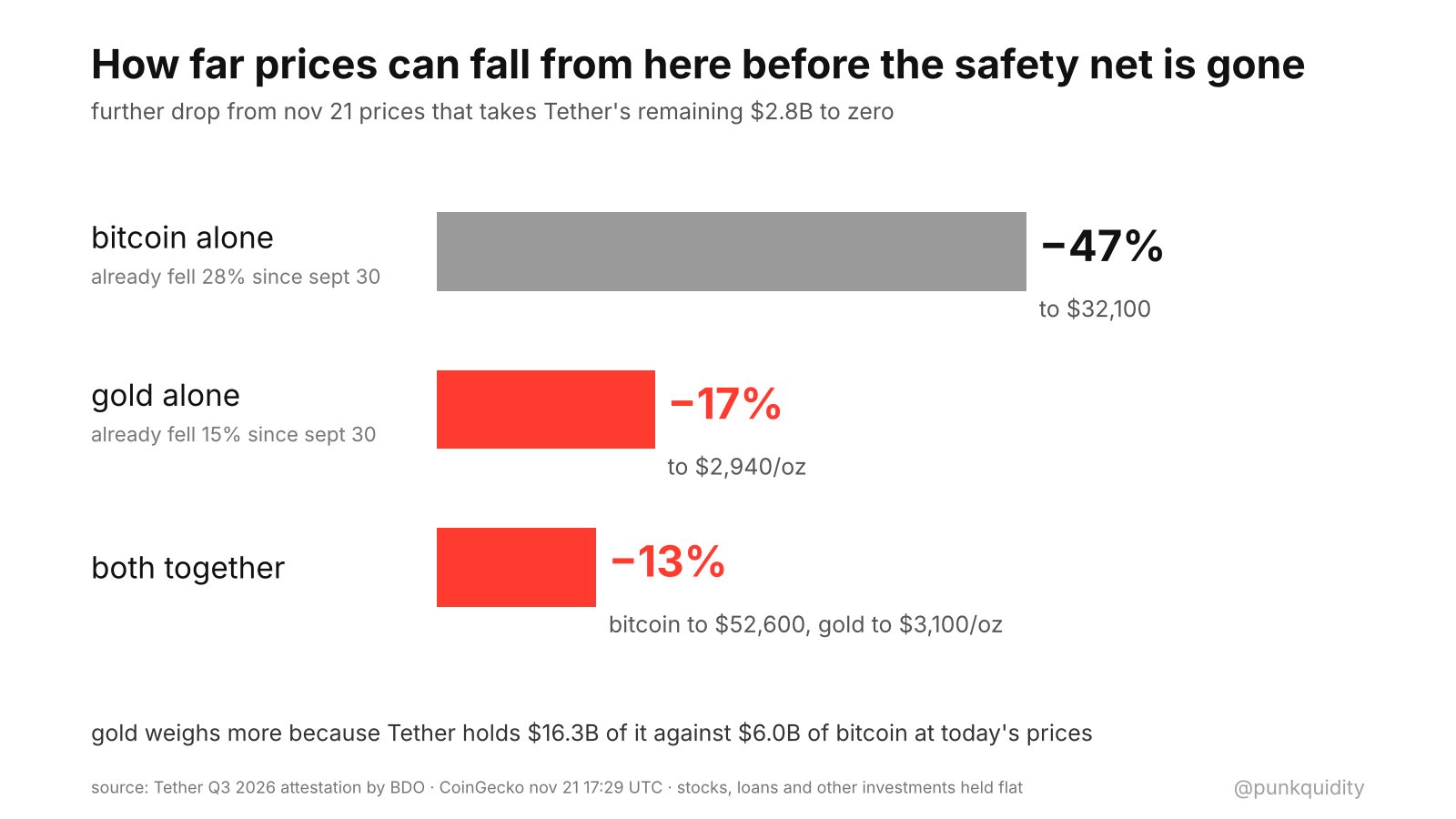
Tether's gold holdings are 2.7 times that of Bitcoin, and if gold drops another 17%, clearing the $2.8 billion reserve buffer, its reserves will fall below 100% coverage.
Machine translated. Refer to the original for accuracy.
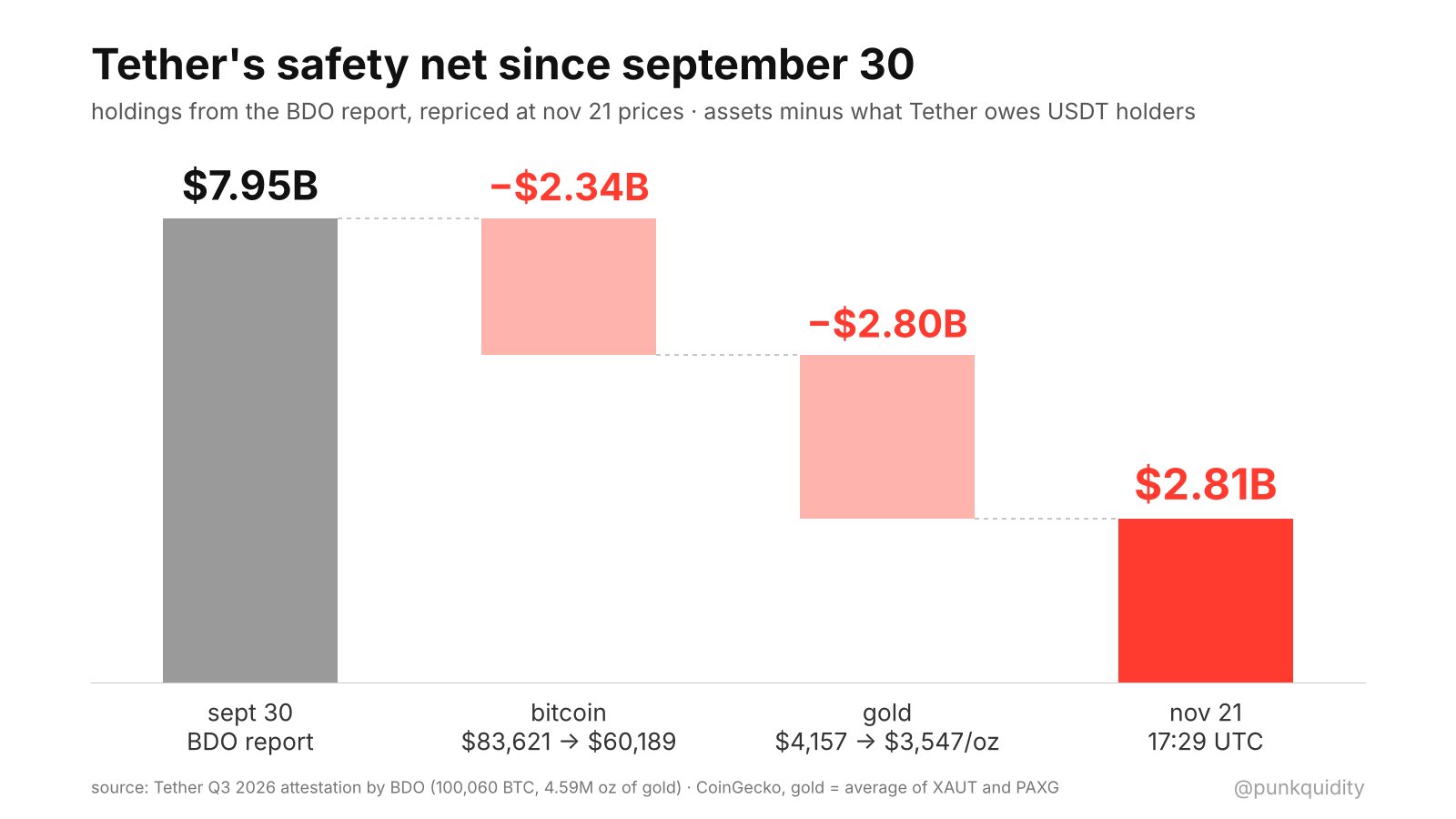
Author: punkquidity Source: X, @punkquidity Translation: Shano Ba, Jinse Finance As of September 30, @tether holds $7.95 billion more in assets than the liabilities it owes to $USDT holders. This extra amount serves as its cushion: Tether absorbs losses before any USDT holder loses a cent. At today's prices, this cushion has shrunk to about $2.8 billion. A widely circulated post on social media today claims that if Bitcoin and gold drop another 16%–20%, Tether will fall below full reserve. According to my calculations, both would need to drop 13% at the same time; however, the weight of the two asset classes is not the same: for every 1% drop in gold, the cushion decreases by about $163 million; for Bitcoin, it decreases by about $60 million. And this is a lenient calculation. It still values Tether's $4.18 billion in stocks at September prices, but the Bitcoin treasury company controlled by Tether, Twenty One Capital, has dropped 38% since then. TL;DR The $7.95 billion cushion in September is worth about $2.8 billion at today's prices. Gold contributed to a $2.8 billion shrinkage, and Bitcoin contributed $2.3 billion, as Tether holds $16.3 billion in gold and only $6 billion in Bitcoin. If Bitcoin maintains its current price and gold drops to about $2,940/ounce, the cushion will go to zero, equivalent to a 17% drop from today; if only Bitcoin drops, it needs to fall another 47% to about $32,100. This assumes Tether's $4.18 billion in stocks do not depreciate. If they drop like gold mining stocks or Twenty One Capital, the cushion will only be around $1.2 billion to $1.9 billion, and gold would only need to drop another 8%–12%. Tether's own real-time data shows $5.47 billion, which seems to account for Bitcoin's drop but not gold's. If you hold $USDT, redemptions are still functioning normally: $8.75 billion has been redeemed since September, with $USDT quoted at $0.9985. The real risk is that next January’s report shows a coverage ratio below 100%. Data is as of November 21, 2026, 17:29 UTC. Tether's September report was reviewed by the accounting firm BDO, prices are from @coingecko, and Bitcoin wallet data is from mempool.space; sources are listed at the end. What Tether Holds Tether releases a quarterly reserve report reviewed by BDO, the latest corresponding to September 30. On that day, Tether's liabilities were $183.5 billion, almost all owed to $USDT holders; assets were $191.45 billion. The difference of $7.95 billion is the cushion. Tether calls this “excess reserves,” while others refer to it as a “buffer.” Most of its assets are boring but safe: $139.6 billion is held in U.S. short-term Treasury bonds, collateralized short-term loans, and cash, covering 76% of its liabilities. The rest varies with market fluctuations: $19.08 billion in gold $14.18 billion in loans secured by other companies $8.37 billion in Bitcoin $6 billion in “other investments” $4.18 billion in stocks, reported to track gold, Bitcoin, and other assets. BDO's valuation on Bitcoin is $83,621 and for gold is $4,157/ounce, both as of the September 30 closing price. This means Tether holds 100.06k $BTC and 4.59 million ounces of gold, approximately 143 tons. This report is just a snapshot of that day; Tether has not released new data since. All calculations below are based on today's prices recalculated from these holdings. Where Did the $5 Billion Go? Since September 30, Bitcoin has fallen from $83,621 to $60,189, a 28% drop. Based on 100.06k $BTC, that amounts to a loss of about $2.34 billion. Gold has fallen from $4,157 per ounce to about $3,547, a decrease of 15%. With 4.59 million ounces, this results in a loss of approximately $2.8 billion. Combined, $5.14 billion has evaporated, leaving a reserve buffer of about $2.81 billion. At around 06:00 UTC today when Bitcoin was still near $55,700, this number was closer to $2.3 billion. Tether reported $8.23 billion at the end of March and $4.11 billion at the end of June, and today’s figures are below these two points. Why Gold Is the Price to Watch Tether is known for buying Bitcoin, but at today’s prices, it holds $16.3 billion in gold, compared to only $6 billion in Bitcoin. Thus, a 1% fluctuation in gold affects its reserves almost three times more than Bitcoin. 17% sounds like a lot, but gold has already dropped 15% over the last seven weeks. Gold needs to fall another 17%, to about $2,940 per ounce, to bring the reserve buffer to zero; it has already dropped 15% since September. Bitcoin would need to fall another 47%, to about $32,100; it has already dropped 28%. If both drop at the same time, a 13% decline would suffice, translating to about $52,600 for Bitcoin and about $3,100 per ounce for gold. In other words, gold needs to drop just $610 per ounce, the same magnitude it just lost; Bitcoin, on the other hand, needs to crash again after already crashing once, and by a larger magnitude. What Tether’s Own Data Indicates Tether’s website showcases September data, but the data source behind the page, app.tether.to/transparency.json, has a field called "shareholder_eq." As of November 20 at 23:59 UTC, this field reads $5.47 billion, down $2.49 billion from September, with a floating loss of less than about $6 million from 10,006 BTC at that time. This indicates that this field appears to account for the Bitcoin drop but not the gold drop. I found no explanation from Tether regarding this, so I don’t consider it a real number. If it indeed missed out on the gold, then it has overestimated the reserve buffer by about $2.8 billion, exactly the amount gold has dropped. Stock Holdings Make the Situation Worse The report does not specify what Tether’s $4.18 billion in stocks consist of, only stating that they provide “indirect exposure to gold, Bitcoin, and other assets.” Therefore, the calculations above have treated September valuations, which is already the loosest criterion. We at least know one: Tether International, which issues USDT, is the controlling shareholder of the Bitcoin treasury company Twenty One Capital (XXI), and the report counts all assets held by that company as part of reserves. XXI closed at $6.50 on September 30 and at $4.03 on November 20, down 38%; during the same period, the largest gold mining stock fund GDX fell 22%. If Tether’s stock falls between the two, the reserve buffer would need to decrease by another $900 million to $1.6 billion, leaving about $1.2 to $1.9 billion, with gold needing to drop 8%-12% to go to zero. What Factors Could Make the Situation Worse or Better Worse $14.18 billion in loans. The report does not specify what collateral they are secured by. If the collateral is crypto assets and the borrower cannot provide more margin, the losses will impact the reserve buffer. The gold market reopens on Sunday night, and the opening price could gap in either direction. Better Tether earns interest daily from short-term treasury bonds, generating about $1.5 billion in operating profit per quarter. But not all of this will go into the reserve buffer: this year, it has only increased by $1.14 billion in nine months. Tether's website states that other companies in the group also hold funds that do not belong to the reserves. This money may help, but USDT holders have no claim to it. Is Your USDT Safe? At least so far, those who want to exit can do so. Tether’s page shows that on November 20, the circulating amount of USDT was $174.7 billion, down $8.75 billion since September 30. Since mid-October, USDT has been trading slightly below $1, currently quoted at $0.9985. These redemptions will not reduce the buffer: Tether pays dollars, and an equivalent amount of $USDT is subsequently burned. Tether's primary Bitcoin wallet bc1qjas…c27a4 holds 96,932 $BTC, with its last outward transfer being 4 $BTC on July 10, which means there are no signs of liquidation from this wallet. Even if the buffer drops below zero, $USDT will not stop redeeming the next day: Tether still holds roughly 75% of its liabilities in short-term Treasuries, short-term loans, and cash. What truly changes with a negative buffer is the next report, which will show a reserve coverage ratio below 100%, and it is this type of report that will make large holders nervous. My judgment is: Holding $USDT today, redemptions continue as usual, primarily supported by short-term Treasuries; what Tether loses is the extra buffer space. If gold falls again, or stocks or loans face bad news, the next report will show insolvency. At that time, a slow orderly withdrawal could turn into a stampede. What I’m Watching I think the price of gold is more crucial now for $USDT holders. If it drops another $610, the same magnitude as the previous dip, the buffer will be depleted. Tether's next report is expected to be released around the end of January. Before that, I’m watching the line at $3,000/oz: at this price, assuming Bitcoin maintains its current price, the buffer will be down to about $300 million. My Calculation Process The holdings as of September 30 are from page 4 of the BDO report: Bitcoin $8,367,170,264, unit price $83,621.23; gold $19,084,651,736, unit price $4,157.41/oz. Prices are taken from CoinGecko's data as of November 21 at 17:29 UTC: Bitcoin $60,189, gold $3,547 (averaging $XAUT and $PAXG, since the gold market is closed on Saturday). Today's buffer = $7.95 billion - 100,060 × ($83,621 - $60,189) - 45,900 × ($4,157 - $3,547). Stocks, loans, and other investments are treated at their September 30 values in the main calculation. Stock ranges use Yahoo Finance closing prices: $XXI was $6.50 on September 30 and $4.03 on November 20 (−38%), GDX was $87.80 and $68.40 (−22%), and overall applied to $4.18 billion. GLD gold fund fell 15.2% from September 30 to November 20 close. If it’s used instead of $XAUT and $PAXG, the result would be about $100 million less. Profits and Buffer. Over 9 months, $4.5 billion in operating profit is reflected in the BDO report as $1.66 billion in total performance, with $519 million listed as "net capital flows," and the buffer increased from $6.81 billion to $7.95 billion. The circulation of $USDT uses Tether's own figures: $174.72 billion as of November 20, corresponding to the $183.47 billion issued as of September 30 in the BDO report. The 75% ratio assumes that $8.75 billion in redemptions is paid from $139.6 billion in short-term Treasuries, short-term loans, and cash. Tether's Bitcoin wallet bc1qjasf9z3h7w3jspkhtgatgpyvvzgpa2wwd2lr0eh5tx44reyn2k7sfc27a4 can be checked at mempool.space. Source Tether Q3 2026 Report (issued by BDO): assets.ctfassets.net/vyse88cgwfbl/7nQYtcoP9GxIUFSyro2dGK/8d0521470b9e99c8c0831019cabea4ee/ISAE_3000R_-_Opinion_Tether_International_Financial_Figure_30-09-2026.pdf Tether Q3 2026 Announcement: tether.io/news/tether-generates-1-5-billion-in-q3-net-operating-profit-as-reserve-buffer-doubles-to-almost-8-billion/ Tether Transparency Page tether.to/en/transparency and its data source app.tether.to/transparency.json Tether International, as the major shareholder of Twenty One Capital, announced on May 20, 2026: tether.io/news/tether-international-deepens-commitment-to-twenty-one-capital-through-acquisition-of-softbanks-stake/ Stock prices ($XXI, GDX, GLD) are from Yahoo Finance Figures from March and June 2026 are from Tether's earlier BDO reports, reported by Forkast and KuCoin News Prices are from CoinGecko Tether's Bitcoin Wallet: mempool.space/address/bc1qjasf9z3h7w3jspkhtgatgpyvvzgpa2wwd2lr0eh5tx44reyn2k7sfc27a4
Details compiled from public sources. Always do your own research.