
Analyzing the AI Project Venice: The Controversy Behind Its $200 Million Annual Revenue

Erik Voorhees, founder of the Base chain AI project Venice, stated that Venice's annual revenue has surpassed $200 million. Just two days later, Venice was accused of having security flaws in its core privacy protection mechanism. What kind of project is Venice, which is currently enjoying good news while facing controversy?
Machine translated. Refer to the original for accuracy.
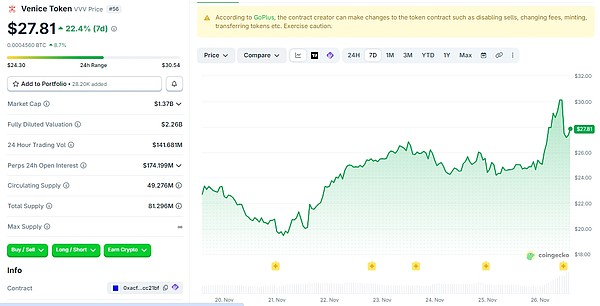
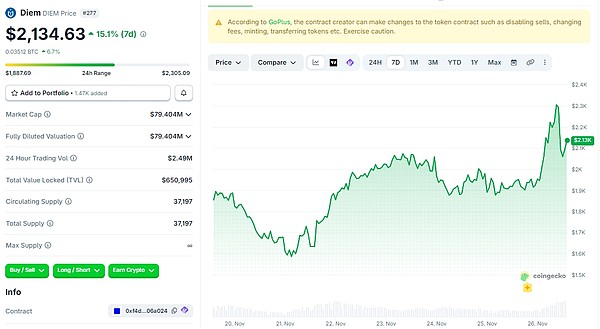
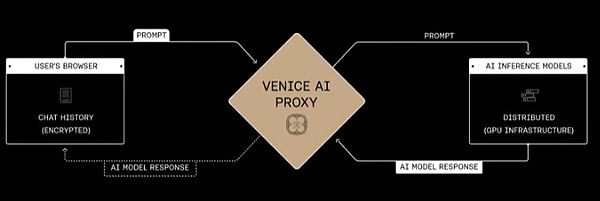
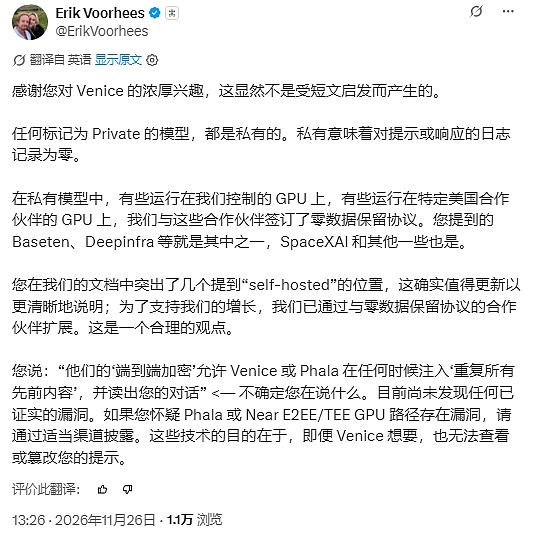
陶朱,金色财经 摘要:2026年11月24日,Base链AI项目Venice创始人Erik Voorhees表示,Venice年化收入突破2亿美元。仅两天后,Venice被指核心隐私保护机制存在安全缺陷。近期喜讯与争议并存的Venice是什么项目? 一、Venice项目概览 Venice由加密行业知名人士、ShapeShift创始人Erik Voorhees于2024年创立,并于2024年5月正式推出。与ChatGPT等传统AI产品不同,Venice将隐私保护和开放式AI作为核心卖点,强调不记录用户提示词、不在服务器上长期保存用户对话,以及尽可能减少内容审查对AI使用的限制。用户可以访问 200 多个领先的 AI 模型,涵盖文本、图像、视频和音频。 Venice的设计理念主要包括三个方面: 隐私保护:用户对话和创作内容主要保存在本地浏览器,不在Venice服务器上持久化存储。 开放式AI:为用户提供多种开源及商业AI模型,降低内容限制对使用体验的影响。 用户自主权:用户可以自主选择模型、使用AI工具,并通过API将相关能力接入自己的应用。 据Venice官网数据,自Venice推出以来,平台发展迅速: 350万注册用户; 每月处理 1.3 万亿个Token; 开发者每天发起 200 万次 API 调用,峰值超过 210 万次; 高峰期每小时 30 万次推理请求; 每月网站访问量约为 130 万至 160 万次,独立访客数量约为 85 万至 100 万。 代币经济也呈现同样的增长趋势。目前已销毁3370万枚VVV代币,约占总供应量的42%。7月1日起,VVV的年发行量将从400万枚降至300万枚,随着需求的增长,供应也随之收紧。 二、Venice代币经济模型 与传统AI平台的不同,Venice将区块链代币引入AI服务体系。目前,其生态主要涉及两种代币:VVV和DIEM,两者均部署在Base网络上,承担不同的经济功能。 Venice选择在Base上发行VVV和DIEM,因为Base拥有低成本交易环境和成熟的链上基础设施。此外,Venice支持通过Base上的USDC进行x402支付,使AI Agent能够直接使用加密资产购买模型推理服务。 1. VVV VVV于2025年1月27日正式推出,是 Venice 的基础资产,初始供应量为1亿枚,主要承担生态权益、质押收益和DIEM发行等功能,旨在驱动可编程 AI 经济。用户可以质押 VVV 以赚取收益,也可以锁定已质押的 VVV (sVVV) 来铸造 DIEM,然后质押 DIEM 以获得每个代币每天 1 美元的 API 信用额度。DIEM 使 AI 计算能力可拥有、可交易和可转让,因此计算能力可以在代理、机器人和应用程序之间转移,或者在不出售 VVV 的情况下实现货币化。VVV 是 Venice 市场的基础,而 DIEM 是其计算单位。 VVV 代币初始供应量为 1 亿枚,分配如下:50% 通过空投发放给 Venice 用户和 AI 社区,35% 用于Venice.ai 的开发和增长,10% 用于激励基金以支持生态系统发展,5% 用于提供流动性。VVV 的年度发行量最初为 1400 万枚,此后多次减少;截至 2026 年 10 月 1 日,年度发行量为 200 万枚。 In April 2026, Venice further announced a programmatic buyback and burn plan: for every new Pro, Pro+, and Max subscription generated, $2, $5, and $10 worth of VVV would be automatically used for purchase and destruction, respectively. In July 2026, the project announced an extension of the buyback and burn mechanism to the API points purchase business, whereby $5 would be allocated to purchase and destroy VVV for every $100 spent on API points. On November 26, on-chain data showed that a wallet potentially associated with Venice founder Erik Voorhees deposited 81,463 VVV into Coinbase, valued at approximately $2.25 million. This wallet currently also stakes around 675,000 VVV, worth about $18.45 million. The transfer to the exchange may draw market attention to its potential selling behavior, but it is currently unconfirmed whether the related tokens have actually been sold, and whether the wallet indeed belongs to Erik Voorhees. As of the time of writing, VVV tokens are priced at $27.81, with a 22.4% increase over the past seven days. 2. DIEM On August 20, 2025, Venice officially launched DIEM, attempting to address the challenges of transferring and trading AI service usage rights. VVV holders can mint DIEM using their staked VVV (sVVV). The specific process is as follows: Lock sVVV to mint DIEM at the current minting rate; During the locking period of VVV tokens, users can still earn 80% of the normal staking rewards; Stake DIEM to earn $1 worth of API points daily, the value of which remains unchanged; Destroy DIEM at any time to unlock sVVV and retrieve the original tokens. DIEM is an ERC20 token on the Base platform, allowing transfers, trading, and staking. However, they can only be created by locking sVVV, making VVV the underlying asset for all tokenized intelligence within the Venice ecosystem. DIEM has three main functions: Access AI services: After staking DIEM, each DIEM can provide $1 worth of API usage per day; Free trading: DIEM is an ERC-20 token on Base that can be transferred, sold, or purchased by other developers or AI Agents; Unlock VVV: Users can destroy DIEM to unlock the previously locked sVVV used for minting DIEM. As of the time of writing, DIEM tokens are priced at $2134.63, with a 15.1% increase over the past seven days. 3. Features of Venice's Products 1. Privacy Protection Protecting user privacy is one of Venice's core principles. The platform's architecture is constructed based on this concept, with every component designed continually around this goal. The Venice API uses the same backend privacy architecture as the Venice platform: all requests are transmitted via encrypted connections through the Venice proxy; during the regular inference process, Venice does not store or log any prompts or responses; in addition, for each selected model, the system offers four privacy modes at runtime: Anonymous, Private, Trusted Execution Environment (TEE), or End-to-End Encryption (E2EE). The Venice proxy serves as the common foundation for various privacy modes. Requests are forwarded through Venice via HTTPS/TLS protocols, and Venice does not store any prompts or response content. Subsequent processing by the model provider or at the model runtime level depends on the chosen model's privacy mode. Venice offers four privacy modes for models. These modes are all built on the same proxy foundation, progressively strengthening protection measures—hiding user identities from model providers, then achieving end-to-end encryption of prompts and sending them into certified secure execution environments (enclaves) for layered security. Venice also provides different levels of privacy protection solutions, including anonymized access, private models, Trusted Execution Environments (TEE), and end-to-end encryption (E2EE). Among these, TEE protects the model inference process through hardware-isolated environments; E2EE further emphasizes client-side encryption, ensuring that the request content can only be decrypted by the corresponding trusted execution environment. 2. API Services for Developers In addition to AI applications aimed at general users, Venice also provides API services that enable developers to integrate its AI capabilities into other products. The Venice API is compatible with the OpenAI SDK, allowing developers to call Venice models in their existing development framework by modifying the API address and key, reducing migration costs. The API supports not only text dialogue but also involves functions such as image generation, audio, video, vector embeddings, and provides developer tools like web search, web scraping, and document parsing. In terms of payment, Venice supports using x402 for API calls through USDC on the Base or Solana networks, allowing users to pay on a per-request basis without needing to register an account. This enables Venice to serve not only general AI users but also provide model inference capabilities for AI Agents, automation programs, and other on-chain applications. 4. Recent Controversies Facing Venice On November 26, Venice was accused of having flaws in its end-to-end encryption mechanism while routing a large number of user prompts to third-party service providers for processing. According to Sulat, KTibow pointed out that among the 18 image models listed by Venice on OpenRouter on November 21, 14 were actually hosted by Baseten, DeepInfra, Fireworks, or Parasail. Based on Venice's own application configuration, Hunyuan Image 3.0 operates on the fal platform. Additionally, Qwen3.5-397b has looped back through OpenRouter in 32 out of 40 requests, before being moved to DeepInfra between November 22 and 24. Venice's privacy policy page allows for the use of "zero data retention partner infrastructure," so the claim of "being hosted by third-party providers" does not alone constitute direct evidence of a breach of its privacy policy. However, this contradicts the "self-hosting" claimed on Venice’s official homepage; if these third-party hosts have not signed the "zero data retention" agreement promised by Venice, this issue becomes particularly significant. In terms of encryption, KTibow stated that of the 21 data tables in the Venice application database, 7 were unencrypted, and keys were stored in plaintext; moreover, a storage area named "venice-rx-db-encrypted" contains 31 collections, none of which are encrypted. They also noted that the end-to-end encryption protocol actually allows Venice or Phala to read or inject messages. These doubts directly involve Venice's core product selling points regarding user privacy and data security. So far, the information primarily comes from KTibow's one-sided accusations, and there have been no disclosed issues of user privacy breaches by Venice. In response to external accusations, Venice AI founder Erik Voorhees addressed concerns over its privacy protection mechanism by stating that all models marked as "Private" do not record user prompts or model replies. Some related models operate on Venice's own GPUs, while others run on GPUs from US partners with whom they have signed zero data retention agreements, including Baseten, DeepInfra, and SpaceXAI. Voorhees acknowledged that certain parts of Venice's documentation still describe the models as "self-hosted," a statement that needs updating to more accurately reflect their current capabilities being expanded through partnerships. Regarding external concerns that the end-to-end encryption mechanism might be exploited to read or tamper with user conversations, he stated that there is currently no evidence proving such vulnerabilities exist and called on researchers who discover vulnerabilities related to Phala or NEAR’s encryption and trusted execution environment (TEE) GPU channels to disclose through proper channels. He emphasized that the design intent of the relevant technologies is to ensure that even Venice cannot view or alter user prompts.
Details compiled from public sources. Always do your own research.