
DeepSeek Financing List Exposed: 31 All-Star Lineup
Hangzhou DeepSeek completes a new round of industrial changes with 31 institutions indirectly investing through Hangzhou Chengyan, Tencent and CATL as the largest external investors, and Liang Wenfeng's total shareholding remains about 67.42%, with control unaffected.
Machine translated. Refer to the original for accuracy.
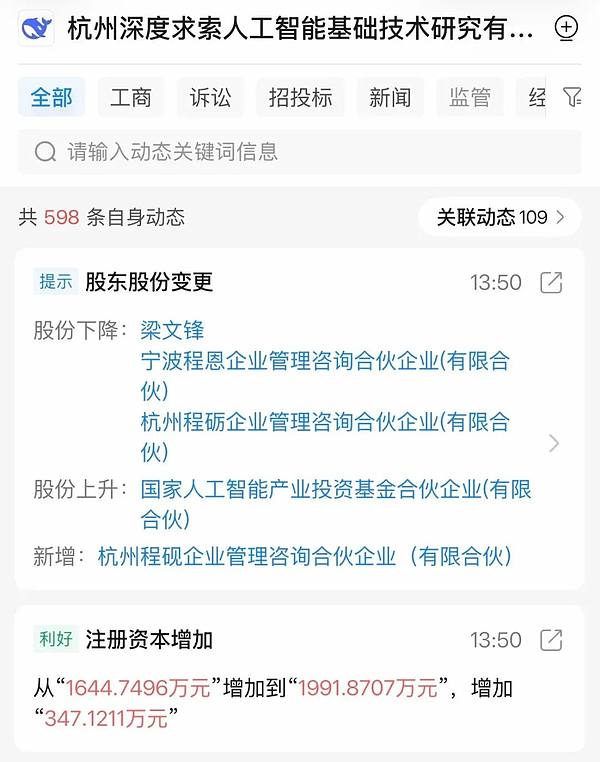
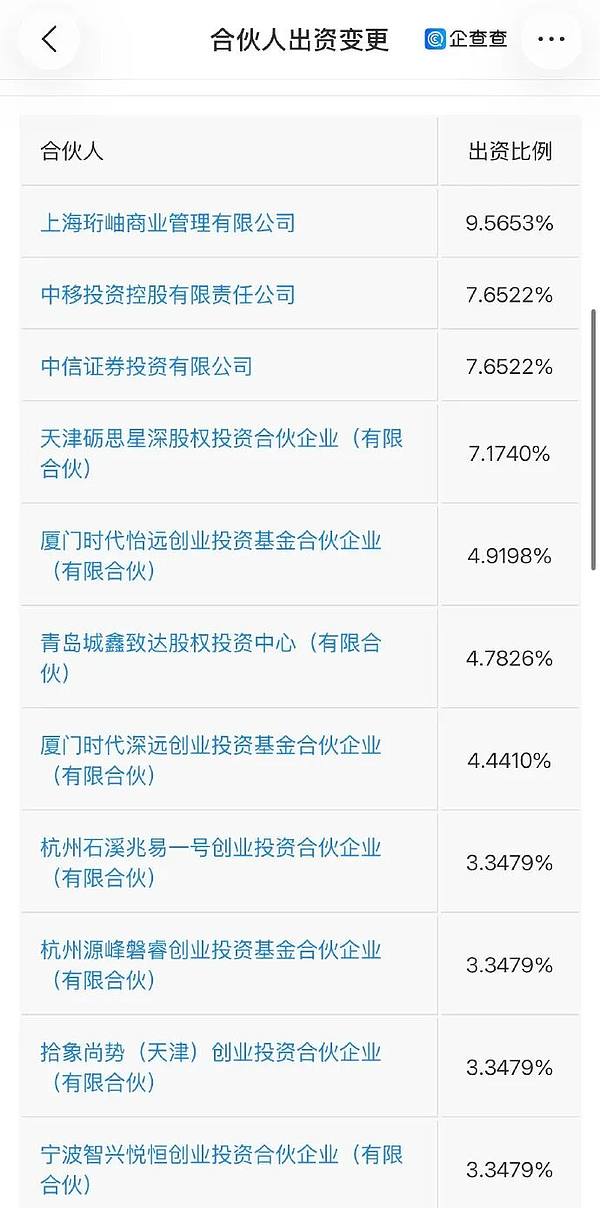
Money comes in, but tickets don’t—this is the first collective stance of the Chinese AI industry chain. — Written after the list of 31 names surfaced On November 17, Hangzhou DeepSeek AI Technology Research Co., Ltd. completed an industrial change. The registered capital jumped from 16.4475 million yuan to 19.9187 million yuan, an increase of 21.1%, with a newly added shareholder being a newly established holding platform—Hangzhou Chengyan Enterprise Management Consulting Partnership. What really made waves in the investment circle was not this number, but what lies beneath it: the registered capital contribution of Hangzhou Chengyan surged from 6,000 yuan to 3.439 billion yuan, with 31 new partners added in one go. A list that nearly names the entire upstream and downstream of China’s AI industry chain at once. First, let’s stabilize the numbers Note: Reports regarding amounts and valuations must be prefixed with—market estimates, not officially confirmed by DeepSeek. Under this premise, the mainstream figures are as follows: Funding in this round: 105.5 billion yuan Post-investment valuation: 615.5 billion yuan First round funding (June 2026): 51 billion yuan Approximate post-investment valuation for the first round: 400 billion yuan Over 150 billion yuan absorbed in four months combined — Data from Qichacha Business Change Record: Registered capital and shareholder equity changes in sync In two rounds, capital absorption exceeded 150 billion yuan within four months, breaking China’s single funding record in the AI sector. What can be confirmed through business records is that Hangzhou Chengyan holds 17.265% of DeepSeek, making it the third-largest shareholder; the largest shareholder, Ningbo Chengen, holds 49.70%, and Liang Wenfeng directly holds 25.60% (diluted by about 5.4 percentage points compared to before the change). Beyond numbers, it’s more worth watching who is on the list and how they come in. Second, 31 entities are not scattered soldiers but five camps Arranging by Hangzhou Chengyan’s contribution ratio reveals a very clear structure: — Change in partner contributions: Overview of the contribution ratios of 31 institutions First tier: Internet + New Energy dual core Tencent’s Shanghai Hengxiu 9.5653%, CATL through its three funds Xiamen Shidai Yiyuan, Shidai Shenwei, and Fujian Shidai Zeyuan collectively 9.5653%, making them co-largest external investors. Back-calculating from 105.5 billion yuan suggests about 10 billion yuan per entity. Tencent’s cumulative investment has reached 20 billion yuan while CATL increased from 5 billion in the first round to 10 billion in this round. Second tier: State team + Securities firms China Mobile Investment Holdings, CITIC Securities at 7.6522% each; China Life related entities at 4.78%; China Telecom at 2.87%; Zhongjin Hegang and Zhongjin Pucheng are also included. According to Shanghai Securities Journal, at least nine securities firms are indirectly involved, contributing approximately 9.52 billion yuan in total. The state-owned capital only accounted for about 2% in the first round but jumped to around 27% in this round. Third tier: End-users and manufacturing Vivo at 2.87%, Midea 2.87%, Luxshare Precision 2.77%, Zhaoyi Innovation 1.43%, Geely 0.96%, and SMIC at 1.60%, along with Hangzhou Shixi Zhaoyi No.1 affiliated with Shixi Capital at 3.35%. Hardware fronts covering mobile phones, home appliances, automotive contract manufacturing, storage, and wafer equipment are basically all represented. Fourth tier: Internet scenarios Meituan Longzhu 2.87%, NetEase LeiHuo 2.39%, Shanghai Kehui affiliated with Ctrip at 1.43%, Xiaohongshu (Xingyin Information) 0.96%. These four names answer the same question—where to land after model training. Fifth tier: Familiar faces in the primary market Lisi 7.17%, Boyu 3.35%, CPE Yuanfeng 3.35%, Zhengxin Valley 3.35%, Shixiang 3.35%, IDG 3.32%, Gaorong 2.87%, Junlian 2.87%, Hongzhuo 1.43%, and Hengdian Capital 1.43%. Notably, Lisi, IDG, Zhengxin Valley, and Shixiang participated from the first round and secured priority quotas this round. Representative investors from the camps: Internet + New Energy: Tencent, CATL State team + Securities: China Mobile, CITIC, China Life, 9 securities firms End-users and manufacturing: Vivo, Midea, Luxshare, Geely, SMIC Internet scenarios: Meituan, NetEase, Ctrip, Xiaohongshu Familiar faces in the primary market: Lisi, IDG, Zhengxin Valley, Shixiang Upstream chips, midstream computing power, downstream scenarios, and the state team stands beside. Third, more critical than "who invested" is "how they invested" None of the 31 external shareholders appears directly on DeepSeek's shareholder roster. All shares are indirectly held through Hangzhou Chengyan, whose executive partner (GP) is Hangzhou Chengce Business Consulting Co., Ltd.—Liang Wenfeng holds 99% of this company. Liang Wenfeng himself has even withdrawn from the direct partner list of Hangzhou Chengyan, retaining control only at the GP level. — Liang Wenfeng: The money has come in, but control has not changed one bit. "Translated, this means: The money has come in, but the票 hasn’t come in." The 31 institutions hold the status of limited partners (LP), enjoying financial profit rights but not voting rights and not entering the board of directors. According to the Securities Times' calculations, after this round of financing, Liang Wenfeng's total direct and indirect shareholding remains about 67.42%, and the influx of hundreds of billions in capital has not shaken control one bit. In today's financing market, this stance is extremely rare. According to feedback from investors in contact with the Daily Economic News, institutions trying to negotiate terms have basically been told "there is no room for negotiation." In the past, investors selected projects; this round, projects are selecting investors—one must pass through rigorous scrutiny, accept a long lock-up period, and relinquish governance rights to qualify for entry into this shell. The only exception: The National Artificial Intelligence Industry Investment Fund directly invested in DeepSeek, holding 0.39%. IV. What Does This List Bet On? If we re-arrange the 31 institutions by “what they are here for,” the logic emerges: Computing Power and Energy CATL, SMIC, Zhaoyi Innovation, and Shixi—the next phase bottleneck for large models is not in algorithms, but in electricity and chips. Cloud and Government-Enterprise Channels China Mobile, China Telecom, and China Life—determine how many government and enterprise server rooms the model can access. End Devices Vivo, Midea, Luxshare, and Geely—the model needs to grow a body and must first integrate into mobile phones, home appliances, and cars. Scenario Traffic Tencent, Meituan, Xiaohongshu, NetEase, and Trip.com—daily active users are the true consumers of inference computing power. Capitalization Channels CITIC Securities, CICC, and at least 7 brokerages—resource pre-burials before the IPO. Industrial capital accounts for over 50% of funding, making it the absolute main force in this round. It's not about money seeking models; it's about the industrial chain seeking hubs. This is completely different from the financing structure of the "financial capital chasing hot spots" wave in 2023-2024—this time, it's not money seeking models; it's the industrial chain seeking hubs. "DeepSeek is already seen by the market as a hub that drives the joint operation of domestic computing power, energy, and application ecology." The list of 31 institutions is a manifestation of this judgment. V. The Step Not Yet Fulfilled Business registration ≠ Financing announcement, Financing announcement ≠ Listing. Currently, the only confirmed fact is that CITIC Securities has entered for listing preparations, but the formal guidance agreement and Zhejiang Securities Regulatory Commission's filing have not yet completed the process. The market rumors of "trillion-dollar valuation" and "Hangzhou’s second trillion-dollar listed company" are expectations projected by institutions based on a valuation of 615.5 billion, not pricing. Note: What to truly observe are three things: 1. When will the official confirmation of 105.5 billion / 615.5 billion occur—currently all are based on reverse deductions. 2. The rhythm of computing power procurement—out of 150 billion, the bulk invested in computing power, the supplier list will explain the strategic direction better than the shareholder list. 3. Whether the GP/LP structure can pass the Sci-Tech Innovation Board review—the highly centralized control + 31 LPs without voting rights is the most need-to-explain segment in the prospectus. China's AI industrial chain has collectively aligned for the first time. The value of this 31-person list lies not in "how much money was raised," but in "who is willing to give money without taking votes." When Tencent, CATL, China Mobile, CITIC, Meituan, Geely, Midea, and Vivo are willing to squeeze into a shell controlled exclusively by the founder and still feel the slots aren’t enough— "This vote cast with real money by the market is more honest than any valuation number." As for trillions and listings, that is the next chapter's business. The title of today’s chapter has already been written: China’s AI industrial chain has collectively aligned for the first time.

Details compiled from public sources. Always do your own research.