
After the treasury companies' buying spree halted: who has sold coins and who will be forced to sell?
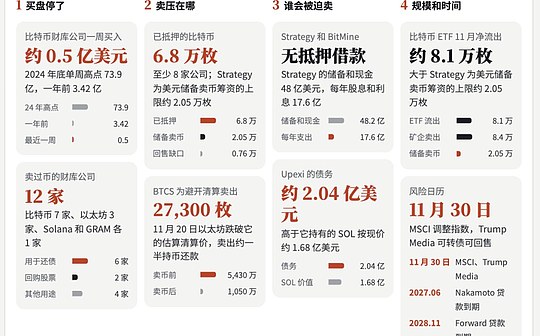
The buying activity of treasury companies has essentially come to a standstill, with selling pressure triggered by debt maturities and collateral ratios, and the scale remains smaller than ETF outflows.
Machine translated. Refer to the original for accuracy.
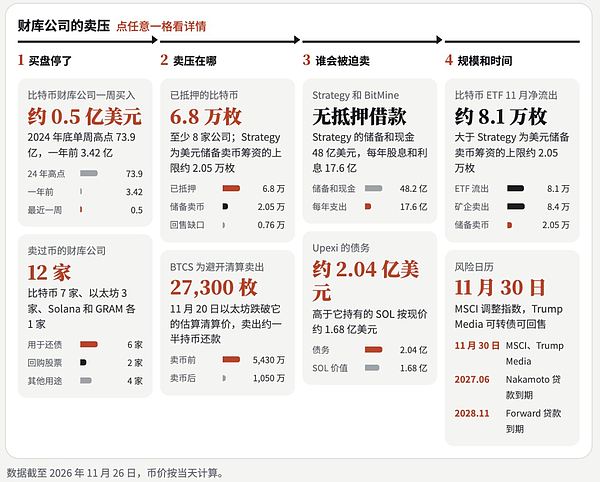
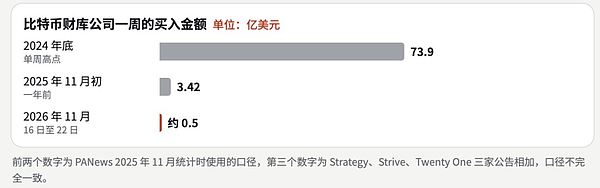
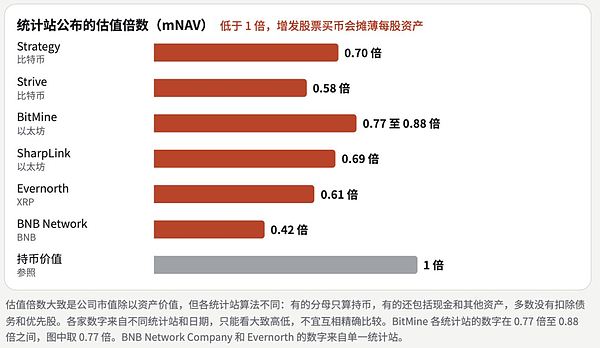
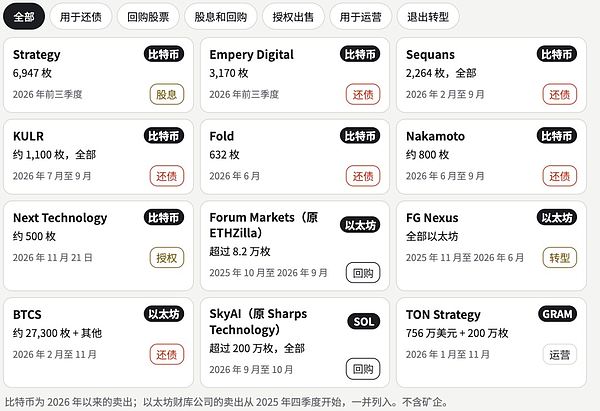
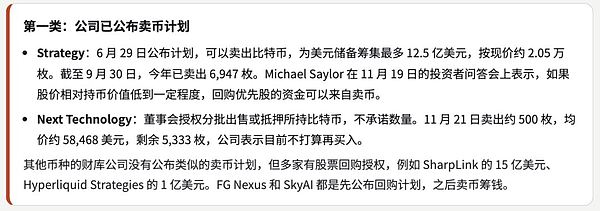
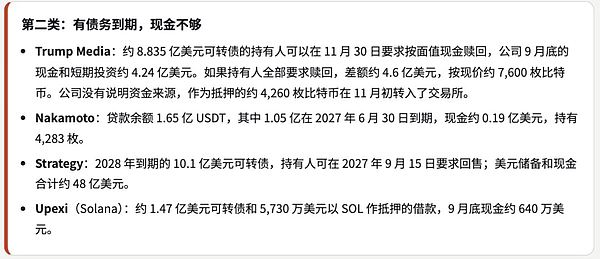
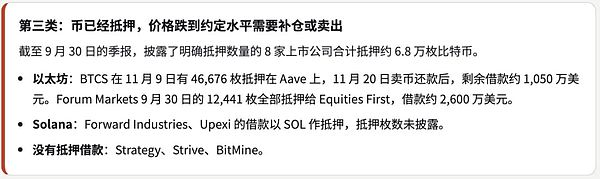
Author: Frank, PANews During the last round of price increases, listed companies were among the most stable buyers in the crypto market. They issued stocks and bonds to buy Bitcoin, Ethereum, Solana, and other tokens, and then relied on rising coin prices to boost their stock prices and continue financing purchases. By November 2026, listed companies held approximately 1.3 million Bitcoin, 7.5 to 7.9 million Ethereum, and about 19 million SOL, which represented about 6%, 6%, and 3% of their respective circulating supplies. Currently, the market capitalization of these companies is generally lower than the value of their holdings, and most have stopped buying while some have started selling. For investors holding coins, the question becomes: how much of the coins in the hands of these companies may turn into selling pressure, and at what price and time will they sell? PANews has sorted through the announcements and quarterly reports of treasury companies holding major cryptocurrencies such as Bitcoin, Ethereum, Solana, HYPE, BNB, XRP, and GRAM, categorizing potential sell-offs into three types and compiling known trigger prices and times. Note: In this article, "collateral" refers to pledging coins to lenders as guarantees, while "staking" refers to token participation in network validation. Coin prices as of November 26: Bitcoin at approximately $61,000, Ethereum at approximately $1,700, and SOL at approximately $71. Overview: Buying has stopped, selling is triggered by debt and collateral ratio, scale is smaller than ETF outflows. Buying activity: Most companies have stopped buying; those still buying are doing so in small amounts. In terms of Bitcoin, the main companies still announcing weekly purchases are Strategy, Strive, and Twenty One. From November 16 to 22, Strategy bought 457 coins, approximately $29.6 million; Strive bought 251 coins the previous week; and Twenty One bought 172 coins on November 20. About 95% of the newly added Bitcoin over the past year came from Strategy and Strive. For Ethereum, BitMine, which holds the most coins, is still buying, but the scale has decreased. From November 16 to 22, they increased their holdings by 7,819 coins, while a year ago they were buying about 70,000 to 100,000 coins weekly. The second-largest holder, SharpLink, has approximately 895,000 coins, and their main recent action has been stock buybacks. Regarding Solana, Forward Industries increased their holdings by approximately 226,000 coins from October 1 to November 9, DeFi Development has bought for nine consecutive weeks, and Solana Company used $15 million to buy about 125,000 coins in the third quarter. At current prices, these transactions total less than $30 million. HYPE is the exception. Hyperliquid Strategies increased their holdings from approximately 18.83 million coins at the end of March to 38.52 million coins at the end of September, with no liabilities, and approximately $255 million in cash at the end of September. Major treasury companies holding BNB, XRP, and GRAM have not seen significant increases in their holdings in recent months. The reasons for reduced buying activity are consistent: stock prices are below the value of their holdings. In this situation, issuing stocks to buy coins results in fewer coins per share. There is also not much cash available for direct coin purchases. In terms of Bitcoin, Strategy has approximately $1.09 billion in cash, Strive has about $490 million, and Twenty One has about $83 million, totaling approximately $1.67 billion, or about 27,000 coins at current prices. Strategy has an unused issuance quota of about $43.2 billion, but in the past week, it sold $176.7 million of common stock, of which only about $30 million was used for buying coins, with the rest used for repurchasing preferred stock. Already sold: most for debt repayments, some companies are selling coins to repurchase stocks. According to Lookonchain statistics, as of November 10, 14 listed companies have sold 108,247 Bitcoin this year, totaling approximately $8.08 billion, of which about 78% came from mining companies, with MARA and Riot accounting for approximately 60,800 coins. In treasury companies, Bitcoin, Ethereum, Solana, and GRAM have already been sold by various companies. The sale of Bitcoin by treasury companies primarily occurs due to debt maturities or insufficient collateral ratios; many other token sales happen when stock prices fall below the value of the tokens held, leading companies to sell tokens to repurchase stocks. SkyAI sold off approximately 2 million SOL, FG Nexus sold all of their Ethereum, and Sequans and KULR sold all of their Bitcoin. Twelve treasury companies that have sold tokens: Three types of selling pressure: planned token sales, debt maturities, and pledged tokens. PANews categorizes potential sales into three types based on determinism. There is overlap among the categories, and they cannot be summed up. · Planned token sales · Debt maturities · Pledged tokens Eight publicly listed companies disclosed the quantity of pledged tokens, measured in Bitcoin. Tokens in staking do not belong to these three categories but can affect the speed of sales. BitMine has about 86% of their Ethereum staked, SharpLink has nearly all of their Ethereum staked, TON Strategy has approximately 99% of GRAM staked, and Hyperliquid Strategies has all of their HYPE staked; exiting staking requires a queue, and cannot be sold the same day. Triggering price: A Bitcoin loan has dropped below the liquidation line, prompting BTCS to sell half of its Ethereum to avoid liquidation. Collateral loan contracts specify the margin call and liquidation lines. Three transactions with specific figures have been disclosed: Empery Digital's Bitcoin loan, BTCS's Ethereum borrowing on Aave, and Forward Industries' SOL collateral loan. According to BTCS's borrowing and collateral estimates on November 9, when Ethereum drops to about $1,717, its borrowing on Aave will enter a liquidatable state. On November 20, Ethereum fell to about $1,561 intra-day, and BTCS sold approximately 27,300 tokens, about half of its holdings, generating $43.8 million all used for repayment. The remaining borrowing is about $10.5 million, with a loan-to-value ratio of about 32%. The company stated this was done to reduce the risk of liquidation. Unlike traditional bank loans, Aave's liquidations are automatically executed by on-chain contracts without a negotiation period. For Empery Digital's Bitcoin loan, based on 765 pledged tokens and $35 million borrowed disclosed on November 5, the current price has already fallen below the contract's liquidation line. The company has not announced any additional collateral or repayments, and the actual status will have to wait for the next disclosure. Forward Industries' SOL collateral loan estimates that when SOL falls to about $62, it will hit the margin call line. According to quarterly reports or announcements disclosing pledged quantities and loan balances, not accounting for subsequent additional collateral, repayments, and derivative positions, it does not represent the current actual collateral ratio for each company. Multiple margin calls or token sales for collateral ratios have already occurred this year: in February, Fold added 50 Bitcoins, Empery added 576 Bitcoins, and Nakamoto added 688 Bitcoins before selling tokens for repayments; BTCS sold Ethereum three times in February, the second quarter, and on November 20 to repay its Aave loans. Whether companies have added collateral or repaid after quarterly reports will have to wait for the next announcement. Largest holders: Strategy and BitMine are not forced to sell in the short term. Strategy holds 851,305 Bitcoins, at an average cost of $75,446, currently showing a floating loss of about $12.4 billion. BitMine holds 6,085,564 Ethereum, accounting for about 4.98% of the total supply, currently valued at about $10.4 billion, roughly half of its acquisition cost. Both companies do not have collateralized loans, so there is no liquidation price. Strategy's reserves and cash are as of November 22, with convertible bonds maturing in 2028, allowing holders to request a repurchase on September 15, 2027. BitMine's cash and liabilities are as of August 31 fiscal year-end, with preferred stock dividends calculated based on 3.5 million shares issued in June, with a face value of $100 and a 9.5% yield, and staking income for the previous fiscal year. The two companies holding the most tokens currently face the issue of being unable to buy, rather than being forced to sell. HYPE's largest treasury company, Hyperliquid Strategies, also has no debt. The risk of forced selling is concentrated among smaller companies with mortgage loans or short-term debt: Bitcoin's Trump Media, Nakamoto, Empery Digital, and Solana's Upexi. Ethereum's BTCS has already sold half of its holdings for repayment on November 20. Looking at it by token type: the risk for Ethereum and Solana is among smaller companies, while HYPE's treasury has no debt. Upexi holds about 2.35 million SOL, valued at approximately $168 million at current prices, which is below its roughly $204 million in convertible bonds and mortgage loans. It was also removed from the relevant index list by MSCI on November 30. HYPE's situation is the opposite: Hyperliquid Strategies has an average cost of $56.35 and is still slightly above cost at around $62 at current prices, making it the only major treasury company among seven tokens without an unrealized loss. The holding figures are based on the companies' latest announcements or quarterly reports. "At current prices" refers to the number of tokens multiplied by the price on November 26. Click a row for details. Size comparison: The potential sells from treasury companies are smaller than ETF outflows in a month. Taking Bitcoin as an example. The U.S. spot Bitcoin ETF saw a net outflow of approximately $4.94 billion in November, the largest single-month outflow since its launch in 2024. ETF outflows, converted at current prices, actually occurred at different price levels. The Strategy announcement in June set a limit of $1.25 billion for selling tokens to bolster dollar reserves, converted at current prices; this is not the total amount of tokens the Strategy will sell. Next Technology's plan allows for the sale or collateralization of the remaining 5,333 tokens, without a committed amount included. The funding gap for Trump Media assumes that all convertible bondholders will demand redemptions, with the amount put back to sales subtracted from cash and short-term investments at the end of September, which does not represent that the company will necessarily sell tokens. Other tokens are in similar circumstances. For Ethereum, among the three companies that have sold tokens, FG Nexus has already sold out completely, while Forum Markets and BTCS collectively hold about 37,000 tokens as per the latest disclosures, with the largest BitMine having no mortgage loans; for Solana, the Forward mortgage loan that is close to triggering has only $50 million. This means that, in terms of size, treasury companies are currently not the largest sellers in the market. Their impact lies in two points: one is that hundreds of millions to billions of dollars in buying weekly has disappeared; the other is that their selling is triggered by debt maturity dates and collateral ratios, timing and prices are relatively concentrated. For investors holding tokens, three numbers are worth tracking: the dollar reserve balance of Strategy; the corresponding token prices for collateral loans of companies like BTCS, Forward, Empery, etc.; and the weekly net purchases or sales by treasury companies. These three figures can better illustrate the changes in selling pressure than the total amount of tokens held. Frequently Asked Questions Are crypto treasury companies still buying tokens now? Most have stopped. In Bitcoin, the major companies still announcing purchases weekly are Strategy, Strive, and Twenty One, totaling about $50 million a week; Ethereum's BitMine has increased its holdings by about 7,800 tokens per week, down from around 70,000 to 100,000 tokens weekly a year ago. HYPE's largest treasury company, Hyperliquid Strategies, still made significant purchases in Q3. Which treasury companies have already sold tokens? In Bitcoin, there are Strategy, Empery Digital, Sequans, KULR, Fold, Nakamoto, and Next Technology; for Ethereum, Forum Markets (formerly ETHZilla), FG Nexus, and BTCS have collectively sold about 37,000 tokens, with FG Nexus having sold all its Ethereum, and BTCS having sold about 27,300 tokens on November 20 to avoid liquidation; Solana has SkyAI, which has sold all approximately 2 million tokens; GRAM has TON Strategy. Most Bitcoin treasury companies are selling tokens primarily to repay debts, while for other tokens, many are selling to repurchase shares. How far will the price of cryptocurrencies drop to trigger treasury companies to sell tokens? There have been three disclosed thresholds. Empery Digital’s Bitcoin loan, based on 765 Bitcoin pledged, $35 million borrowed and contractual thresholds, sees approximately $70,000 hit the margin call line and about $65,400 hit the liquidation line; the current price has fallen below the liquidation line, and the company has not issued any announcements about additional collateral or repayments. BTCS's Ethereum loan, estimated using digital pricing as of November 9, could be liquidated at around $1,717; on November 20, Ethereum fell to about $1,561, leading BTCS to sell approximately 27,300 tokens that day to repay its loan. Forward Industries' SOL mortgage loan is estimated to hit the margin call line at around $62. Will Strategy and BitMine be forced to sell tokens? In the short term, there are no conditions prompting forced sales. Neither company has collateralized loans. Strategy has about $4.8 billion in reserves and cash, with annual dividends and interest payments around $1.76 billion; BitMine has debts of only $33.7 million at the end of the fiscal year, with about $545 million in cash. Strategy announced plans in June that they can sell tokens to raise up to $1.25 billion in dollar reserves; as of September 30, they have sold 6,947 tokens this year. Are treasury companies the largest sellers in the market? By current scale, they are not. The U.S. spot Bitcoin ETF saw a net outflow of about $4.94 billion in November, equivalent to approximately 81,000 tokens at current prices; mining companies sold around 84,000 tokens this year; and Strategy's maximum sell-off to supplement dollar reserves is capped at $1.25 billion, translating to approximately 20,500 tokens at current prices. The impact of treasury companies primarily manifests in the absence of buy orders, with selling concentrated around debt maturity dates and collateral ratio trigger points. Data and Calibration The holdings, borrowings, cash, and sales of each company come from quarterly reports submitted to the U.S. SEC, 8-K announcements, and company press releases, focusing primarily on reports and announcements after the quarterly report dated September 30, 2026. The aggregate sales of Bitcoin by publicly listed companies are sourced from Lookonchain statistics as of November 10, and ETF fund flows up to November 24. The aggregate holdings and market value of public companies and their holding value ratio are derived from statistics from BitcoinTreasuries, The Block, CoinGecko, DefiLlama, etc., with varying standards across different statistics platforms. The cryptocurrency prices referenced are from publicly available markets on November 26, used for estimation purposes; different coins are not snapshots at the same time point. Estimated liquidation prices for BTCS before selling tokens are calculated based on borrowings and collateral as of November 9, using an 80% liquidation threshold; the number of pledged tokens after selling remain undisclosed, reverse-engineered from the remaining borrowings and loan-to-value ratio provided by the company. The pledged amount for Forward Industries is undisclosed but estimated based on $50 million in borrowings, a 65% initial ratio, and the SOL price at the time of withdrawal, generating an estimated margin price. Empery Digital's margin call and liquidation lines derive from the amended loan contract. The following data has not been disclosed: Metaplanet's pledged token count; Hut 8's total holdings as of September 30; the margin call and liquidation lines for loans by Nakamoto and Hut 8; Forward Industries' pledged token count; and purchases by Hyperliquid Strategies after September 30. About 1.3 million Bitcoin held by publicly listed companies is an estimate. Michael Saylor's remarks on November 19 are based on media reports from an investor Q&A session.
Details compiled from public sources. Always do your own research.