
How Did Revolut Achieve a $115 Billion Valuation and Become a Challenger to Banks?
From a currency exchange card to a $115 billion valuation, Revolut completed a decade of accumulating traditional banking customers, but the true moat still lies in account relationships and credit capabilities.
Machine translated. Refer to the original for accuracy.
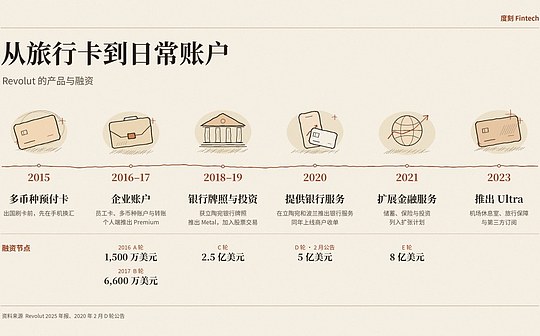
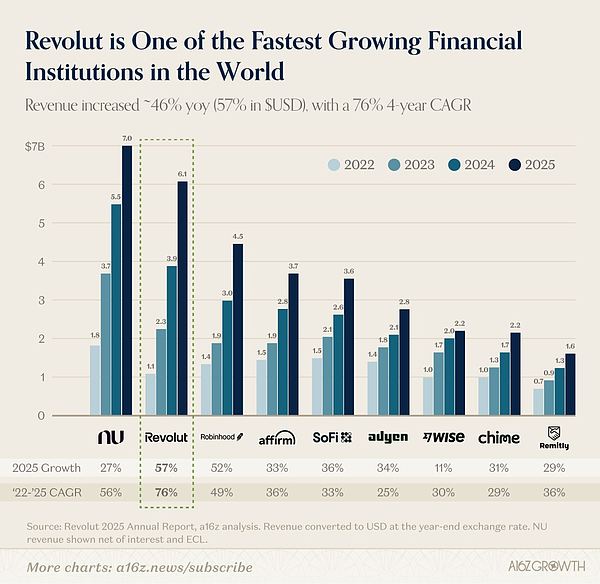
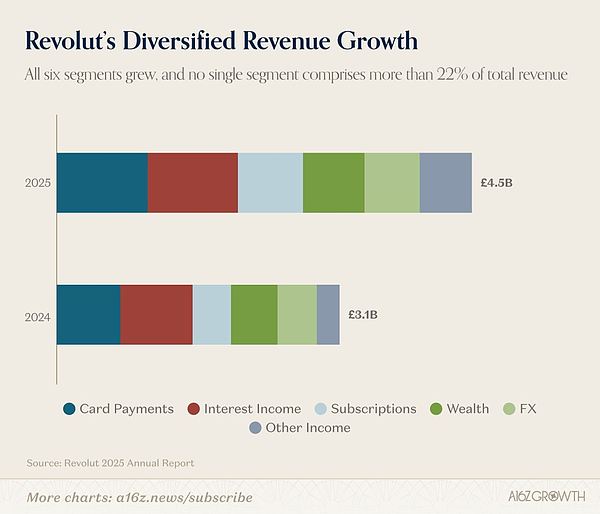
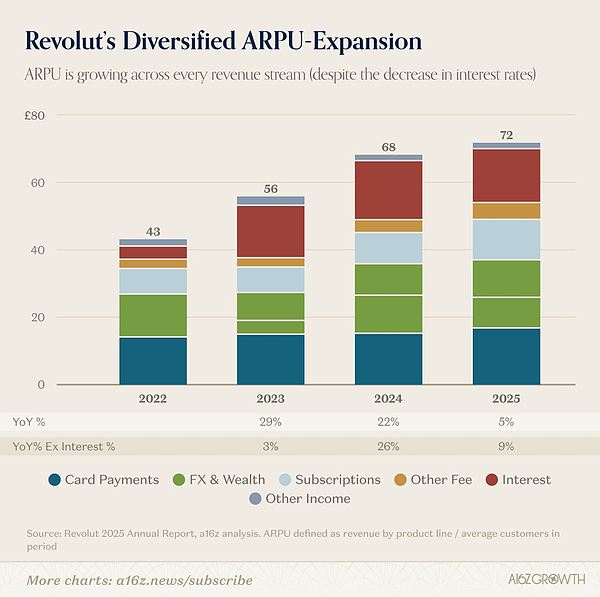
John Collison asked Nik Storonsky on Stripe's podcast Cheeky Pint: Will Revolut directly compete with Amex Platinum and Chase Sapphire when it arrives in the U.S.? The answer from the co-founder and CEO of Revolut was a simple one word: Yes. More than a decade ago, Revolut was just a card for UK residents traveling abroad. You could change money on your phone before departure, and upon arrival, you could use it as usual without paying a conversion fee. Today, the company has over 80 million retail customers, with the latest funding round valuing it at $115 billion. The market it aims to enter is that of the cards most frequently used by Americans. How did Revolut reach the customer scale of traditional banks in just ten years? How has it maintained the rapid growth of a tech company in the financial payments industry? With these questions in mind, we looked through Revolut's 2025 report to attempt to find some answers and insights. 1. What does Revolut still lack after reaching 80 million customers? Revolut's growth has moved past the stage of achieving high growth rates from a low base. a16z compares it to Nubank: both companies continue to grow rapidly even after crossing a billion dollars in revenue. a16z estimates Revolut's compound annual growth rate for revenue from 2022 to 2025 to be around 70%. By 2025, revenue is projected to reach £4.52 billion, up 46% year-on-year. Pre-tax profit is expected to rise to £1.71 billion, a 57% increase, with the pre-tax profit margin climbing from 35% to 38%. The $115 billion valuation comes from a secondary stock transaction completed in November 2026, which did not bring in new funds to Revolut. The valuation from a share sale in 2025 was $75 billion, roughly 19 times the $4 billion revenue of 2024. The latest valuation of $115 billion compared to 2025's projected $6 billion revenue is still about 19 times. The pricing of the two transactions rose by 53%, but the revenue multiples based on their respective most recent full fiscal year remained almost unchanged. The business has already gained scale, and profits are growing even faster than revenue. Looking back, early investors were backing a very specific transaction. Balderton partner Daniel Waterhouse publicly shared excerpts from a 2015 investment memo in 2020. What attracted them at the time was that users could pay abroad as easily as they could with local cards, while saving on currency exchange fees. Five years later, the focus has shifted from payments to accounts. In its D round announcement, Revolut has already listed increasing the frequency of everyday account usage as a goal. Today, a16z is looking at the company with two key questions: How many more customers can be added, and how much revenue (ARPU) can each customer bring in? By the end of 2025, Revolut is expected to have 68.3 million retail customers, an increase of about 16 million in a year. The figures disclosed for 2026 have already exceeded 80 million. For reference, JPMorgan's consumer and community banking division serves over 88 million U.S. consumers. Revolut is no longer just a The first version of the product combined currency exchange and overseas card transactions. For travelers departing from the UK, even if their destination is a European country like France or Spain that uses the euro, they still incur costs when exchanging pounds for euros. Users can view exchange rates and exchange money on their phones before leaving, allowing them to use the same card locally. In 2016, Revolut completed a $15 million Series A funding round. By 2017, when Index Ventures led a $66 million Series B round, Revolut had over 700,000 customers in Europe and had launched its Premium offering for individuals. Index partner Martin Mignot was impressed that Revolut could simplify and clarify cross-border funding flows. 2.2 From Personal Accounts to Business Accounts The company subsequently brought the same currency exchange and payment capabilities to the business sector, introducing Business accounts that feature multi-currency wallets, employee cards, and cross-border transfers. A traveler might exchange money a few times a year, but businesses must pay suppliers and handle employee expenses monthly, providing Revolut with an opportunity to enter day-to-day operations. By the end of 2025, Business accounts had reached 767,000 customers, contributing approximately 16% of the group's revenue. 2.3 Gradually Introduced Financial Services In 2018, DST Global led a $250 million Series C funding round, raising Revolut's valuation to $1.7 billion. At that time, Revolut had nearly 2 million customers and was processing transactions worth about $1.8 billion per month. In the same year, the company obtained a banking license in Lithuania and launched a Metal card, while cryptocurrency trading, added the previous year, provided another use for accounts. In 2019, the app integrated stock trading. Users began to have reasons to open Revolut accounts beyond just traveling. In February 2020, TCV led a $500 million Series D funding round, bringing the valuation to $5.5 billion, with customers exceeding 10 million. TCV partner John Doran emphasized Revolut's bank-like experience enabled by technology. Storonsky's goal at the time was more specific: to expand European banking services so that more people use them daily. In the same year, the company launched banking services in Lithuania and Poland and also introduced merchant acquiring for business customers. When Revolut reached 1 million customers in 2017, it noted that some cardholders were using their cards for daily expenses, even as their primary transaction accounts. At that point, the company began to be able to turn these uses into more comprehensive services. In 2021, SoftBank Vision Fund 2 and Tiger Global invested $800 million, raising the valuation to $33 billion, with customers exceeding 16 million. Tiger Global's Scott Shleifer recognized the speed of product development and user experience as key drivers for further expansion. The company's announced use of funds included savings, insurance, investments, and international markets. In 2023, Revolut launched its highest-tier membership, Ultra, which includes travel insurance, airport lounge access, and third-party subscriptions in the monthly fee. Storonsky mentioned in a program that the number of people purchasing it exceeded his initial expectations. 3. Profit Model In an interview, Storonsky mentioned that card interchange fees in Europe are low and credit regulation is strict, and thus Revolut must first earn income from transactions. By 2025, the group's revenue of £4.52 billion will see approximately £3.43 billion from fees and service charges, accounting for 76%. For every card swipe, currency exchange, trade, or subscription, revenues of this kind could flow to Revolut. Interest income will account for another total of £2.16 billion. The annual report divides revenue into six categories: Card Payments Interest Subscriptions Wealth Foreign Exchange Other Income Fees per transaction. Card payments are the largest portion, projected to yield about £1 billion in revenue in 2025, accounting for 22.2% of the group's revenue. When users swipe their cards, Revolut, as the issuer, can earn interchange fees. This category also includes some withdrawal and recharge fees. Foreign exchange income is expected to be approximately £606 million, derived from fees related to fiat currency exchanges, including fees exceeding package limits. Wealth business is projected to contribute roughly £663 million, covering services like stocks, crypto assets, commodities, and savings, with fee structures involving transaction commissions, markups, and custody fees. Monthly or annual fees are charged. Subscriptions contributed £707 million in 2025, up 67% year-on-year. Individual users pay for higher currency exchange limits, travel insurance, and membership benefits, while businesses purchase packages for accounts and operational tools. A company using a Revolut corporate card may also pay additional fees for currency exchange, acquiring, or expense management services. In 2024, crypto trading was active, and Revolut X launched that year, leading to a 298% growth in wealth business revenue. By 2025, this growth rate fell to 31%, card payments still grew by 45%, and subscriptions grew by 67%. Customers conducted fewer transactions, which could affect commissions. As long as they are willing to renew, Revolut will receive a membership fee next month. From earning interest on funds. Revolut had a total interest income of £974 million in 2025, with net interest income of £891 million after deducting interest expenses. Of the total interest income, about £448 million came from cash and bank balances, £371 million from treasury investments, and customer loans contributed only about £151 million. Cash and treasury investments contributed approximately 84% of total interest income. By the end of 2025, the loan balance more than doubled from the previous year to about £2.2 billion, still only equivalent to 6.2% of customer deposits under annual report standards. Storonsky likens bank lending to selling put options: continuously earning interest but with potential credit losses concentrated during economic downturns. Consumer loans, credit cards, and mortgages may increase revenue per customer. To determine whether it’s worth scaling up, one must consider whether interest can cover funding, bad debts, and capital costs. Based on a16z’s average customer count estimate, from 2022 to 2025, Revolut’s revenue per customer increased by approximately 65%. By 2025, the group had 11 product lines each generating over £100 million in revenue. Revenue per customer is an average for the group and may be affected by regional differences, the proportion of business customers, and changes in the business mix. In addition to revenue, a16z also estimates, based on average shareholder equity, that Revolut’s return on equity in 2025 was around 35%, attributing part of the efficiency to organic customer acquisition, building its core infrastructure, and fewer physical branches. This metric reflects the returns on the existing business mix. If credit becomes significantly heavier on the balance sheet in the future, capital consumption and credit cycles will affect this metric. In addition to natural customer acquisition, growth also involves tangible expenditures. In 2025, Revolut’s advertising and marketing expenses rose from £359 million to £529 million, an increase of 47%, closely matching revenue growth rates. During the same period, administrative expenses excluding sales, advertising, and marketing dropped from 38% to 33% of gross profit. Next, it will be important to see if, as Revolut continues to invest in customer acquisition, the number of customers and revenue per customer can both rise. 4. Revolut’s Growth and Global Expansion 4.1 Growth Using a16z’s two variables for analysis. The first is the customer base. a16z’s European survey provides a clue: younger customers are more willing to use Revolut. For those who already have a primary bank, switching accounts means changing salary deposits and bill payments. For those just starting their careers, these habits are still forming. Growth opportunities in Europe partly stem from users who have not yet been covered and from a younger generation gradually moving more financial activities online. The second is revenue per customer. a16z investor Alex Immerman told Reuters that he looks at primary account adoption rates and total customer balances. In 2025, the number of Revolut primary account customers grew by 45%, faster than the 30% growth of retail customers, though the company did not disclose the absolute numbers. From completed transactions, the change in depth of usage is also evident. In 2025, Revolut disclosed that the number of transactions per customer increased by 24% year-on-year, and the adoption of paid packages grew by 42%. The former reflects more frequent use of accounts, while the latter indicates more customers are willing to pay. Combining these metrics with primary accounts and balances provides a clearer picture of whether customer relationships have deepened compared to just looking at new account openings. Changes in balances are even more straightforward. The total customer balance at Revolut rose from approximately £18 billion in 2023 to £30.2 billion in 2024, and then to £50.2 billion in 2025, with the last year growing by 66%. Storonsky said that depending on the market, about 10%-20% of monthly active users deposit their salaries into Revolut. After the salary comes in, card usage, bill payments, and investments are more likely to occur in the same account. Two metrics measure the growth of main account customers and the proportion of salary deposits among monthly active users. Moreover, the account balance can drive payment, foreign exchange, and investment activities. For Revolut, the first step is to get customers to keep a bit more money in their accounts. Once the balance grows, the second judgment comes into play: should more funds continue to be allocated to cash and financial assets, or gradually used for consumer loans, credit cards, and mortgages? The capital costs and risks of these two paths are different. 4.2 Going International Europe remains the main source of incremental growth. By 2025, the UK and Europe combined will contribute about 96% of Revolut's fee income. Fee income from European markets outside the UK has grown by 54% year-over-year, contributing about 70% of the group's new fee income. Fee income growth outside of Europe is even faster, but in terms of new amounts, Europe still drives the most growth. Revolut is also a company going international. When it expanded from the UK to Europe, it sold a card that saved on currency exchange fees. In Mexico, it leveraged local banks to receive deposits. Officially launched in January 2026, by the end of September, it had over 1 million account holders and deposits nearing 7.9 billion Mexican pesos, still operating at a loss in the third quarter. Account opening is quick, but whether it can turn deposits and daily transactions into a profitable business will depend on local dynamics. The U.S. presents another challenge. Revolut has received preliminary conditional approval, but still needs to navigate additional approvals before officially launching its own bank. It aims to compete for customers with premium credit cards against Amex and Chase. The card can bring transaction volume, but it remains to be seen whether users will also deposit their salaries and funds with it, and whether the costs of card benefits and credit can be recouped. Asia also presents a noteworthy case. Revolut entered Singapore in 2019. The company claims that local operations achieved net profitability for the second consecutive year by 2025, increasing the number of enterprise clients nearly fivefold that year. In October 2026, Revolut announced plans to invest nearly SGD 350 million in Singapore over the next five years. The company did not disclose the absolute number of local enterprise clients in its announcement, but this case provides another observation path: first establish local business through cross-border payment and enterprise accounts, then see if customer and revenue growth continues as investment increases. Revolut can apply the same account technology in many places. However, in each new market, it must rely on local products to answer why users open accounts and what motivates them to deposit money next. After reading through Revolut's 2025 data, one can clearly see the complete picture of the emerging Neobank that Revolut depicts: Starting with a currency exchange payment card, gradually building/deepening account relations, and eventually providing diversified financial services. Five, Insights for Emerging Neobanks The first batch of Revolut's customers had a very specific reason to open the app: to save on currency exchange fees while traveling abroad. When the same product can be used to receive salaries and pay bills, users have a reason to continue using it after their travels. Revolut has already integrated stablecoin transfers into its existing app. According to Polygon Labs' disclosure in November 2025, Revolut users processed a total transaction volume of over $690 million on Polygon at that time. For teams looking to start a stablecoin Neobank from scratch, a more pertinent question is: Revolut already has a set of clients who are accustomed to currency exchange and transfers, which group of people are you planning to help first in receiving funds? Most teams target regions across Africa and Asia, discussing the narrative of using blockchain and stablecoins to address the financial inclusion needs of the 1.3 billion unbanked/underbanked populations. The answer to this question will vary across different markets. In areas where credit cards and mobile banking are already functional, a stablecoin card may not lead users to switch from their regular cards. In places where cross-border payments are inconvenient, a freelancer may just want overseas clients to pay their earnings, leaving part for local bills. If the product first captures this money, and the same income recurs the next month, users will have a reason to return. In a specific market, truly finding a pain point (e.g., helping them to make money) is the hallmark of a serious endeavor. Blockchain can help platforms easily globalize and connect to cross-border settlements, offering users familiar with crypto assets more trading and investment options. At first glance, it seems to have reached that high ARPU stage. However, the problem lies in its relatively small user base, which is also incompatible with traditional user demographics. Can you realistically expect someone without a bank account to use a crypto wallet to trade stocks like Nvidia? It's similar to a recent conversation I had with a big brother who had a sudden realization: With 1.3 billion unbanked/underbanked individuals, do they really need bank accounts?



Details compiled from public sources. Always do your own research.