
The Rise and Fall of Sovereign Assets (Part One): Who Created the First Ponzi?
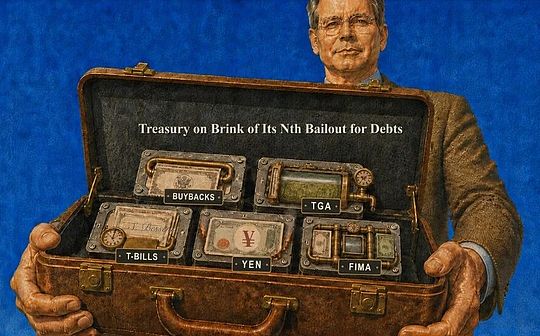
Opening a market is not as good as founding a nation, saving money is not as good as issuing bonds.
Machine translated. Refer to the original for accuracy.
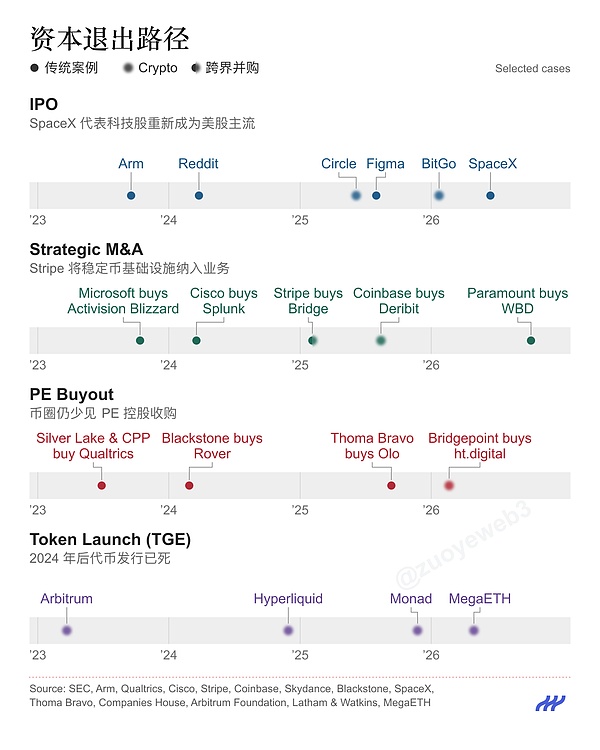
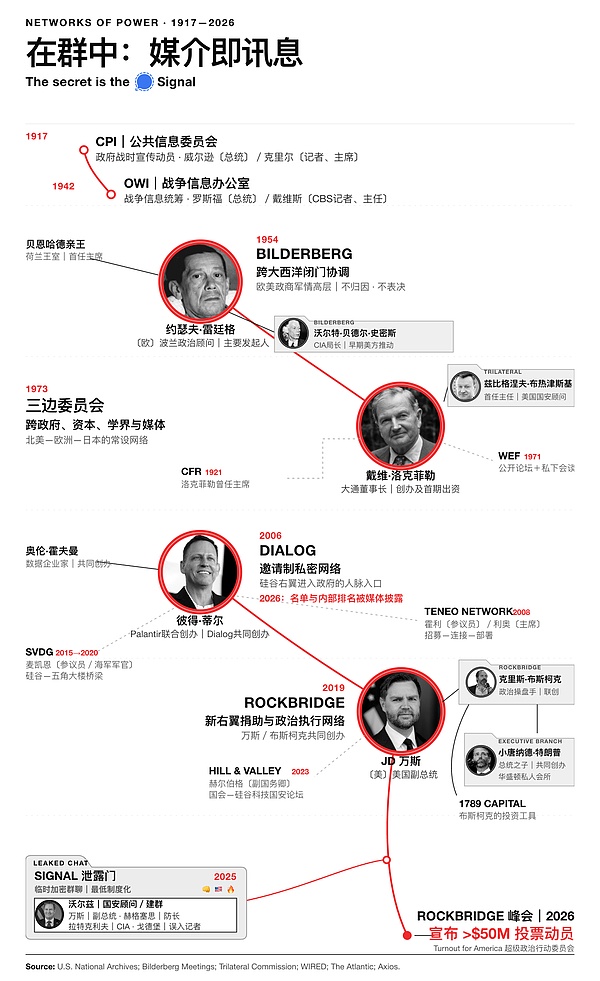
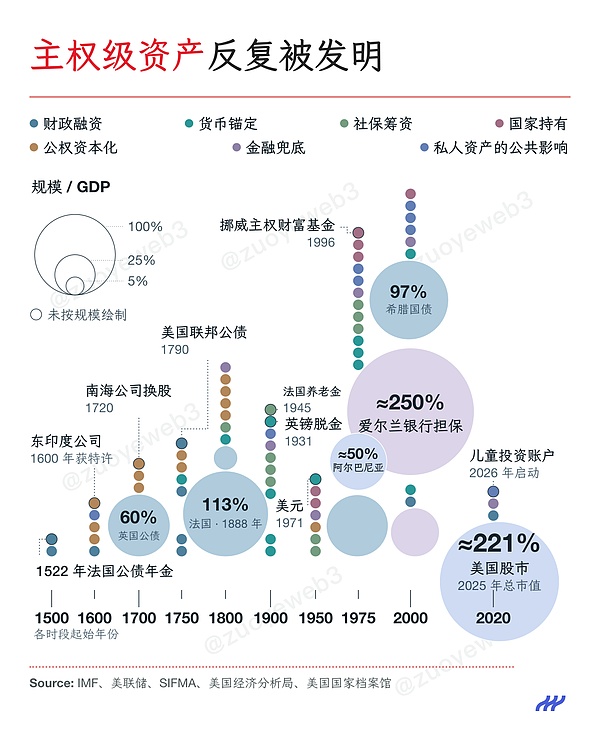
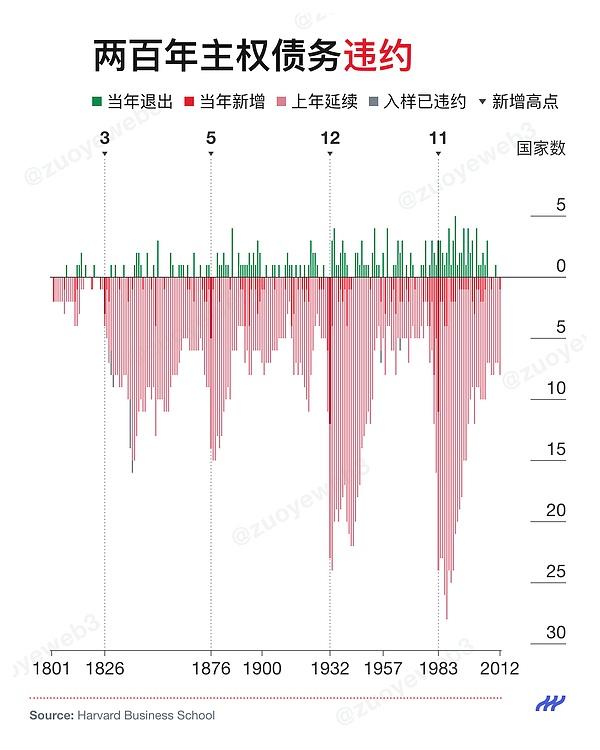
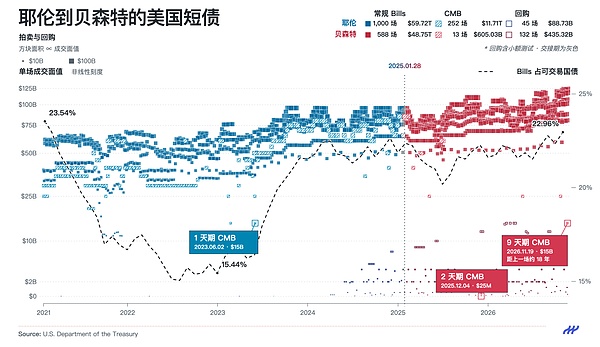
The cryptocurrency market has not been performing well lately. This decline partially stems from the sluggish prices and decreasing trading volumes, but the more significant reason is the disillusionment of narratives. Once upon a time, SBF truly inflated the bubble and guided funds in the crypto space to integrate with AI, envisioning a yet-to-be-reached realm of the metaverse. A skilled cook cannot make a meal without rice; the core issue lies in the lack of asset creation forms. In terms of liquidity's exit strategy, the crypto space can only choose between facing the retail investors with Token Generation Events (TGE) or the stock market with Initial Public Offerings (IPO), while outside capital rarely opts for mergers and acquisitions; it almost never sees private equity (PE) engaging in contrarian bottom-fishing, and many projects are disappearing entirely. Image description: Capital exit pathways Image source: @zuoyeweb3 To be more straightforward, the creative appeal of cryptocurrencies is continuously declining. It boils down to just Meme/Perp and prediction markets, entering a state of bewilderment where everything needs to be perpetual. Moreover, SpaceX/ANT’s double new issuance has been ridiculed by brokerages. In other words, the crypto market's trading has failed to attract external buying, and the art of issuing has become the worst it has ever been. It is essential to learn how the original Ponzi schemes were repeatedly invented and even managed to survive to this day. Let’s get to the answer: the first Ponzi is the nation. The Ponzi is not an anomaly of finance; it is the very essence of finance. Sovereign assets are the most successful Ponzi, born from war, spread through securitization, and achieving a sense of eternity over time. The issue in the crypto space is not that there are too many Ponzis, but that there is a failure to issue sovereign-level Ponzis. War invented government debt. The starting point of sovereign assets is not in finance but on the battlefield. In the Middle Ages, the only industries needing massive capital investment were those governing nations, with large projects requiring considerable funding only found in wars. The invention of government bonds is related solely to one thing: a nation's foreign war. Whether it's the fundraising expeditions to Constantinople financed by Venice in the Middle Ages, or Britain issuing bonds to conquer Napoleon and achieve the Rothschild myth, or the social investment initiated by "Jay Cooke" during the American Civil War, which truly made government bonds modern bonds. The campaigns among feudal lords gave birth to the precursor of modern finance. The investment returns on risks in the financial industry spawned the Age of Discovery, capitalism, and advancements in science and technology. It is not a shift from substance to virtual after the Industrial Revolution; rather, it is the creation of sovereign-level assets that enabled the Industrial Revolution. Moreover, the mobilization of war bonds can not only raise funds in wartime but also serves as a routine version of modern democratic politics. Votes can be seen as donations, and election battles can be equated with civil wars. Image description: Fundraising equals mobilization Image source: @zuoyeweb3 Although the Republican Party did not win the midterm elections, it personally raised over $50 million in political donations. The fight never ceases, and funds are more crucial than support rates. It can even be argued that political donations are more scientific than exchanging welfare for votes since welfare incurs long-term liabilities with very low returns. One might assert that the South China Sea bubble was merely a minor problem for the British, gradually digestible over time, but wars are different. One can lose the Boer War but must win it back; otherwise, financial confidence collapses. Just as not winning against Iran could lead to losing both houses. Business, therefore, became militarized, utilized throughout the Western world as a means of social mobilization, continually creating methods of credit generation. Wealth is related to the continuous opening of sovereign assets to businesses and individuals. The essence of British privateer ships is public-private partnerships; pirates robbing the Spanish became partners of the English king, while the East India Company managed to obtain stock pricing benchmarks through its cash flow management from India. In our impression, sovereign assets perceive ordinary individuals merely as investors; however, observing Western history, ordinary individuals and businesses can completely become the main players, recognizing or confirming innovators, rather than being a deliberate invention by the government. Ponzi creates liquidity. War teaches nations to borrow, but what truly transforms debt into assets is when someone slices it up to sell to retail investors. One can even go to extremes: war bonds spur the emergence of stocks, social insurance systems, and even modern monetary systems. This is not a sensational claim. The South Sea Bubble and Mississippi Bubble fundamentally stem from the English and French governments addressing fiscal issues by packaging and selling government debt and taxation powers to specific companies, which in turn sold it to retail investors, thereby further securitizing it, which effectively birthed the modern stock market. Meanwhile, repeatedly banned financial methods like options and short selling were invented almost instantly. Bugs are never exterminated, and derivatives are never prohibited. Whether it was the British Empire or the American Empire after World War II, neither could maintain the binding relationship between their currency and gold. In the wave of foreign exchange liberalization in the 1970s and 1980s, the Chicago Mercantile Exchange pioneered the invention of interest rate futures. Before that, all options and futures essentially required physical delivery, even in foreign exchange, which involved the exchange of different currencies, whereas interest rates have no physical counterpart. Ultimately, innovation outpaced regulation, and the CFTC eventually stamped approval afterward, allowing for cash settlement in USD and creating a modern version of differential settlement. This was the real starting point for Arthur Hayes's invention of perpetual contracts. By 2025, the largest lending institution will not be JPMorgan Chase, but BlackRock, crushing all banks with a scale of $3.2 trillion, with its core assets being bonds. We can even argue that the central bank-centric monetary banking theory is no longer in line with reality. Nixon couldn't withstand the inflationary pressure of the dollar, marking the origin of the entire cryptocurrency leverage mechanism. History is quite humorous; it seems to repeatedly try to teach humanity under the banner of technological innovation. The invention of the Gutenberg printing press not only increased literacy rates, leading to religious revolutions but also resulted in the mass printing of paper money, which catalyzed severe inflation. Derivatives are merely a side branch; the greater product at the sovereign level is a form of mass frenzy that occurs roughly every hundred years. Debt is just a credit certificate; the swap of funds and resources is what’s more real. The reasoning isn't complicated. Creditors invest in an asset belonging to an overseas nation, such as the French obsession with Mississippi in the 1720s, Britain's obsession with Latin American minerals, or even the progenitor of Ponzi schemes in the 1637 Dutch tulip craze, which was a secondary product of the Dutch East India Company actually making money. Since the end of the Middle Ages, throughout human history, about every hundred years or so, humanity falls into a collective frenzy, and apart from the narrow definition of war bonds, most assets that can spark a nationwide craze are represented by bonds: 1637 - Tulip Bubble 1720 - South Sea Bubble, Mississippi Bonds 1820 - American Railroad Mania 1920 - Coolidge Prosperity 2020s - AI Mega Funds The aforementioned cases are certainly not all bond trades, but Nvidia's AI chip revolving loans, the stock market surge during the Coolidge era, and the capital form of railroad mania essentially all follow an early bond-driven path, leading to later retail investor takeovers in the stock market. Convertible bonds are not a creation of Jia Yueting; they are merely an unintended homage to the English and French of 300 years ago. Microstrategy’s STRC is based on BTC reissuance, merely the accumulation stage of the South Sea Bubble; the return must be guaranteed from physical production or into a mania for AI factories. Perhaps this time it will be different. In the boring years between wars, bankers and ordinary citizens who enjoyed high-interest rates eagerly sought the next high-return project, with ordinary investors often being more fervent than bankers, much like Hyperliquid community members being more devout than project parties. Image description: Sovereign-level assets are repeatedly invented. Image source: @zuoyeweb3 The sovereign assetization of US stocks is not a romantic tale under the sycamore; even though the Great Depression of 1929 originated from the stock market crash, it cannot prove that the stock market has hijacked the American economy. The modern stock market is still the latest invention from the 1970s, with employee retirement funds, executive options, and corporate stock buybacks comprehensively putting the assets of all Americans into the stock market, thus truly innovating the stock market into a national asset. Even day traders are creations of this wave, with Robinhood merely being its reinvention in the internet era. Therefore, Peter Thiel would place a conquer-the-world index in the PayPal office; it clearly reflects the number of users acquired by burning money, but under the packaging of growth rate miracles, this is a discount standard based on expectations, and everything has been financialized. In the new century, the only industries requiring large-scale capital investments are those that conquer the world, and the only large projects needing massive funding are innovative ones. From South Sea Securities to the Chicago Mercantile Exchange, from interest rate futures to perpetual contracts, and to PayPal’s conquering the world index, the crypto circle's Perp and TGE originally belong in this family tree, albeit the generation with the least seniority. Furthermore, when Ponzi meets state entities, it becomes sovereign-level assets, especially when a regime controls a certain hegemony, channel, or resource for a certain time, it becomes a mechanism that repeatedly extracts wealth from the opposing party. When Ponzi reaches its end, debt reaches its limit; eliminating creditors is far simpler than paying interest. A state will not go bankrupt. The question is, if every round of frenzy ultimately collapses, why can sovereign-level assets keep coming back? In the news, we often see abstract cases such as the U.S. government shutdown, the debt crisis of the five Southern European countries, and even the national bankruptcy of Sri Lanka. This contradicts our common sense; as sovereign nations, how can they go bankrupt like a company due to mismanagement? In fact, compared to wars and sanctions, the international debt system has a stronger ability to constrain governments, because credit ratings can truly determine whether a government can obtain funding from abroad. Compared to collecting taxes internally, borrowing money for projects often has a more direct and sometimes even higher return. Moreover, counterintuitively, the consequences of debt default for most countries are not as frightening as we imagine. Take Argentina as an example; even after defaulting, it can still obtain loans from the IMF and support payments from the U.S. Image description: Sovereign debt default Image source: @zuoyeweb3 From the trajectory of sovereign assets, war bonds hinder the ability of nations to repay personal pensions, leading to repeated collapses. The repeated credit defaults by the state towards individuals are the historical basis for "internal debt is not debt." If sovereign-level assets cannot ultimately be redeemed, they will devolve into a Ponzi scheme, but this is not inherently a problem. In fact, during the long debt resolution cycle, humanity invented capitalism and modern science, with the only cost being two world wars. By the time of the 2008 financial crisis that we are part of, we are still in the aftermath of that cycle. As mentioned earlier, the way to resolve the European debt crisis was through two world wars, while the resolution for the American debt crisis will clearly not be through the Federal Reserve. If we do not anticipate the arrival of a third world war, it is best to hope that AI's promises are true. In particular, central banks are fundamentally powerless to stop the continuous erosion of administrative systems, but to prevent the total collapse of the credit system, they must perform on stage, pretending to care about the money supply. Image description: Treasury QE Image source: @zuoyeweb3 During Biden's term, under Treasury Secretary Yellen, in 2023 there was bold financial innovation to swap long-term U.S. debt for short-term U.S. debt, even using CMB ultra-short-term tools to lower long-term bond yields. Here, a brief explanation: the long-term rates of U.S. debt are the true "risk-free rates" that determine the base rates for student loans, mortgages, etc. Performing such operations before the election year, Bencet has criticized Yellen multiple times, believing she is manipulating the situation deliberately to aid in the election. The swap between long-term and short-term bonds would rapidly drain the government’s cash flow reserves since repayment is due next year. However, for Biden at this moment, losing the election means no future at all. Furthermore, if he loses, it could create enormous financial troubles for Trump. As expected, Trump may win the 2024 presidential election, but facing a structural fiscal crisis, election promises to voters, and fiscal spending amid tariff wars, Bencet can only become Yellen and continue issuing short-term debt to quench thirst with poison. It can be understood this way: issuing short-term debt is the Treasury circumventing the Federal Reserve to forcibly create short-term market liquidity through fiscal means, with the cost being that interest size will rise year by year. Even so, compared to government bonds and corporate bonds in Europe and Japan, U.S. bonds and AI bonds are still more cost-effective, as they are at least securing military spending rather than issuing welfare, at least investing in productivity rather than issuing welfare. We all know U.S. bonds are collapsing, yet we still regard them as the risk-free foundation of the entire global financial system. These two situations coexist. A Ponzi scheme is not frightening; sovereign-level assets themselves are a Ponzi that cannot be eliminated. Conclusion Why can sovereign-level assets be repeatedly reinvented? It is not the sanctity of the state—regarding debt responsibility, with recent cases like Sri Lanka, or the historical case of French annuities; nor is it the size of the state—corporate and sovereign debts are essentially no different, both guaranteed by profitability, and yet will eventually be crushed by the interest itself. A more reasonable explanation is time. When any system crosses a generation's cycle, it is viewed by the world as eternal. The establishment to the collapse of the Bretton Woods system occurred in just 27 years, and at that time, people never considered the possibility of collapse. During the Clinton era, the U.S. government even had surpluses. The current surge of U.S. debt is strictly a direct consequence of 2008. According to estimates, government bailouts to the financial sector generally create a 188% tax increase impulse; debt never disappears but only transfers to ordinary individuals. Sovereign governments possess the population, which gives them the confidence to constantly default. They are not pure scams; even after deleveraging, they can exist in the long term, forming a daily mechanism without exorbitant profits. Returning to the crypto world. Starting in 2025, the PE Guy image became popular on the American internet. Even at the peak of the U.S. stock market, new (repeatedly reinvented) asset forms emerged, but the crypto industry fell into confusion, believing everything was about to end. In reality, there is no need for that; the road to innovation is long, and even disruption itself has value in being assimilated. In contrast to the history of sovereign-level assets, what is lacking in the crypto space is quite clear: Lack of War. Without a collective goal that requires everyone to spend money, DeFi Summer and the Metaverse have played brief roles in this, and now we can only rely on AI; Lack of Securitization Channels. Perpetual contracts are merely a self-recycling mechanism within the circle, lacking connections to external cash flow. SpaceX/ANT's public offering was toyed with by brokerages, highlighting that the channels are not under their control; Lack of Time. No cryptocurrency system has lived through a generation, and naturally, no one considers it eternal. As for the Ponzi schemes by companies and individuals, they are nothing more than clumsy imitations of sovereign-level assets, the degree of imitation depending on how much national credit can be borrowed. This will be elaborated in subsequent parts of this series.
Details compiled from public sources. Always do your own research.