
Has the First Great Mountain of Mathematics Been Conquered? Anthropic Claims to Prove the Riemann Hypothesis

Released 17 million lines of Lean source code, AI proof document exceeds 250,000 pages.
Machine translated. Refer to the original for accuracy.
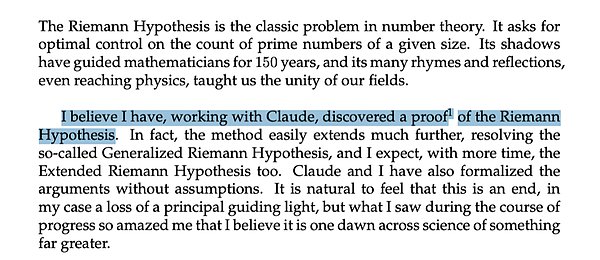
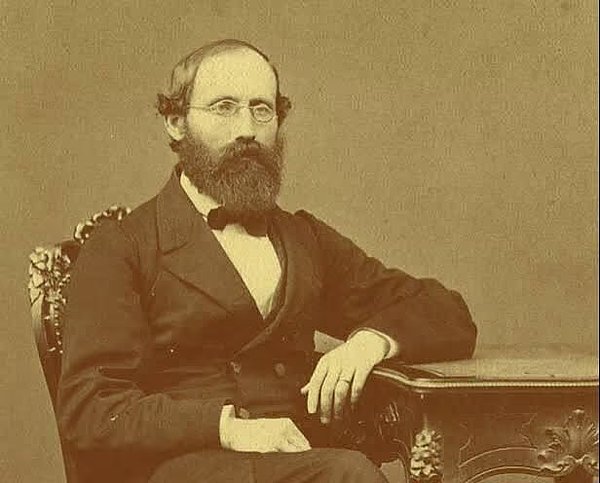
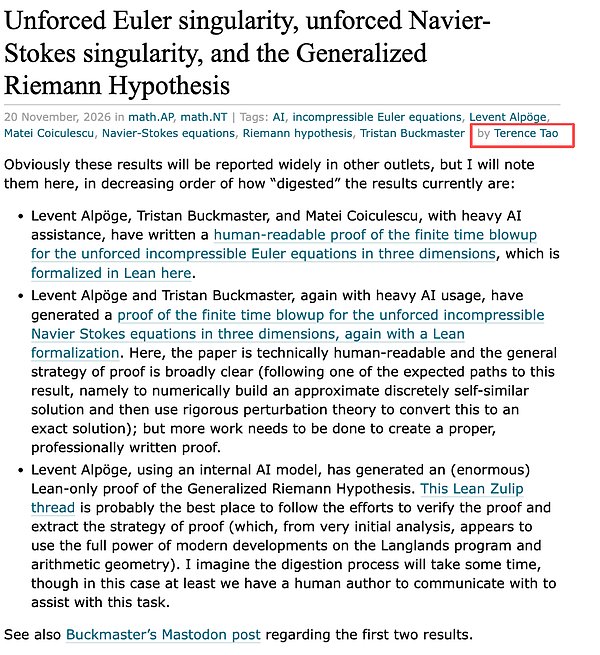
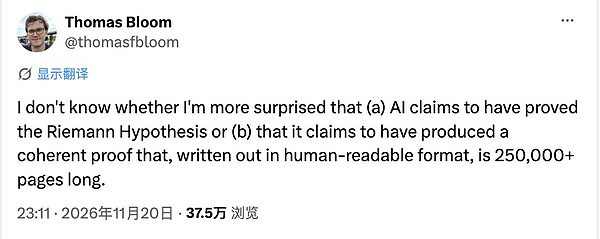
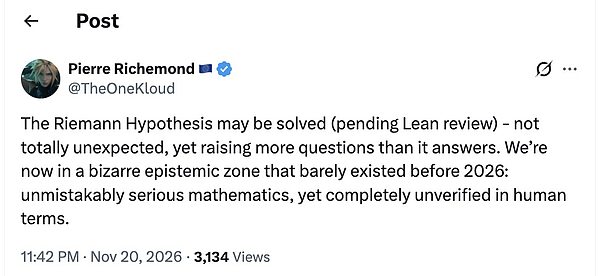
Author: Li Jia, Wall Street Watch The Riemann Hypothesis, which has troubled the mathematics community for 167 years, may be on the verge of its first significant breakthrough. However, whether the AI-generated proof can withstand scrutiny from the mathematical community remains the biggest suspense. On November 20, Anthropic mathematician Levent Alpöge announced that he, in collaboration with the AI model Claude, had found a method to prove the Riemann Hypothesis and the Generalized Riemann Hypothesis (GRH), and simultaneously published over 17 million lines of Lean formalized code. Due to the timing of the announcement coinciding with the day after Anthropic went public, this mathematical breakthrough has also sparked discussions about the timing and commercial motives behind it. Alpöge wrote the proof in Lean language and released it in 14 compressed files. Meanwhile, the text version of the proof generated with Claude exceeds 250,000 pages, but it has not been published due to its length and difficulty in readability. Currently, no mathematician has officially confirmed the validity of this proof. The community still needs to verify whether the final theorem proven by the Lean code truly corresponds to the Riemann Hypothesis itself and whether there are any logical flaws in the entire proof process. Classical portrait of Riemann (1850s) Proof method: Claude achieves the key breakthrough at the "finish line" Alpöge introduced the core process of this collaboration in his statement: He directed Claude toward key research directions, and Claude subsequently proposed a crucial step he believed was groundbreaking—a "theta lift" chain with a length approximately equal to the square root of the defined prime sum. Each lift corresponds to the "multiplicity" relied upon in classic function domain proofs, which is very difficult to find in the integers. "As we approached the finish line, Claude far surpassed me. No, Claude was practically soaring, dancing, and dazzling near the finish line," Alpöge wrote. He also attached what is claimed to be a research timeline organized by Claude: work began on the "Stepanov determinant" on October 6, and by November 16, there was only one record left—"GRH". MIT mathematician Andrew Sutherland, after independently completing the related Lean code compilation, stated: "This is indeed a historic moment. The world has changed... In my view, this is a victory for humanity, a day worth celebrating." Response from the mathematics community: Cautious optimism, waiting for independent verification Several top mathematicians and AI researchers have expressed concern about this development, but they remain cautiously optimistic about whether the proof is indeed valid. 2006 Fields Medal winner Terence Tao expressed on his personal blog that preliminary analyses indicate that this proof appears to synthesize modern research results from the Langlands Program and arithmetic geometry, noting that verification work is expected to take some time. Mathematician Elliot Glazer's preliminary checks found that the formalized mathematical propositions in the Lean file are indeed the Generalized Riemann Hypothesis, estimating that the probability of Lean itself having flaws is "far less than 1%". Alex Kontorovich, the head of the mathematics department at Rutgers University, also indicated that as more details emerge, he is feeling more confident about the possibility of the proof being successful. A mathematician and AI researcher from Princeton University emphasized that human involvement is still the best way to leverage large language models to solve mathematical problems. He also pointed out that in this research, Alpöge should receive recognition equal to Claude's. 250,000 pages of proof: The contradiction between AI breakthrough and human verification The enormous length of the proof has become another focal point of concern within the mathematics community. Mathematician Thomas Bloom from the University of Manchester stated on X that he is unsure what shocks him more: the fact that AI claims to have proven the Riemann Hypothesis or that it claims to have generated a logically coherent proof that, when converted to human-readable form, exceeds 250,000 pages. Pierre Richemond, head of multimodal business at Cohere and former Google DeepMind researcher, believes that the Riemann Hypothesis might have been solved, but it still requires Lean verification. This development raises more questions: AI-generated research outcomes already possess serious mathematical value, yet they have not undergone sufficient verification by the human mathematical community. Timing controversy: Announced the day after IPO, Alpöge responds proactively The timing of the statement's release has also drawn public attention. Anthropic went public on November 19, and the day after, Alpöge announced this significant mathematical progress, inevitably raising market speculation about its commercial promotional motives. Alpöge proactively responded to the controversy in a statement, admitting that "the timing was very unfortunate." He stated that the key work was completed late at night on November 15 to early morning on the 16th local time, after which he asked Anthropic CEO Dario Amodei if it could be made public, "In the end, we figured out that there were indeed restrictions that needed to be adhered to." He denied negative external speculation regarding the release time, calling this "obviously cynical view" incorrect and stated that he "could not wait any longer" and was willing to take full responsibility for it. It is noteworthy that Anthropic had previously made phased progress in AI mathematical research. In August of this year, the company announced Claude's research results on the distribution of zeros of the Riemann ζ function, raising the lower bound of the zero proportion on the critical line from 41.6% to 67.2%. However, at that time, Anthropic clearly stated that it did not expect the technology used by Claude to ultimately prove the Riemann hypothesis. Bonuses and Recognition: Several Years Away from the Million Dollar Prize Even if the proof ultimately holds, Alpöge is still quite far from the $1 million prize set by the Clay Mathematics Institute. According to the institute's rules, a solution to the Millennium Prize Problems must be formally published, undergo at least two years of public scrutiny, and gain general recognition from the international mathematical community before applying for the prize. Alpöge is optimistic about the form the proof will take once accepted. He believes that this proof is likely to be significantly simplified and could be realized soon. He described this development as "the dawn of something greater in the realm of science." The capital markets have yet to form a clear judgment on this news. The relevant odds on prediction platforms still reflect market divergence. Meanwhile, a past post from OpenAI CEO Sam Altman jokingly asking on X in 2022, "When will the Riemann Hypothesis be solved?" was also dug up by netizens, with one comment joking: "Anthropic got it done before you, bro."

Details compiled from public sources. Always do your own research.