
Bitcoin Plummets for Two Weeks: Who Stood Strong?

Bitcoin fell over 20% at its lowest, with five out of the ten most watched tokens outperforming BTC: the market favors profit-generating assets and is willing to pay a premium for AI and new financial markets.
Machine translated. Refer to the original for accuracy.
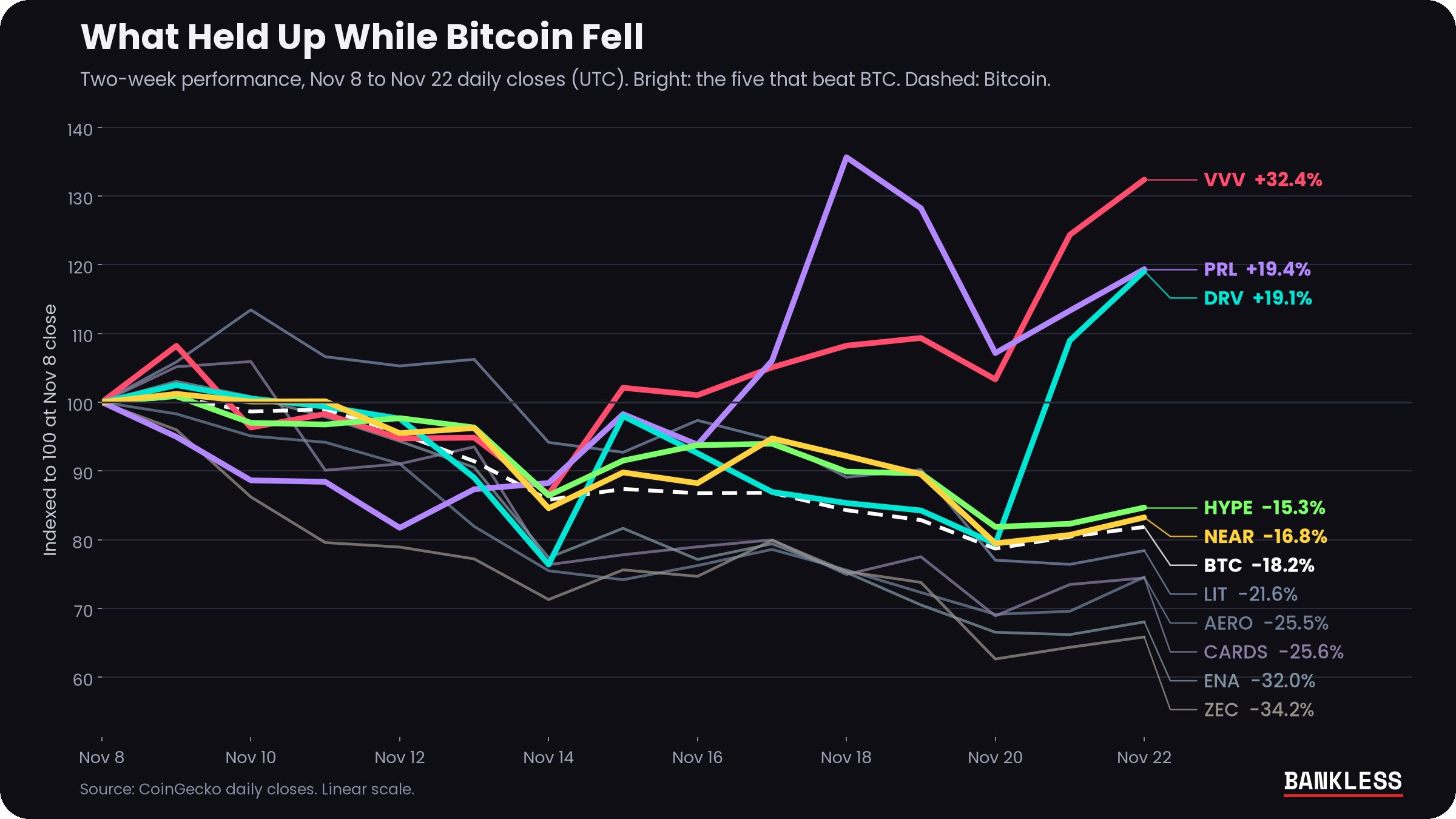
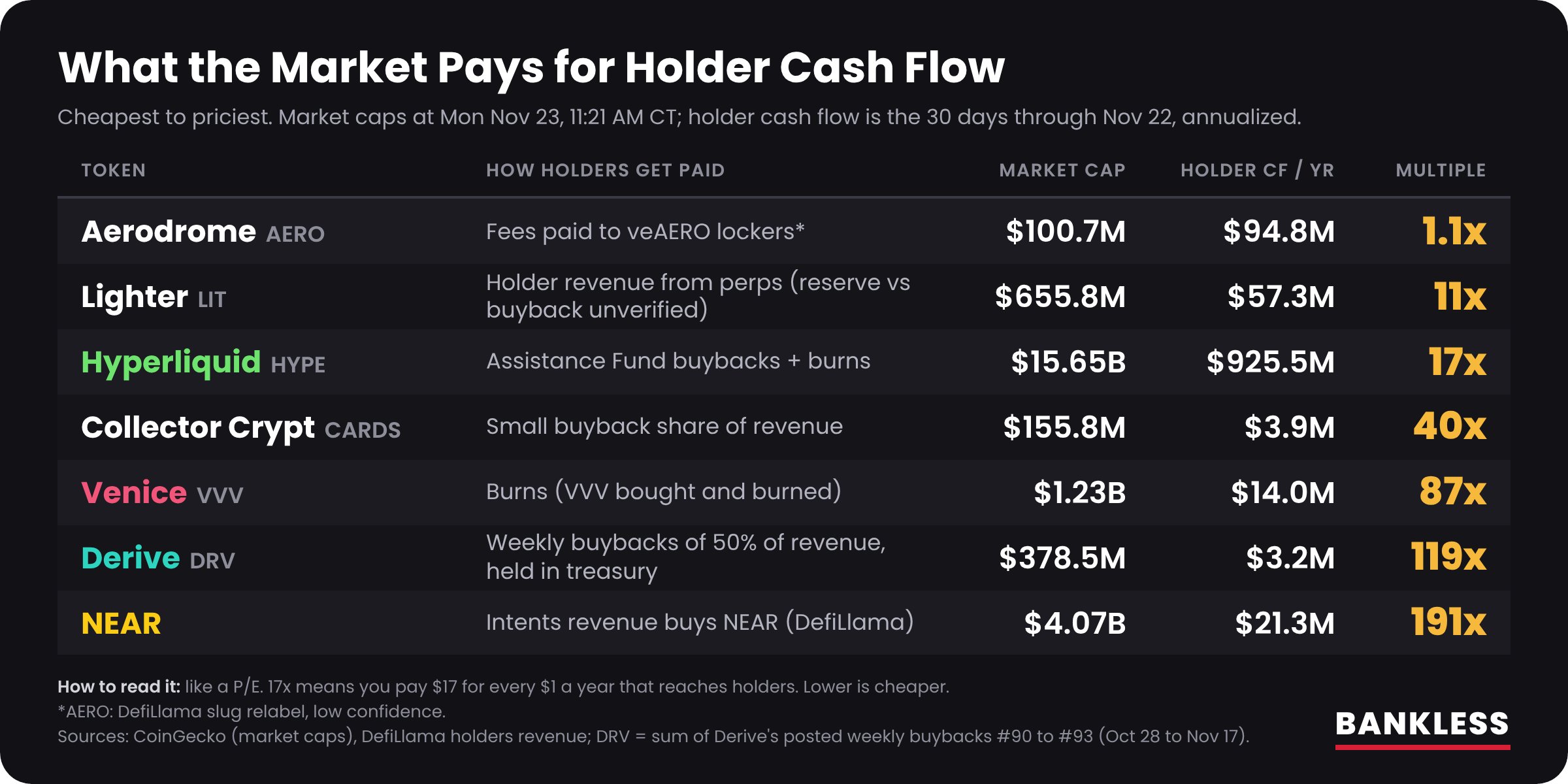
Author: @davewardonline; Source: X, @Bankless (originally published in Bankless Newsletter); Translation: Shan Ouba, Jin Se Finance The past two weeks have been quite difficult for the crypto space. Bitcoin saw a drop of over 20% at its lowest point, while ETH and almost all other assets fell in sync. On Saturday, BTC briefly dropped to nearly $55,000, marking a new low since September 2024. The AI stock sell-off in traditional markets propagated to the crypto side: BlackRock's IBIT recorded outflows for two consecutive days, while miners used their Bitcoin reserves to pay for their self-built AI infrastructure. Fortunately, prices rebounded from Saturday's lows, holding up till the weekly close on Sunday, which was a good time to check 'who withstood it.' I selected the ten most watched tokens in the market—each recently popular—and compared them one by one to Bitcoin. The result showed that five outperformed Bitcoin. Five Outperformers Against Bitcoin 1. Venice | VVV: +32.4% Venice (VVV) topped the list, ranking third in percentage gains among the top 100 tokens by market cap. Almost all of the gains came from last week: VVV rose 29.7%, while BTC fell 6% during the same period. It was indeed a week of recognition for Venice, with much of the attention coming from outside the crypto circle. The AI-generated movie trailer NUREMBERG made with Venice surpassed 35 million views on X; on November 17, the payments for its two most expensive packages set a single-day record. Along with this came Minds— a market specializing in professional intelligence, where platform fees are used to burn VVV. Before this rally, it had just set a record of $458,000 in burn on November 9; the current market valuation is about 87 times the annualized burn rate, one of the highest multiples on this list. 2. Pearl | PEARL: +19.4% Pearl ranked second and rose another 14% by Monday morning. Pearl is a highly controversial Bitcoin fork, originally designed to enable AI computations while acting as mining. Three things propelled its success: FP8 upgrade entering the testnet; Syncracy Capital disclosed a large position; and the research institution behind the protocol, Pearl Research, launched the DeepSeek endpoint on OpenRouter, which the market interpreted as validation of its core argument. 3. Derive | DRV: +19.1% On-chain options and perpetual contract exchange Derive almost matched Pearl's gains. Market volatility brought it the highest two-week fee income since January 2025, with half of the protocol's revenue allocated for weekly buybacks. Most of the gains were concentrated in a single trading day: on November 21, DRV surged approximately 37% in a single day. Over the past 30 days, Derive's fee income was $727,000, with the current valuation about 120 times the annualized buyback amount. 4. Hyperliquid | HYPE: -15.3% Hyperliquid outperformed Bitcoin by 2.8 percentage points, yet still reached a new 90-day closing low on November 20. Like Derive, it benefited from this round of volatility: fees rose by 22% compared to the previous two weeks; approximately $76 million flowed to holders through buybacks and burns over the past 30 days, nearly five times the sum of all others on this list. By this metric, HYPE's valuation is about 17 times the annualized cash flow for holders, making it one of the cheapest on the list. According to the buyback mechanism, when the repurchase amount is fixed, the lower the price, the more tokens you acquire: in the last week, every $1 million of buyback bought about 15,500 HYPE, up from about 12,400 previously. 5. Near | NEAR: -16.8% NEAR slightly outperformed Bitcoin by 1.4 percentage points. When the market rises, it often leads: from the low on August 30 to the high on October 11, it rose approximately 224%, while Bitcoin only gained 8% during the same period. However, relative to its price, its income story is the thinnest among the five: DefiLlama data shows that the portion of NEAR's 30-day fees belonging to holders was $1.75 million, corresponding to a valuation of about 191 times the annualized cash flow for holders. What This Report Card Indicates In the latest podcast episode, Tulip King told David Hoffman that investable tokens can be divided into "two buckets": "currency coins" and "money-making coins". This aligns with the views of many in the market, including myself, and the ten tokens discussed in this article are categorized in the same way. Zcash and Pearl belong to the first category, serving as a form of value storage by another meaning — or rather the expected value storage by people. The other eight fall into the second category, which includes emerging businesses that can generate income: Venice, Hyperliquid, NEAR, and Derive, along with Lighter, Aerodrome, Collector Crypt, and Ethena. "Money-making coins" occupy four of the five spots that outperform Bitcoin, although HYPE and NEAR are only roughly matched to the median of the top 100 tokens by market cap (which itself has dropped by 15.3%). Pearl is the only value storage asset among the winners, and this category shows a wide range: from Pearl's +19% to Zcash's -34%, the author believes Zcash is overextended in its rise. The same category also contributed four of the five underperformers: Lighter down 21.6%, Aerodrome down 25.5%, Collector Crypt down 25.6%, and Ethena down 32%. Making money does not make a token immune to declines. So what’s the distinction? Two themes stand out distinctly among the winners. The first is AI, which spans both categories. Venice and NEAR sell private inference services, while Pearl allows AI computation to function as mining. All three have outperformed Bitcoin, while none of the five underperformers have any ties to AI. The second is new financial markets. The other two winners are both exchanges that convert trading fees into buybacks, and they are expanding the range of tradable items on-chain. Hyperliquid has turned perpetual contracts into a standalone market, now extending to stocks and pre-IPO assets. Derive focuses on on-chain options, with a scale only a fraction of the former. Lighter is a leveraged bet on the same perpetual contract track, the one closest but failing to outperform, lagging Bitcoin by 3.4 percentage points. Its valuation has decreased from 15 times the cash flow of holders to about 11 times, rebounding approximately 9% on Monday morning. This is just a snapshot of two weeks and ten tokens, but the market's appetite is already clearly readable: it desires money-making coins and is willing to pay a premium for two narratives — AI and new financial markets. Venice meets both criteria and significantly outperforms all other listed assets, and the author will analyze VVV in a subsequent article (representing only the author's views and not constituting investment advice). This article is a translation of the original text, representing only the author's views and not constituting investment advice.
Details compiled from public sources. Always do your own research.