
No One is Buying Cryptocurrency? Where is Binance's Next Growth Point?
Binance's problem over the past decade has been: how to get more people involved in new markets? The question for the next decade is: when opportunities are no longer scarce, why would users still need you?
Machine translated. Refer to the original for accuracy.
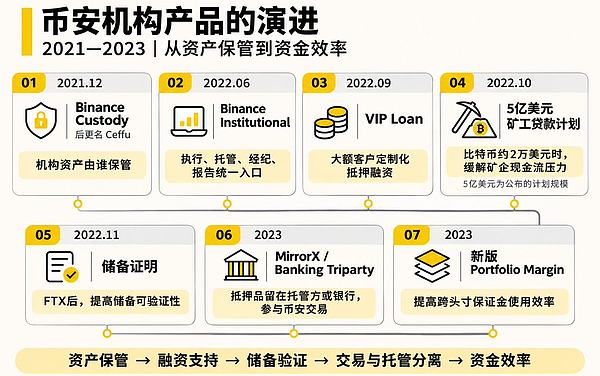
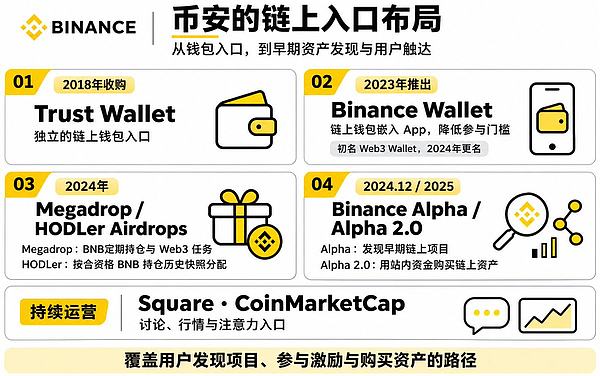
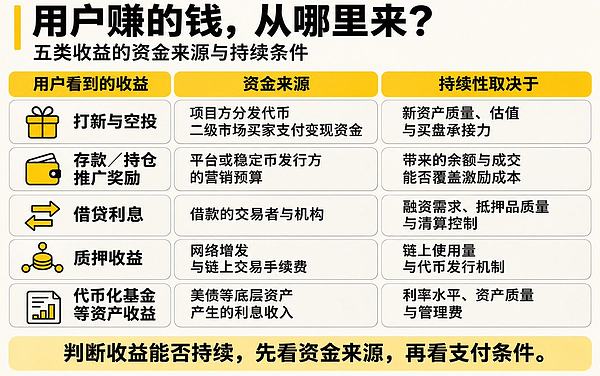
Author: danny; Source: X, @agintender In April 2021, in the middle of the bull market. Coinbase was about to ring the bell at NASDAQ, Bitcoin was standing at $60,000, and crypto users had a lot of stablecoins in their pockets, waking up every day asking: Where's the next new story? Introduction: Did you know? Binance sold the same Tesla stock twice. Binance conveniently moved Tesla into its trading interface. The product was called "stock tokens," issued by German licensed institution CM-Equity, priced in BUSD, and supported fractional shares. Crypto users who never opened a U.S. stock account could get exposure to Tesla's price with just a few clicks. Subsequently, Coinbase, Apple, and Microsoft were successively listed. However, just three months after the launch, it was a flop—multiple regulatory warnings occurred, and finally, on July 16, Binance stopped this service. Fast forward five years, Tesla made a comeback. In June 2026, Binance launched bStocks, issued by affiliated company BTech Holdings Limited, which executed according to the structure of tokenized securities with one-to-one backing for the stocks. Within regulatory compliance, these could be transferred into the BNB Smart Chain wallet; starting in October, more bStocks were added directly to the collateral lists for Cross Margin and Portfolio Margin. This reveals Binance's repeated standard playbook over the past decade: demand first grows wildly outside, and then Binance lowers the participation threshold, extracting current users, funds, and liquidity to enlarge the market, achieving full-range firepower coverage, followed by competitors joining, forming a larger liquidity network. If we enumerate the product development path since 2017, we will find that Binance has repeated this playbook numerous times. How effective has it been? It's somewhat like how Xiahou Dun defended the city—one eye open, one eye closed; sometimes it was a divine move, and sometimes, well, it was just paying tuition. 1. Six things done over nine years. If we lay out Binance's nine-year product history, it can be summarized as six actions: Find new profit opportunities, turn them into low-threshold products, keep funds in the pool, bring the interests of BNB holders into demand, sell trading capabilities to institutions, and ensure that when the next wave comes, the entry is still in its hands. Going through the years chronologically, these six actions are similar to Xiahou Dun reading the Spring and Autumn Annals—clear at a glance. Of course, this is a retroactive business logic aka hindsight. Many products back then were purely responsive to competition, market conditions, and regulatory pressures. Binance's skill lies in its ability to always regain existing users, funds, and trading networks, regardless of the reasons for new product innovations, some attributable to its strength and others due to competitors’ mistakes. Regardless, this front-end based on 'wealth effect' attracts users, while the back-end turns traffic into sustainable business through trading, retention, and institutional services, has already become the starting move of this money-printing machine. 2. 2017-2018: ICOs were responsible for issuing coins, while Binance made trading happen here. In 2017, issuing a coin was easier than setting up a farmers’ market. Ethereum smart contracts brought the cost of issuing coins to nearly collapse, and the ICO fundraising amounts at that time exceeded hundreds of millions of dollars. That was in 2017 when Bitcoin's peak was just below $15,000. The consequent problem was that there were too many coins in the market, yet a lack of decent trading venues; retail investors looked at the K-line charts enviously but had no idea where to buy or sell? Binance itself was a product of this wave. In July 2017, it issued BNB through ICO, raising about $15 million and went live in the same month. Unfortunately, on September 4, the domestic ICOs were halted, and domestic platforms were cleaned up, so Binance overnight moved its team and servers overseas, unintentionally becoming one of the first global trading platforms. It tapped into a fundamental need: allowing users in Mainland China to buy and sell new assets without regulatory constraints. Cryptocurrency trading, rocket-like speed of new listings, matching performance, multilingual interfaces along with rebates hit the sweet spot of Asian users’ hearts. Later, as the order book deepened, it attracted another wave of projects and retail investors. By the end of 2017, Bitcoin touched $20,000, and Binance's new users were so numerous that the servers began to smoke, even temporarily suspending new user registrations in January 2018—can you imagine a business so good that it needed to turn users away? At this time, the function of BNB was to reduce trading costs: 0.1% fees, and discounts for paying with BNB. But from the holders’ perspective, BNB was not just a discount from day one, but also a bet on the exchange's money printing ability. In the same year, Launchpad trialed two token sales, BREAD and GIFTO. Shortly after, the bear market of 2018 hit, with Bitcoin falling to around $3,200, and ICOs saw widespread failures. Binance faced its first existential question that would linger for the next eight years: New coins aren’t rising, there’s no wealth effect? What will bring users back? 3. 2019: A fire in the bear market, the flames spread On January 28, 2019, BTT was launched on Launchpad. The approximately $7.2 million was split into two sales of BNB and TRX, which sold out in 13 minutes and 25 seconds and 14 minutes and 41 seconds, respectively, causing the system to lag. After the ICO boom faded, the market lacked a wealth effect, and BTT proved that exchanges could create this miracle. At the same time, BitMEX dominated the derivatives market, and the trading volume of perpetual contracts overshadowed that of spot trading, making other exchanges jealous. Binance took two major steps this year. First, it changed BNB from a "fee discount coupon" to a "new token lottery ticket." Two months later, Launchpad switched to a lottery system: the number of tickets was linked to historical BNB holdings, and winners paid with BNB. Project teams needed users, and retail investors were looking for listing opportunities and liquidity, finding a perfect match where BNB became the entrance ticket to riches. The motivation to hold BNB shifted from "saving a bit of money" to "not missing out on wealth." It was reported that Launchpad completed 11 sales throughout the year, with platform users surpassing 15 million, listing 184 types of tokens and 591 trading pairs. Second, in September, Binance launched BTCUSDT perpetual contracts, later expanding to U-based and coin-based structures. With the same assets, trading relationships multiplied: market makers managed cross-market inventories, and arbitrageurs borrowed coins, adjusted margins, and accessed APIs, further expanding trading volume and asset accumulation. With more asset accumulation, how to retain users? Thus, Margin, Lending, Staking were launched in the same year, along with Loans introduced in 2020. In the first batch of Lending 14-day products, BNB, USDT, and ETC had annualized returns of 15%, 10%, and 7%, respectively. Combined with P2P transactions, fiat entry, and the launch of BUSD in September in partnership with Paxos, a complete internal funding chain was established: Fiat enters to buy coins → borrow money or open contracts to amplify exposure → idle assets are put into financial products for interest → one-click conversion to stablecoins, allowing people and funds to never leave the platform again. Binance began to wean itself off the dependency on "only having a spot bull market to survive." This year marked two more key events: in May, about 7,000 Bitcoins were stolen, and the SAFU fund fully compensated for the loss; in April, Binance Chain and Binance DEX went live, which in hindsight seems to be an early attempt at DeFi by the exchange and indicates Binance's aspiration for decentralized facilities. Every wave of enthusiasm will recede, but the accounts, balances, and trading habits left behind can become the starting point for the next business. 4. 2020-2021: Opportunities Outside the Exchange In June 2020, Compound distributed COMP, igniting DeFi Summer. The amount locked surged from less than $1 billion at the beginning of the year to $10 billion by the end, with Ethereum Gas prices skyrocketing to several dozen, even hundreds of dollars for a single transaction—buying groceries felt like riding a rocket. This posed a threat to Binance, as it meant fewer transactions: token issuance, trading, lending, and mining all became closed loops on-chain, reducing exchanges from "must-visit paths" to "optional choices." Binance quickly adjusted its strategy with two approaches. One focused on building chains: in September 2020, it launched BSC, which is compatible with EVM and has very low fees, allowing PancakeSwap to capture small to medium funds that were blocked by high Gas fees on Ethereum. BNB was also upgraded to become smart contract fuel and staking assets. The other focused on in-house yield encapsulation: in the same month, it launched Launchpool, and two months later, BNB Vault, simplifying cumbersome processes of on-chain wallet management, cross-chain, and calculating impermanent loss into a single click of “staking,” so funds wouldn’t need to leave the platform. The bull market of 2021 pushed this framework to its pinnacle. BNB soared from under $40 to nearly $700. That same year, BEP-95 introduced real-time burns, and by the end of the year, features like Auto-Burn were launched, etc. The bull market also brought about a round of "willing to try anything" expansion: the NFT market, fan tokens, blockchain games, Pay, Card, stock tokens, and more were intensively launched. Basically, whatever hot topic existed in the market was pursued. The result was naturally severe differentiation: fan tokens ended quickly, Pay was lukewarm, NFT services shut down in 2026, and stock tokens exited after three months. The summer of 2021 inevitably faced regulatory scrutiny from multiple countries, akin to the targeting of the first advantage of speed from 2017, which turned into risk exposure in 2021. 5. 2022—2023: Users not only ask how much profit there is but also how profits circulate. The continuous explosions of 2022: in May, the collapse of Terra wiped out a market value of approximately $40 billion; in June and July, Celsius and Three Arrows Capital defaulted and filed for bankruptcy; in November, FTX collapsed within a week. Industry concerns shifted from "where is profit higher" to "where’s the money, who can move it, and who is liable if something goes wrong." Binance's product focus shifted dramatically, with most of the things launched in those two years likely unheard of by retail users: On the retail side, subtraction was being carried out, with Simple Earn merging Savings and Staking in 2022. Stablecoins saw a complete offense and defense: in September 2022, Binance automatically converted USDC, USDP, and TUSD balances to BUSD, with circulation breaking $20 billion; but good times didn't last long, as Paxos halted the minting of BUSD in February 2023 per New York regulatory requirements, truncating its path to a proprietary branded stablecoin. November 2023 marked a watershed: Binance pled guilty in connection with U.S. related cases, paying about $4.3 billion in fines and confiscated assets, accepting compliance rectification and independent oversight, and CZ stepped down as CEO. From then on, service entities, access boundaries, and fund isolation all needed to follow regulations to establish a framework. Viewed now, this is very forward-looking as it becomes a ticket for Binance to access banks, institutional funds, and traditional assets. On-chain developments didn’t stop either, with opBNB and Greenfield launching in 2023, but this time only catching the technical trend without practical implementation. 6. 2023—2025: By the time projects are listed, the golden opportunity has passed. On January 10, 2024, the U.S. SEC approved a spot Bitcoin ETF, leading large funds to go through traditional brokerage accounts. The same year, meme coins were batch-created on-chain, completing their issuance to zero in just a few days; meanwhile, major projects being listed were generally overvalued with low circulation, making "getting trapped upon opening" a regular occurrence for retail investors. The order of traditional listings flipped: users completed discovery, purchase, and exit before projects went live on exchanges; by the time tokens were listed, users on-chain had become the path for liquidity exit. This essentially turned Binance’s liquidity into a dumping channel which was intolerable. Binance's solution was to add a layer of entry in front of the main site: This distribution network's scale is astonishing: Binance's registered users surpassed 250 million by the end of 2024 and exceeded 300 million by the end of 2025; in 2025, the total trading volume across all products was about $34 trillion, with spot exceeding $7.1 trillion, and the number of users for Alpha 2.0 reached 17 million, trading volume surpassing $1 trillion. The main site managed accounts, clearing, and compliance, while wallets and Alpha were racing towards new narratives on-chain. Thus, BNB completed its third transformation, becoming a distribution mechanism: project parties exchanged tokens for reach, users received airdrops based on holdings, and budgets for new projects transformed into subsidies to retain old users. The costs were also quite apparent: gaming the system, professional "flipping", and dumping after claiming. There’s also an unavoidable arithmetic problem in the background— the more people participate in the cake-sharing, the thinner each person's portion becomes. The platform can lower the entry threshold, but it can't create more hundredfold tokens; the wealth effect abruptly stops. What Binance excels at is transforming the profitable opportunities discovered by a few individuals into products that many can participate in with just a few clicks. 7. A Hidden Line: Selling Trading Capability to Others The excitement on the retail side is just a facade, as everyone knows that large funds and institutions are the main theme: since 2019, Binance has continuously exported trading, account, financing, and payment capabilities to institutions. This hidden line doesn’t need the story of hundredfold tokens, but answers the question, "If retail investors can't find the next wealth story, what sustains the exchange's business?" The starting point was the large OTC in January 2019, reportedly with a minimum single transaction of 20 BTC. It then took four steps: Acting as an infrastructure provider: In September 2019, Binance launched Broker, which later became Binance Link; in February 2020, Binance Cloud was launched, and by 2022, it bridged MT4/MT5. The logic is B2B wholesale; instead of acquiring customers one by one, it is better to serve enterprises with a massive user base. In September 2026, Exchange Link will be categorized under Crypto-as-a-Service, shifting from "connecting Binance" to "embedding crypto modules into other products." Incorporating institutional organizational structures into accounts: By December 2021, the documented Managed Sub-Account had already separated the powers of funders and traders, and in July 2022, Binance Fund Manager allowed associated funds to consolidate trading volumes and BNB holdings to qualify for VIP status. In October 2024, Binance Wealth will serve high-net-worth clients, while in April 2025, Fund/Portfolio Accounts will aggregate funds based on strategies, calculating net asset values. Providing algorithm execution and financing: In 2023, TWAP/POV algorithmic orders were launched, and by August 2024, spot trading will support FIX API and Drop Copy; on the financing side, there are VIP Loans and Institutional Loans, allowing up to ten sub-accounts to be included under the same risk credit line. Separating trading and custody completely: In the wake of FTX, institutions strictly control exchange concentration. In 2023, MirrorX reflected managed assets from Ceffu onto trading accounts, while Banking Triparty placed collateral in third-party banks. In June 2025, MirrorRSV strengthened independent cold wallets and on-chain verifiable holdings. According to data released by Binance, registered institutional users increased by nearly 97% in 2024. Additionally, Binance Pay connects the merchant side, and the Binance Pool launched in 2020 (now suspended) linked miner output with financing, allowing Binance to reach real-world enterprises not primarily focused on cryptocurrency trading. Section 8, 2025-2026: When crypto-native assets stop selling, they will turn to capture off-circle assets. In July 2025, the United States signed the GENIUS Act, where BlackRock and Franklin Templeton turned money market funds into on-chain tokens; meanwhile, the profitability of altcoins diminished in the crypto sphere. The question became: can traditional high-quality assets be brought in? Learning from the lessons of 2021, Binance decided to secure regulatory approval before launching products. In January 2026, under the Abu Dhabi ADGM framework, three licensed entities began to share the roles of exchange, clearing custody, and brokerage. Subsequently, perpetual contracts for gold, silver, and stocks were launched, with bStocks introduced in June and the margin collateral range for bStocks expanded in October. Thus, the asset hierarchy evolved into five layers: crypto spot, crypto perpetual, TradFi perpetual, on-chain assets and collateralized tokenized securities bStocks from spot and BSC, and the BNB reserve company DAT extending from external capital markets. Changes on the institutional side are quieter yet heavier: In February 2026, Franklin Templeton announced that qualified clients could use tokenized money market fund shares from the Benji platform as off-exchange collateral to participate in Binance trades through Ceffu. Franklin Templeton's RWA upgraded from "trade object" to being "the funding basis of transactions." AI is the latest entry point in 2026. Binance launched AI Agent Skills, and in September, Pay Onchain introduced corporate deposits and Agent Pay based on x402. This both follows the trend and attempts to address the "menu debt" accrued over a decade—dozens of products piled within the app, making it seem overwhelmingly extensive for ordinary users. The Agent transformed "finding the menu" into "saying tasks." However, currently, hoping for a direct correlation between "AI Agent utilization growth" and "BNB surging" is seen as asinine, needing a closer look at its actual demand. On October 29, this system faced an extreme stress test: a significant security incident occurred at Binance. A preliminary report on November 3 indicated that approximately $6.34 billion in assets were impacted, with about $2.85 billion frozen or intercepted, and Binance bore the financial losses. Compared to the 7,000 BTC stolen in 2019, the impact magnitude increased by two orders of magnitude, yet Binance managed to withstand it. Nine, Two Funding Lines Over a Decade: BNB Manages Rights, Stablecoins Manage Turnover Looking back at the nine-year product development path, there are two main lines that run through it. BNB is responsible for continuously giving users reasons not to sell: from the 50% discount on transaction fees in 2017, to the Launchpad lottery in 2019, the Launchpool and BSC fuel in 2020, Auto-Burn in 2021, the Fund Manager institutional VIP in 2022, and the upcoming Megadrop/HODLer airdrop in 2024, as well as the BNB Reserve Company in 2025. The underlying logic: Binance’s business expansion → increase in BNB use cases → holders receive returns. Stablecoins are responsible for ensuring liquidity between products. USDT has been consistently present while Binance's supported objects have undergone five rounds of changes: Reliance on USDT in 2017 → Promotion of BUSD in 2019 and a strong shift to USDC balances in 2022 → BUSD minting stopped in 2023, with FDUSD taking over → Collaborating with Circle to promote USDC in December 2024 → Lastly, supporting United Stables, known as U. Just after switching USDC for BUSD, Binance reconciled with Circle and then presented the new asset U. This operation illustrates one key point: Binance truly safeguards settlement and liquidity; the brand on the front is not what's important, but rather the operational flexibility. Circle's prospectus puts a price on this relationship: paying Binance a one-time fee of $60.25 million, along with monthly incentives tied to USDC balances and benchmark interest rates. The source of funding has expanded from project parties in 2019 to funding issuers in 2024. To add, the BFUSD launched in 2024, along with WBETH, BNSOL, and USDe, further eliminates the dichotomy of 'earning interest' versus 'acting as collateral.' However, as the utilization rate of funds peaks, the risks of collateral valuation discounts and liquidation liquidity cannot be overlooked. This was evidently felt on October 11, 2025. Ten, The Wool Comes from the Pig: Who Pays for Users' Earnings? The sustainability of the wealth effect depends on a simple math problem: who is the one coughing up the extra money in user accounts? Are project parties giving users money as a subsidy? That's impossible. In business, everything involves a trade of interests. Venture Capital pours money to pay team salaries and marketing costs, while users receive tokens. At the moment of token monetization, it's the secondary market buyers paying the price, motivated by the belief that the pool is large enough and that there are future buyers. Ultimately, every new reward cycle requires someone to pay on the secondary market. Eleven, Looking Back: The Same Set of Combo Moves Used Six Times Reflecting on nine years, Binance has rarely been the first to pioneer; it's skilled at external validation of demand, then lowering the bar and pricing before leveraging existing resources: But what goes in are potential customers, not ready-made depth—how traditional stock contracts handle market making and pricing during the off-hours must be rebuilt each time. However, not every attempt is successful; the Binance Chain and DEX initiated in 2019 became marginalized over time, burdensome to maintain dual chains, and after functionalities migrated to BSC, the Beacon Chain officially ceased operations on December 3, 2024. The NFT market, chain games, and decentralized storage have followed similar paths. The difference between success and failure lies in whether a momentary impulse can be transformed into sustained demand: perpetual contracts surrounding standardized assets have generated a whole set of mutually reinforcing financial demands; every NFT is unique and has thin depth, not sustaining the craze. Therefore, the complete business cycle is: Use opportunities to attract new users → Use transactions to increase frequency → Use financial tools for retention → Bind rights with BNB → Open capabilities to a larger market. Recognizing this complete cycle also brings clarity to where the next growth chapter lies. True growth points are never in 'the next hot topic,' but rather in the areas of sharp internal contradictions during the current stage. The most pressing contradiction for Binance now is holding excess distribution capability while the supply of crypto-native assets is insufficient to sustain this machine. Crucially, the old audience and holders still expect this strategy to continue. Therefore, everyone can only take clumsy steps, developing emerging businesses while caring for BNB rights—resulting in an outcome that reaches neither end. By giving old users a few rounds of airdrops, it’s just transferring back and forth within the existing pool, and growth is bound to return to zero once the subsidies end. Therefore, Binance's next breakout point is to leverage its years of refined trading structure to accommodate massive external assets, focusing on traditional asset trading, over-the-counter collateral, and stablecoin balances. But looking deeper, what is truly valuable behind these three focus points is not the act of "listing" but the pricing power of collateral. Traditional assets, stablecoins, and tokenized funds could theoretically be listed by any exchange, but only the largest one can determine “how much these things are worth in a $34 trillion margin system.” Whether pricing assets like those from Franklin Templeton or pricing illiquid small-cap stocks in the future, it is not the issuer that decides how much leverage purchasing power they can exchange for; it is Binance’s margin risk control table. Once this pricing power is established, it will reshape upstream supply through capital efficiency. The transmission process is actually very straightforward: when Binance’s risk control table grants a higher margin conversion rate for a certain category of assets, the cost-effectiveness for large funds holding it will instantly be maximized—they can not only earn yield on the underlying assets but also leverage trading. Funds will naturally vote with their feet, flocking to those assets in the Binance system that are “more useful and more valuable.” Upstream issuers will quickly understand that whether their products can gain traction depends not only on the assets themselves but also on whether they can meet Binance’s collateral thresholds and obtain higher conversion rates. Listing coins determines what users can buy, and margin rules determine what users can do with their assets. Thus, Binance’s role has undergone a qualitative change: it was previously about speed, moving others' assets into the exchange; later, it began to influence which types of assets are more worth issuing and holding through margin pricing. When others issue assets, Binance prices the assets and then prices assets beyond the crypto world, transforming from merely “receiving questions” to truly “posing questions.” bStocks and TradFi perpetuals have introduced U.S. stocks and commodities, and now that margin collateral and on-chain flow are connected, it remains to be seen how many people will continue to trade once the incentives fade; For over-the-counter collateral, tokenized funds, Ceffu, and bank tri-party collateral leave the trading relationships of traditional large funds within Binance, allowing assets to create depth without entering the exchange; For stablecoin balances, from the distribution share of USDC to the latest supported U, the essence is turning massive stagnant funds into a long-term yield-generating pool. As for Agent, it has only changed the operation entry, and new funding purposes are yet to emerge; meanwhile, most airdrop activities still revolve around giving existing users another round of rewards, so let’s wait and see. Binance's problem over the past decade has been: how to get more people to participate in the new market? The question for the next decade is: when opportunities are no longer scarce, why would users still need you?
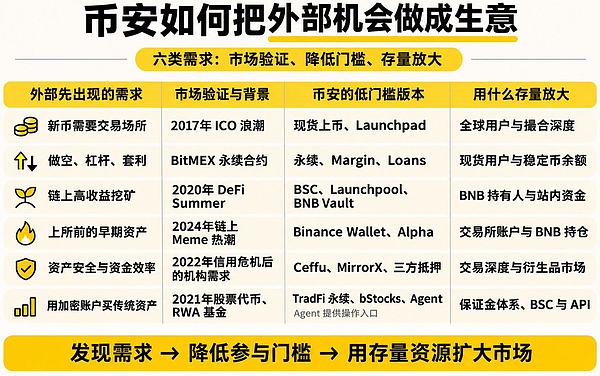
Details compiled from public sources. Always do your own research.