
Sky Founder Owes $77 Million, Du Jun Intends to Acquire All SKY Tokens

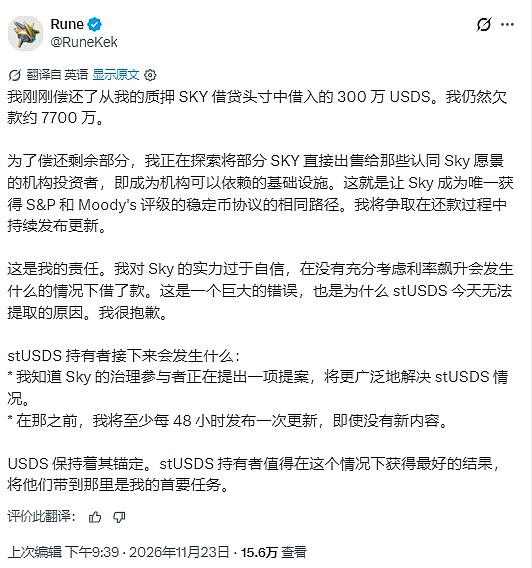
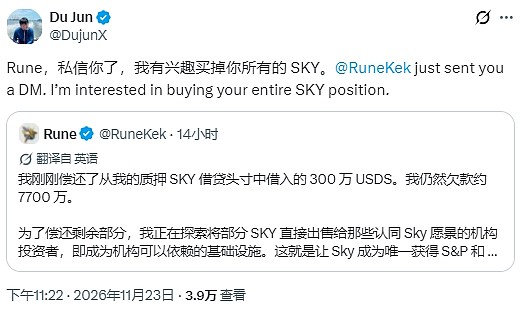
Sky co-founder Rune admits that his large collateralized loans are one of the reasons for the liquidity exhaustion of the stUSDS fund pool, having repaid 3 million USDS, with 77 million USDS still outstanding. ABCDE co-founder Du Jun expressed intent to acquire all SKY tokens held by Rune.
Machine translated. Refer to the original for accuracy.
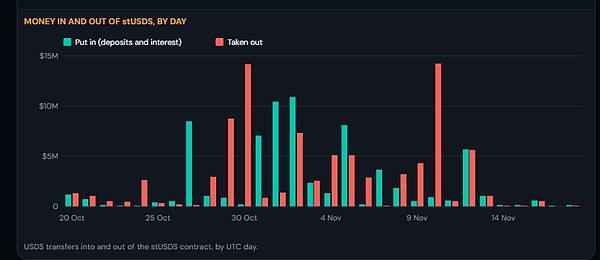
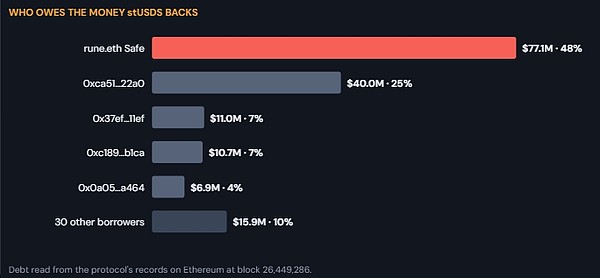
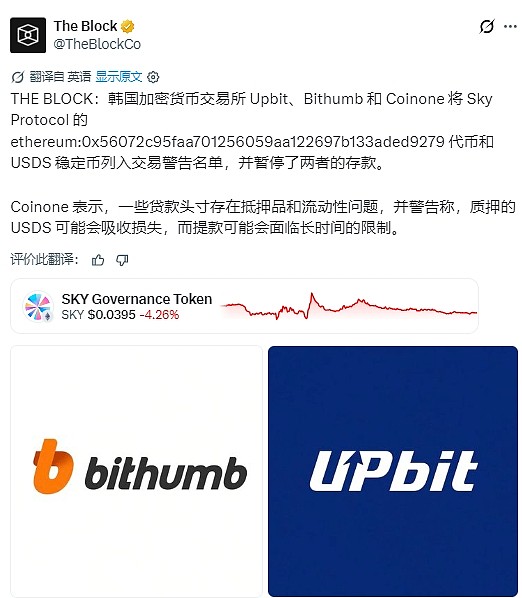
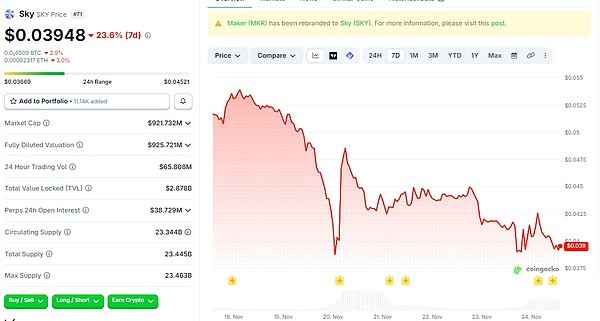
Tao Zhu, Golden Finance Summary: On November 23, 2026, Rune Christensen, co-founder of Sky, publicly admitted that his large collateralized loans were one of the reasons for the liquidity exhaustion of the stUSDS fund pool, which resulted in users being unable to withdraw normally. He announced the repayment of 3 million USDS, while about 77 million USDS in debt remains outstanding. Subsequently, Du Jun, co-founder of ABCDE, expressed intentions to acquire all SKY tokens held by Rune and has contacted him via private message. I. The Sky Founder’s Enormous Debt In mid-November, users who had deposited funds into the Sky platform found that they could not withdraw their funds. The funds in the savings pool had all been lent out, with one borrower accounting for 48% of the total loans. A post on social platform X pointed out that a wallet associated with Sky co-founder Rune Christensen bore roughly half of the debt in the savings pool. An analyst noted that this wallet had not made any repayments in the past six months. According to Protos, the video game studio Raw Power Games, founded by Rune, filed for bankruptcy on October 30. According to Bitquery tracking: the wallet bears a debt of 77.1 million USD, accounting for 48% of the total lent funds in the savings pool. However, the situation is worse than described in the post—since the loans were issued in May 2025, the wallet has never made any repayments and the debt balance has never decreased. Bitquery also tracked the flow of these lent funds: the largest amount went to an account at cryptocurrency broker Bitcoin Suisse, with smaller amounts flowing to cryptocurrency exchange Kraken. Afterward, these funds lost track on-chain. stUSDS Daily Inflow and Outflow Situation The operation mechanism of stUSDS, why depositors cannot withdraw funds at any time Sky has its own token, SKY, which can be traded on public markets, allowing holders to participate in Sky's governance voting. Holders can also use SKY as collateral to borrow USDS; the locked SKY serves as collateral for this loan. Since September 2025, stUSDS has begun to support these loans. Sky refers to stUSDS as "risk capital." Depositors bear the risk of borrower defaults in exchange for interest earnings. (Note: SKY and stUSDS are two important components of the lending mechanism in the Sky ecosystem. SKY is the governance token of the Sky protocol, allowing holders to stake SKY as collateral to borrow USDS; stUSDS is the yield certificate obtained by users depositing USDS into a designated lending fund pool, with the funds used to support loans secured by SKY.) Depositors can only withdraw funds that have not been lent out. The stUSDS page shows that when all funds are lent out, depositors may need to wait for borrowers to repay to retrieve their funds. The current situation is precisely this: data from November 19 shows that the total amount in the fund pool is 161.6 million USD, and it has all been lent out. As the new loan limits have reached the current total debt, more loans cannot be issued at this time. When the fund pool is completely drained, the yield offered will rise—this situation has occurred before. On November 19, the yield reached 25% annualized. In the DeFi space, it is not uncommon for fund pools to be drained: in October, a "whale" user borrowed all the remaining USDC from the Jupiter Lend platform. Is Rune the Debtor? The largest borrower is "Safe" (a shared wallet, where each payment needs to be confirmed by one or more owners' signatures). The ENS name used by this wallet is "rune.eth." Bitquery points out three clues that link this Safe to Rune Christensen: First, the ENS name "rune.eth" registered in March 2022 points to this address; second, the crypto research institution Oak Research listed it as Christensen's address in 2024; and lastly, since 2022, there have been financial transactions between this Safe and another wallet marked by Bitquery as belonging to Christensen (both outflows and inflows). The Safe's four loans total an outstanding amount of $77.1 million, accounting for 48% of the total funds supported by stUSDS. The second-largest borrower owes $40 million; this wallet is unmarked and has no direct transfer records with the aforementioned Safe. The top five borrowers account for 90% of the debt, while the remaining 30 borrowers share the rest. Risk assessors had already noticed this borrower a year ago. In October 2025, LlamaRisk, responsible for risk assessment for the lending platform Aave, pointed out that one address (holding four positions) accounted for 93% of the USDS total amount borrowed against SKY collateral. On-chain data shows that the Safe's four loans align with this figure. Subsequently, although other borrowers' loan sizes have increased, leading to a decrease in the Safe's proportion, its total debt has continued to rise—from about $52.9 million at that time to now $77.1 million. One Safe accounts for 48% of the stUSDS supported funds. Since May 2025, the treasury (Safe) has borrowed a total of 25 times without making any repayments. Debts will continue to grow with the accumulation of interest. The total borrowing amount of the treasury is $66.7 million; including interest, the current total outstanding amount has reached $77.1 million. The $10.4 million difference represents the interest that has not yet been paid in cash. The Sky protocol will mint this interest and inject it into the liquidity pool, which depositors see as returns; however, in the case of a full liquidity pool, they cannot withdraw this portion of the earnings. Where did Rune's borrowed money go? On November 16, according to PC Gamer, a wallet associated with Rune Christensen, founder of the DAI stablecoin protocol Maker and its USDS successor Sky, borrowed $1 million against SKY tokens on October 26. Less than a week later, his game studio Raw Power Games went bankrupt. Protos cited a 2022 report from Denmark stating that Rune founded this studio with his own funds. The report also mentioned that he stepped down as a director around October 29. A commentator cited by Protos speculated that the studio's operating funds came from stUSDS loans. However, on-chain data could not confirm this. The largest funds tracked by Bitquery flowed to accounts at Bitcoin Suisse and Kraken exchange, and the subsequent whereabouts of these funds have moved out of the scope of on-chain tracking. 2. Du Jun Proposes to Acquire All SKY Holdings After Rune announced the repayment of part of his debts and considered selling SKY to institutional investors, potential buyers quickly emerged in the market. On November 23, Du Jun, co-founder of ABCDE, responded to Rune's repayment statement on X, stating that he has sent Rune a private message expressing his intention to purchase all the SKY tokens he holds. In addition to Du Jun's personal acquisition intentions, the Sky community has also proposed some solutions. ares put forward his demands: Provide a public timetable and mechanism for resuming withdrawals—such as lowering the debt ceiling, enforcing deleveraging, introducing PSM (Peg Stabilization Module) or Surplus Buffer as backing, or other feasible solutions. Clarify how bad debts will be handled if SKY continues to decline, and whether stUSDS holders will bear the corresponding losses. Establish a fair withdrawal queue or proportional repayment allocation mechanism to ensure that exit opportunities are not monopolized by MEV robots. Disclose the largest borrowing positions and their repayment plans in the LSEV2-SKY-A protocol, especially those related to Sky's founders or core contributors. Maintain regular updates on progress (e.g., weekly) until the withdrawal function is normalized. ares calls on SFF to take the following actions: Repay the LSEV2-SKY-A debt as soon as possible using its held sUSDS; Clarify whether the remaining debt of about 12 million USDS will be repaid and when; Commit to not making any new LSEV2-SKY-A borrowing during the liquidity shortage of stUSDS. I understand that the initial borrowing was to fund operations without selling SKY. However, considering the interest rates up to 49.74%, maintaining this loan while holding 27.9 million sUSDS is unbeneficial for SFF and depositors. Rather than making any statements, prioritizing loan repayments would be more helpful for rebuilding trust. blackforest hopes the Core Council and BA Labs can provide clear updates on the following points: How long does asset utilization need to maintain close to 100% before taking governance-level actions? Can BA Labs clarify the specific conditions and execution order regarding the reactivation of the LSEV2-SKY-A liquidation mechanism, restoring the liquidation ratio to 145%, and reassessing the oracle cap? Can the Core Council indicate who is currently responsible for coordinating the response efforts and confirm when stUSDS holders can expect the next public progress update? xb0b points out: I have a feasible solution regarding the stUSDS situation. What if we reallocate the originally planned budget of 750,000 USD per day for SKY repurchases to purchase stUSDS on the open market? This way, all stUSDS holders can gradually exit within a year. Meanwhile, we can lower the Borrow Rate to 5%, instead of letting it rise to 50%. In this way, stUSDS holders will have a predictable exit route, and borrowers (as well as you) won't need to sell any SKY tokens. We can gradually alleviate the risk exposure related to stUSDS without adding further selling pressure on SKY. When will the Sky debt issue be resolved? There is currently no clear information on when the issue will be completely resolved. Although Rune has begun repaying debts, repaying the 77 million USD debt will take time, and the first repayment of 3 million USD was quickly withdrawn by users. Du Jun's proposed acquisition intention provides a potential channel for Rune to sell SKY, but whether both parties can agree on the price and transaction conditions is still unknown. Meanwhile, proposals for buybacks, prioritizing repayments, and halting new borrowings put forth by the Sky community will also require further discussion and governance procedures. Rune commits to publicly announce repayment progress at least every 48 hours, and whether he can repay the remaining debt through the sale of SKY, personal funds, or other means will become a focal point of market attention. What issues has the Sky crisis exposed? 1. Funding risks are highly concentrated among a few participants. As mentioned above, the Safe wallet associated with Rune has accumulated debts of about 77.1 million USD, accounting for 48% of the outstanding borrowings in the stUSDS lending pool, with the debts of the top five borrowers in the lending pool reaching 90%. Although Sky has multiple borrowers, once one of the large borrowers encounters repayment difficulties, the liquidity of the entire fund pool may be severely impacted. 2. Excessive asset utilization. According to The Block's report on November 23, Sky's stUSDS fund pool is about 159 million USD, with an asset utilization rate of 99.99%, and the annual deposit interest rate once exceeded 50%, yet the amount available for user withdrawals remains zero. This indicates that simply raising deposit rates cannot solve liquidity issues. When borrowers fail to repay their debts in a timely manner and new funds cannot continuously flow in, depositors are still unable to exit. After Rune repaid 3 million USDS, the newly added liquidity was completely withdrawn by users within 24 seconds, which more intuitively reflects the tight liquidity of the fund pool. 3. Do protocol-related personnel need more scrutiny when borrowing? Rune is not only a co-founder of Sky but also a related party of this large borrowing. The borrower has a strong interest affiliation with the protocol, making it difficult for ordinary users to fully assess the associated borrowing risks when depositing. Therefore, when protocol founders, core team members, or other related parties become large borrowers, whether independent risk assessments, borrowing limits, and mandatory information disclosure requirements should be established is a question Sky should reflect on. 4. Risks of the collateral liquidation mechanism in the Sky Protocol According to a survey by Bitquery, Rune-associated Safe borrowed USDS using SKY as collateral. Based on the public market price of SKY, the collateral value is approximately twice the debt, but the internal valuation used by the Sky protocol is $0.025. Based on this valuation, the collateral coverage ratio for this position is about 116%, which is below the safe line of 120%, and the liquidation mechanism for the relevant position has been shut down. This means that even if the collateral value falls below the safety standards set by the protocol, the system cannot automatically liquidate the collateral and repay the debt according to normal mechanisms. This puts Sky in a dilemma: if a large amount of SKY collateral is directly sold to repay the debt, it may put pressure on the market price of SKY; if the status quo is maintained, it may further increase the bad debts and liquidity risks in the fund pool. Therefore, how to reactivate the liquidation mechanism, adjust collateral valuations, and control market impacts on SKY while protecting depositor rights will be the issues that Sky's subsequent governance needs to address. 5. Market Reaction South Korean exchanges Upbit, Bithumb, and Coinone have placed SKY and USDS on a trading warning list and suspended deposits for both tokens. Coinone stated that some loan positions have collateral and liquidity issues, warning that the staked USDS may absorb losses and withdrawals may face prolonged restrictions. According to data from CoinGecko, the price of SKY has dropped from a recent high of $0.0539 on November 18 to a low of $0.039, a decline of 27.64%. As of the time of writing, it is at $0.03948.
Details compiled from public sources. Always do your own research.