
Gloom Hangs Over Year-End Market: JPMorgan Says Negative Risks Are Coming Together

With five weeks remaining before the end of 2026, the market is confronted with a dense list of risks.
Machine translated. Refer to the original for accuracy.
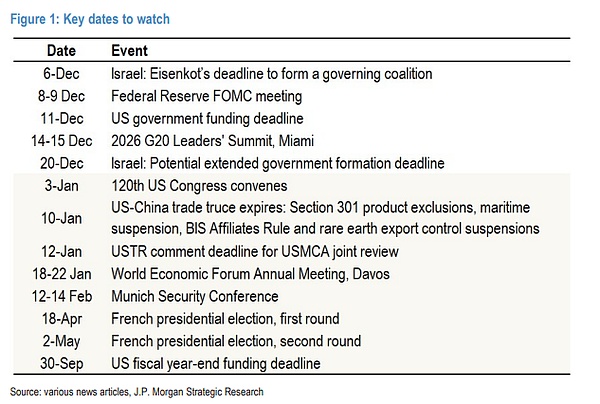
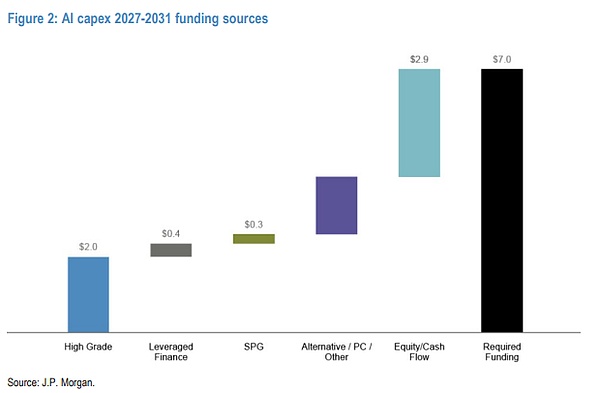
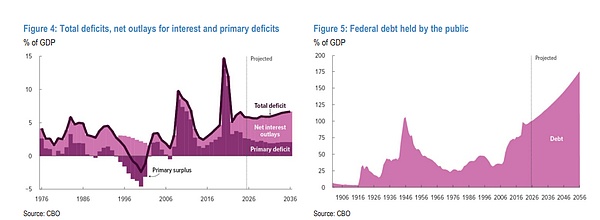
With five weeks remaining before the end of 2026, the market is confronted with a dense list of risks. According to news from Chase Trading Desk, on November 19, Joyce Chang, chairman of global research at JPMorgan, held a closed-door meeting in Washington with policymakers, official creditors, and independent think tank personnel. The bank released a report on November 24, summarizing the core content of the meeting as "Ten Risks to Monitor After the Midterm Elections". The opening tone of the report is heavy. Analysts wrote, "After returning from Washington, we are more cautious about the risks after the midterm elections", while nearly every asset class was falling that week, with US Treasuries and the dollar being the only exceptions. The report cited the most impressive warning of the day: "The collapse of AI financing, coupled with further tightening by the Federal Reserve, could create 'a very ugly Christmas'—a sharp drop in the stock market until the Fed is forced to pivot, just like at the end of 2018." Iran: December Might Be the Most Dangerous Window The participants sketched out three paths for the situation in Iran: negotiations reaching reconciliation (20%-25% probability), maintaining the status quo (30%-40%), or the US resuming military operations (30%-40%). The bleak outlook for negotiations stems from the vast gap in demands— the US insists on an "economic strangulation" strategy, while Iran demands immediate lifting of the blockade, lifting of sanctions, and the withdrawal of US troops from the region. The report describes the Iranian leadership as "increasingly dominated by hardliners in the Islamic Revolutionary Guard Corps focused on the survival of the regime". In terms of timing, the participants specifically pointed out December 9 to 11. The reason is straightforward: the lunar phase during these days will fall on the darkest night of the month, which has historically favored the offensive side. If President Trump authorizes action, it is believed more likely to be a brief intensive airstrike lasting 5 to 6 days targeting Iran's remaining nuclear facilities, rather than a prolonged ground war involving ground troops—"the possibility of US military casualties makes the deployment of ground troops politically very unattractive". Regarding oil prices, the bank's commodity strategist Natasha Kaneva's team poured cold water on the forecast. They predict surpluses in global oil supply of 1.6 million barrels per day in 2027 and 1.4 million barrels per day in 2028, with Brent crude oil expected to fall to $66 per barrel by the end of 2027. The report points out, "Current oil prices have already factored in the probability of an attack, considering that the oil market turned into surplus in September and the surplus further expanded in October, spot prices are 5 to 7 dollars above reasonable levels". Short-term military escalation may bring a temporary spike in oil prices, but the fundamental surplus pressure will soon dominate the trend. Federal Reserve: The Risk of Rate Hikes Making A 'Mistake' The debate over the Federal Reserve's path is another focus of the Washington meeting. One side argues that the Federal Reserve is behind the curve, believing that due to a lack of fiscal constraints, the neutral interest rate could be 100 to 150 basis points higher than pre-pandemic levels, and policy transmission is weakened as businesses and households can bypass policy rates to obtain other financing. One participant expects the Federal Reserve to hike rates three more times, each by 25 basis points, in December, January, and March to April. JPMorgan's US economic team's baseline forecast aligns with this: after three rate hikes, the federal funds target rate will rise to a range of 4.50%-4.75%, then pause until the end of the year. However, another faction's concerns are equally sharp. The Iran conflict pushed oil prices from about $60 per barrel to over $100 per barrel, triggering a significant shift in the Fed's language, but "the shock is mainly concentrated on overall inflation, with core inflation relatively stable". These individuals point out that if oil prices return to $60 per barrel, it would sharply reduce overall inflation through energy prices and base effects; if they fall to $40 to $50 per barrel, it could lead to broader deflation through transportation and other energy-sensitive costs, "core inflation could approach 2% under conditions where other components remain stable". "The risk is that the Federal Reserve continues to raise rates based on lagged data, while supply shocks happen to reverse at this time." The report also mentions that the age of first-time homebuyers has been pushed back to the mid-40s, with mortgage rates around 7.5% and structural supply shortages being the main obstacles. In the context of a temporary energy shock, using rate hikes to curb inflation comes at the expense of the housing market, and this logic is questioned. AI Financing: A $7 Trillion Tower, How Stable Is the Foundation? JPMorgan's credit strategy team predicts that AI capital expenditures will reach a total of $7 trillion from 2027 to 2031, with about $1.4 trillion in 2027 alone, almost double that of 2026. The question is, where does the money come from? The report states, "The annual financing scale of $1.4 trillion has reached the upper limit of what the debt market can bear," and AI investments have yet to achieve self-sustainability. A larger proportion of the financing in 2027 and 2028 will come from equity capital. Currently, the existing credit support arrangement amounts to about $372 billion. What is more alarming is the structure of circular financing. The report cites research from the IMF: The IMF reviewed 14 relevant transactions since 2023, finding about $300 billion in equity investment and $650 billion in debt, in exchange for $1.4 trillion in future income commitments. "The IMF warns that leverage and these financing ties may amplify market corrections if AI investments or profits fall short of expectations." Vendor financing, non-recourse loans, and leasing arrangements raise another layer of concern—these arrangements allow companies to purchase assets at high prices, while shifting most of the downside risk to lenders, creating a self-reinforcing cycle of financing that supports high transaction prices, which in turn validates even higher valuations. The profit growth for Mag 7 companies in the third quarter of 2026 has, for the first time since 2022, fallen below that of the remaining S&P 500 constituents. Tariffs: Effective tax rates may rise to 15%-20% before the end of the year Tariffs are not being reversed but are being rebuilt. Economists Jahangir Aziz and Abiel Reinhart of the bank noted in a report on November 13 that a series of 301 and 232 tariff measures are expected to be announced to restore the average effective tariff rate to levels before the IEEPA ruling was overturned in February. In particular, authorities are investigating "structural overcapacity" across 16 economies under Section 301, with results set to be announced; at the same time, the scope of Section 232 investigations is also expanding, covering products like steel, aluminum, and copper, with effective tariff rates potentially rising from the current 7%-8% to 15%-20%. Canada may receive some exemption, and Democrats may seek to repeal the Section 338 tariffs on Canada as an early political victory, but the overall direction is upward on tariffs, not a reversal. Chip Controls: Preemptive Actions Before New Congress Takes Office The controversy surrounding Nvidia has generated political momentum between the two parties to strengthen export controls, and the White House has incentives to set rules before the new Congress takes office on January 3. The scope of regulation is expanding from traditional chip exports to remote computing access, chip manufacturing equipment, and AI infrastructure investments. The report mentions four related bills that may be included in the National Defense Authorization Act (NDAA), including the Remote Access Security Act (RASA) covering remote access to U.S. data centers, an AI oversight bill for the regulation of AI technology, the MATCH Act for advanced semiconductor manufacturing equipment, and related legislation to combat chip smuggling. Government Shutdown: The Market Underestimates the Risk December 11 is the government funding cutoff date and the first major confrontation between Congress and the White House. The new Democratic majority will leverage this as a bargaining chip, with the core contention revolving around the National Defense Authorization Act (NDAA). The Democrats face a dilemma: they need to fund the Pentagon but do not want to be seen as authorizing the continuation of war with Iran. The report indicates that the Congressional Budget Office (CBO) estimates that by August 1, 2026, the Iran conflict will have cost the Department of Defense approximately $38 billion, with an additional $3 billion or more in monthly expenditures thereafter; the Pentagon's own estimate as of November 13 is $48.3 billion. If broader economic and consumer impacts are included, the independent estimate from the Wharton budget model at the University of Pennsylvania goes as high as $210 billion. The risk of government shutdown has risen due to funding disputes over the Iran war, and the report clearly states, "The impact of a shutdown risk on the market may exceed current market expectations." Fiscal: Both Parties Reluctant to Cut Spending The U.S. fiscal deficit is projected to be 6.2% of GDP in 2026, with JPMorgan economists predicting it to be 6.1% in 2027 and rising to 6.4% in 2028. The consensus among participants is disheartening: neither party has the political will to cut spending to stabilize the deficit. Republicans find it difficult to cut Social Security, Medicare, and Medicaid; the Democrats' priorities include restoring ACA subsidies and reversing cuts to Medicaid and SNAP, which will only increase expenditure. Treasury Secretary Besant is pinning hopes on a "3-3-3" strategy—adding an additional 3 million barrels per day of energy production, achieving 3% economic growth, and reducing the fiscal deficit to 3% of GDP—but the report bluntly states, "The 3% deficit target is far from achievable before the end of this presidential term." CBO estimates that if interest rates remain 50 basis points above their February 2026 benchmark, net interest spending will increase by about $1.6 trillion and total deficits by $1.9 trillion between 2026 and 2036; if the rate rises by 150 basis points, the increases would be approximately $4.9 trillion and $6 trillion, respectively. The consensus among participants is that a significant market or economic shock may be needed to force policymakers to take action. Market implications: Can a 25% drop be endured? JPMorgan's report dedicated considerable space discussing market resilience. Participants generally agree that if an AI correction triggers market sell-offs, its nature would be more akin to 2001 rather than 2008 — it wouldn't trigger a systemic crisis because the economic lifespan of computing assets like chips is about five years, the duration of valuation distortions is limited, banks are well-capitalized, and household and corporate balance sheets are healthier compared to those before the global financial crisis. However, some attendees presented a more pessimistic scenario: as the market value of U.S. stocks has reached 250% of GDP (as of June 2026), a combination of AI financing collapse, tightening technology export controls, and ongoing Fed rate hikes could result in a more significant adjustment similar to late 2018. Harvard economist Jason Furman’s estimates suggest that a 25% drop in U.S. stocks could reduce consumption by about 0.8% in the following year, dragging GDP growth down by approximately 0.6 percentage points; if the complete impact of the wealth effect on consumption is considered, the shock could reach as high as 3.4 percentage points. His hypothetical scenario also indicates that if Nvidia, Microsoft, Google, Amazon, Meta, Broadcom, and Oracle — the seven major AI stocks — drop by 50%, it could lead to an overall market decline of about 11%. The IMF model indicates that an AI shock could trigger a 20% drop in U.S. stocks and a 15% drop in other markets, with U.S. GDP decreasing by 0.8% in 2028 and global GDP falling by 0.4%. In terms of asset allocation, JPMorgan favors high-quality fixed income and the dollar over gold. The report notes that with a core PCE inflation forecast of around 2.7%, a stable yield of about 6% is attractive, with approximately 26% of securities offering yields above 6%. Regarding the dollar, JPMorgan's forex strategy team predicts that the euro will fall to 1.05 against the dollar.
Details compiled from public sources. Always do your own research.