
Liquidity Crisis of the Old DeFi

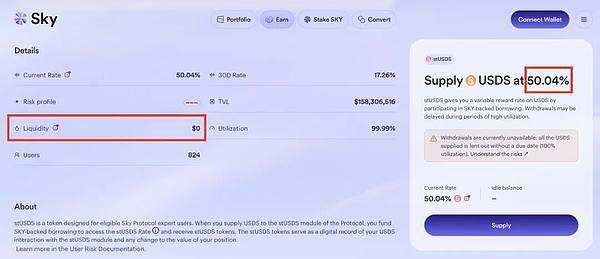
The stUSDS lending module under Sky has been borrowed out, leaving depositors with zero withdrawal limits, but USDS has maintained its peg to 1 dollar throughout.
Machine translated. Refer to the original for accuracy.
On Wednesday, BTC continued to consolidate around the $60,000 level. Recently, the bear market positioning plan of the teaching chain has entered the final stage, thus withdrawing the last batch of ammunition from Spark Savings. Spark Savings is a financial entrance where users can deposit stablecoins such as USDC and USDT to earn interest at a predetermined rate. Where does the interest come from? It comes from the income side of the protocol—the stability fees paid by borrowers, plus the coupon from US Treasuries and RWA, which is then shared with depositors according to the governance-adjusted savings rate. USDS is a stablecoin issued by Sky, which itself does not earn interest. The earning is done by the external wrapped sUSDS. The predecessor of USDS is the well-known old DeFi protocol MakerDAO's DAI. And this Sky is actually the new name after MakerDAO rebranded. The transition from MakerDAO to Sky represents a beautiful commercial track change: during the MakerDAO era, you would collateralize BTC or ETH, borrow DAI for investment, and seek excess returns, bearing all profits and losses; in the Sky era, you no longer need to care about the collateralized assets nor worry about investment returns, just deposit stablecoins as principal, and sit back to collect interest shared with you by the protocol. The former is a pawnshop; the latter is a bank. But with the bank open, some people want to take another step forward. Little do they know, one step forward shows the scenery, but two steps forward leads to an abyss. Later, the protocol introduced a new module called stUSDS. The structure is simple: depositors put USDS in, and receive a certificate called stUSDS; borrowers use their pledged SKY tokens as collateral to borrow USDS. What depositors eat is the interest paid by borrowers. In a nutshell, it is using the tokens issued by the protocol itself as collateral, and borrowing stablecoins from depositors. Thus, Murphy's law worked again. What you fear will happen. During the long and deep bear market that continues to swallow all gains, this pool has finally been borrowed out—since November 10, the utilization rate has been hovering around 100%, and the current pool size is $158.3 million, with the withdrawal limit reduced to zero. The more than 800 depositors who put USDS in thinking they had bought high-yield financial products are now unable to withdraw their principal. Little do they know whether they are now crying without tears? The current displayed interest rate is 50.04%—the protocol has pushed up the interest rate to attract deposits and force debt repayment, while borrowers remain indifferent. A wallet associated with co-founder Rune Christensen has never repaid since its opening in May 2025, with a principal of $66.7 million and accrued unpaid interest of $10.4 million, totaling $77.1 million, which accounts for 48% of the entire pool debt. On November 23, he first repaid $3 million, and within 24 seconds, it was completely withdrawn by depositors and arbitrage bots. So that 50% high interest is essentially not financial income, but interest on bad debts. Outside the pool, significant issues also arose on the stablecoin side. On November 19, CoinDesk reported on an analysis by Inca Digital, indicating that Sky's PSM stable module handled approximately $518 million in transactions initiated by wallets associated with illegal activities. On the same day the news came out, a long queue formed at the PSM entrance: $1.5 to $2 billion USDS was exchanged for USDC within one day. The circulating supply of USDS dropped from $5.24 billion to $3.15 billion, shrinking by 40% in one day; the total of DAI plus USDS is $7.71 billion, which is 43% less than the peak in April. However, one point must be emphasized: USDS maintained its peg to 1 dollar throughout this period without deviating. The reason for maintaining the peg is not complicated. According to Rune himself, Sky has an asset side of about $9 to $10 billion in USD assets, and the combined DAI and USDS total of $7.7 billion is still over-collateralized; although the USDC reserves of the PSM have been withdrawn from $2.5 billion to around $1 billion, they have been continuously redeemable. This is the fundamental difference between it and the tragic incident of the algorithmic stablecoin UST during the Luna/UST crisis in 2022—on the UST side, the pool had nothing but LUNA tokens. In 2022, the stablecoin UST peaked at nearly $18.7 billion, relying on Anchor’s 20% annual yield to attract deposits. Its collateral was the LUNA token, which is the protocol’s own token. After the depegging, arbitrageurs bought the cheap UST, destroyed it, minted an equivalent amount of LUNA, and then sold it; the cheaper UST became, the more LUNA could be minted for the same dollar, increasing the selling pressure, causing LUNA to drop further, which in turn dragged UST down deeper. After several cycles, the LUNA token was massively overissued, reached zero, and pulled UST down with it. This time, stUSDS has three similarities with UST from back then: high interest savings, collateral is its own issued token, and the exit channels disappear during a crisis. There are also two differences. First, the collateral of UST was endogenous, having no external assets in the pool; therefore, once the death spiral began, it could only plummet to zero. In contrast, Sky's collateral is external - assets worth $9 to $10 billion correspond to $7.7 billion in stablecoin liabilities, which sets them apart. Second, the SKy tokens in the stUSDS pool do not have the arbitrage-driven cycle of overissuance - it won’t print more just because the price drops; moreover, stUSDS is an isolated module, and its losses do not directly convert into USDS liabilities. However, there is a boundary: the liabilities are isolated, not the backstop. If stUSDS incurs bad debts, depositors bear the first loss, and any unsustainable portion must tap into Sky's surplus reserves. At the end of September, this reserve stood at $8.508 million, with a mid-term goal of $15 million; yet, the pool is $15.83 million, with Rune alone contributing $7.71 million. More critically, the final means of covering bad debts in the MakerDAO era was to mint more MKR tokens - converted to Sky, that means issuing more SKY tokens. And this is no longer just a theoretical risk. In September 2025, to facilitate the migration from MKR to SKY, Sky turned off automatic liquidation, reducing the minimum collateral rate from 145% to 120%; currently, SKY trades around $0.04, and reports indicate that three of Rune's four positions are already below the liquidation threshold. Liquidation should have been the final barrier, which the protocol itself has closed. The moment the iron rule "collateral cannot be the protocol's own token" was violated, the ultimate party to bear the costs became the entire protocol. Subsequent scenarios could play out in three ways: 1. Successful deleveraging. On November 24, the pool's lender Conquercube proposed to utilize $40 million to $50 million of reserves to repurchase SKY tokens from off-exchange borrowers - the USDS that borrowers obtain from selling coins will be used in the same transaction to pay off loans, and the proposal could reduce utilization from full to around 68% to 74%. An alternative parallel route is for Rune to sell SKY tokens directly to institutions, with investment institutions publicly expressing willingness to acquire the entire amount. If both paths are successful, depositors can withdraw in batches with limited losses. 2. Resulting in bad debts. If SKY continues to decline, liquidation remains open, and the under-collateralized portion is ultimately confirmed as bad debt, borne first by stUSDS depositors, followed by tapping into surplus reserves. 3. Governance backstop. Using reserves or PSM to directly cover the costs, which compromises the credibility of USDS, but the stablecoin itself remains pegged. Among the three potential outcomes, the second most harms depositors, and the third most harms the protocol. The commonality is that there remains potential for USDS itself to be preserved. Thus, this matter is currently still a crisis, not an incident. The greatest progress that DeFi has made over these years may be the realization of an iron rule: collateral must be changed from one's own issued tokens to external assets. However, stUSDS has intentionally or unintentionally retraced old paths by again using its own tokens as collateral. The difference lies in the fact that this time, it is not the protocol itself minting the tokens - the protocol merely loans out depositors' money, while borrowers use self-issued IOUs as collateral. Perhaps it’s not that they are unaware of the risks; it’s just that the temptation to exchange one’s own tokens for real money is simply too great, isn’t it? Therefore, the issue is never about how the code is written, but rather about how the financial structure is designed. Code can be audited, but structure relies solely on people to restrain their inner greed. Whenever you see high interest rates, don’t rush to excitedly deposit; it's best to ask yourself: who exactly is paying this kind of high interest, and how can they afford it?
Details compiled from public sources. Always do your own research.