
Unveiling the 'High Profit' Truth Behind Anthropic: The Cache Tax

Let’s delve into the profit logic behind Anthropic's business model.
Machine translated. Refer to the original for accuracy.
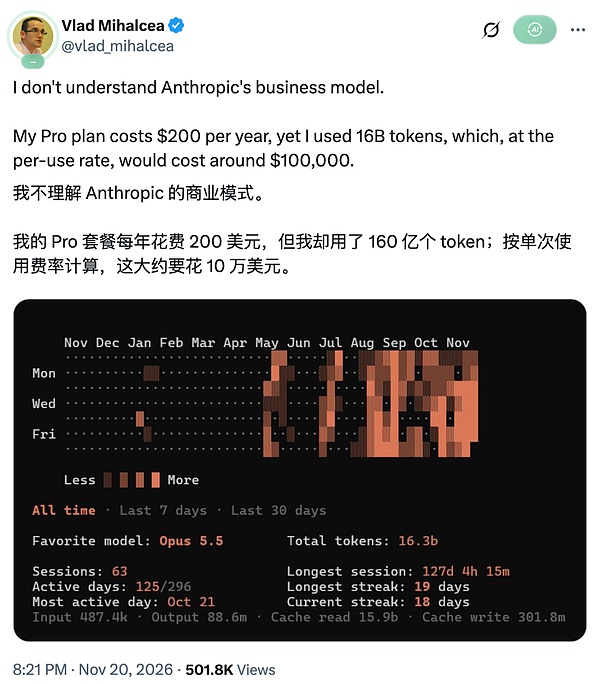
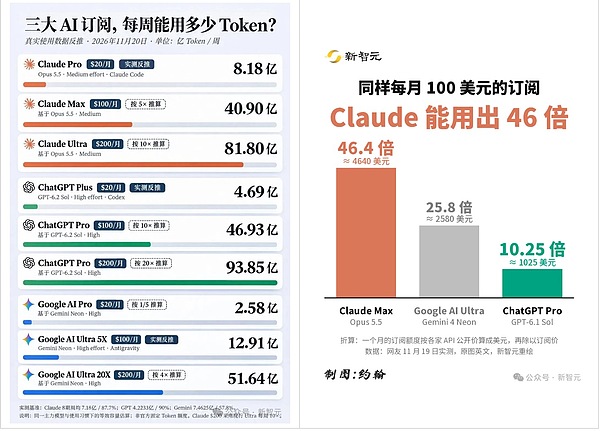
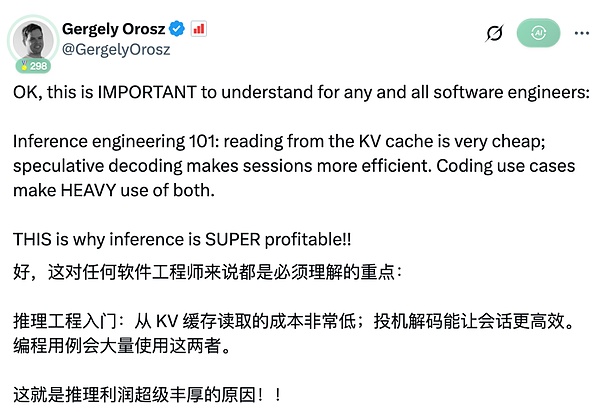
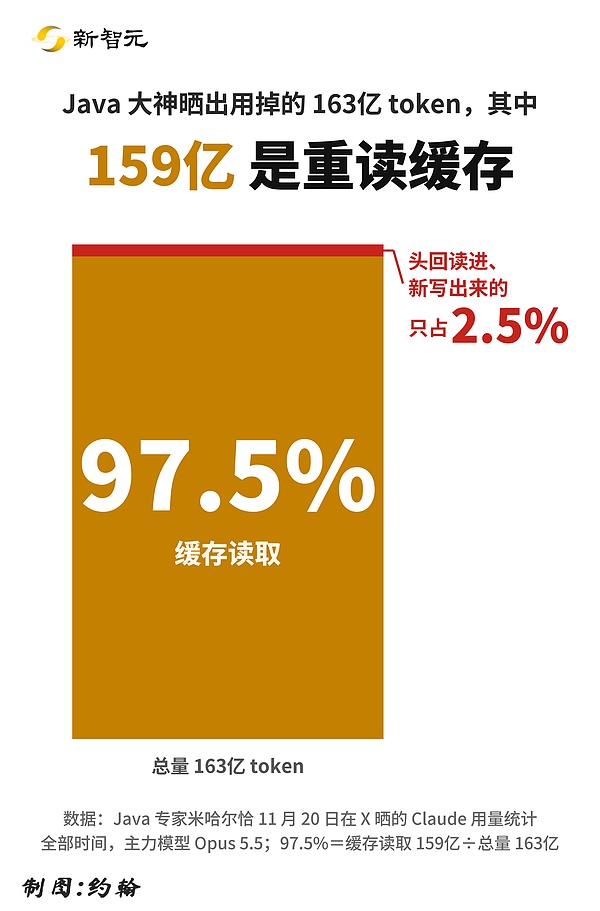
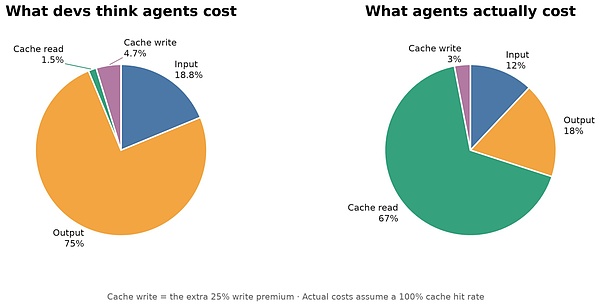
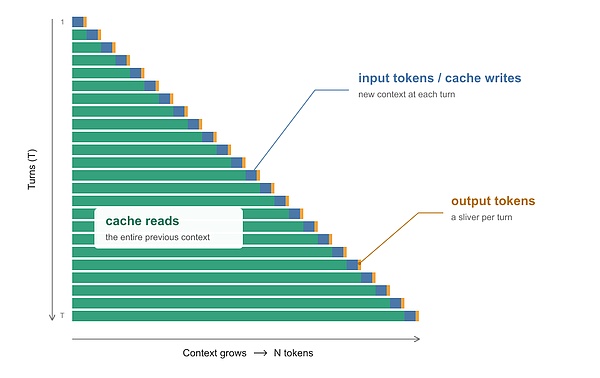
Recently, the AI developer community was rocked by a post that seemed almost surreal. The post was made by the legendary figure in the Java community, Java Champion Vlad Mihalcea. He gazed at his Claude billing for the past year and posed a soul-searching question: "I completely don't understand Anthropic's business model anymore. I only spent $200 on my Pro subscription for the year, yet I used 16 billion tokens – if billed by API usage, this amount would soar to $100,000!" $100,000 worth of service sold to you for $200? This is not a tech company; this is clearly Silicon Valley's living Bodhisattva using investors' money to distribute charity. If you think this is just an extreme case of some 'hardcore' programmer, then a recently released set of real-world data will make you question life even more. On November 20, 2026, a hardcore player reverse-engineered the weekly equivalent allowance of the three major AI subscriptions with actual usage data: The $20 per month Claude Pro subscription (running Opus 5.5 + Claude Code) can consume about 818 million tokens per week; if upgraded to the $200/month Claude Ultra or ChatGPT Pro, the weekly token consumption skyrockets to 8.18 billion and 9.385 billion tokens, while the relatively restrained Google AI Ultra 20X can also deliver 5.164 billion. The semiconductor analysis firm SemiAnalysis even calculated the total account: spending $200/month on the top-tier Claude subscription can yield an equivalent API usage value of $8,000/month, while OpenAI reaches as high as $14,000/month – on paper, manufacturers are losing 40 to 70 times their investment. At this point, many onlookers have started to sweat for Anthropic: how can this business survive? Isn’t it just a matter of time before the computing power collapses and the company goes public? While everyone was speculating, Gergely Orosz, the founder of the renowned tech newsletter The Pragmatic Engineer, came out to clarify: "Every software engineer must understand one thing: the first lesson of inference engineering is — reading KV cache is almost free, and speculative decoding increases long conversation efficiency dramatically. Programming scenarios happen to take these two technologies to an extreme. This is why AI inference can be super profitable!" Wow, it turns out we thought we were frantically 'shearing sheep', but they were actually counting money backstage until their hands cramped. How exactly is this accounted for? Today, we will thoroughly uncover the profit logic behind Anthropic's business model. The Illusion of 16 Billion Tokens: Coding Agent as a 'Heavy Repeater' To solve the mystery, we first need to clarify a question: Are the 16 billion tokens Vlad burned really all the 'original content' painstakingly generated word by word by Claude? Absolutely not. In the early chatbot era, when you asked a question, AI would respond, and token consumption grew linearly. But now, we are in the era of the Coding Agent, and the entire game has changed. A coding agent at work is essentially a crazy infinite loop 'repeater': It first reads the entire context of your codebase (assuming an N-level amount). The longer the conversation and the more frequently tools are used, the total token count explodes at a quadratic rate. Many developers have long believed that the most expensive part of the bill is the high-cost 'output tokens'. Diogo Almieda, co-founder and CEO of Typesafe, specifically wrote a simulator that replayed real programming trajectories of Nvidia's Open-SWE-Traces using Fable 5's pricing, only to find that the output tokens actually used for generating code and replies account for only 9% to 18% of the total bill! Another developer, Martin Alderson, simulated an Opus 5 conversation with a 60,000 Token context and 100 dialogue rounds, revealing that about 76% of the bill was spent on "Cache Reads." In other words, in real programming agent scenarios, over 90% of the Token consumption is simply the model repeatedly reading its own history from just a few seconds ago. You might wonder: even if it’s just “re-reading,” that’s still 16 billion Tokens. Doesn’t that cost a lot of GPU power? How does this allow Anthropic to make such huge profits? Here comes the first real secret weapon. Secret Weapon One: KV Cache, the AI vendors' "zero marginal cost printing machine" Don't be intimidated by the term "KV Cache"; understanding the physical cost of large model inference only requires remembering three things: Step One: Prefill - Costly in computation. When the model first reads your codebase, the GPU must work at full capacity to perform a lot of matrix calculations, converting the text into machine-understandable intermediate states (activation values), and then saving this into video memory. This saved "study note" is the KV cache. Once the cache is written, there's no need to recalculate when reading the same content again. Step Two: Decode - Costly in memory bandwidth. When the model starts generating output tokens, it needs to read the entire KV cache from high-bandwidth memory (HBM) every time it outputs a character. The computation required here is minimal, but the data transfer is massive. That’s why the output token unit price for various APIs is often five times more expensive than the input — memory bandwidth during the decoding stage is the true physical bottleneck in large model inference. Step Three: Tool Invocation - Just pressing the "pause button." When the coding agent stops to run a grep or execute a script, the entire KV cache that was calculated before quietly sits in memory. Having a bunch of bytes lying in memory for a few seconds consumes neither computational power nor memory bandwidth. Now the most absurd and lucrative scenario emerges. When the model generates output in one go, it has to read the entire KV cache each time it produces a character, but the vendor doesn’t charge you an extra "cache read fee" for this, as that expense has already been packed into the expensive output price. However, once the agent stops to adjust a tool and then continues, the API immediately changes its tone and charges you a "cache read fee" for the same KV cache that was quietly sitting in memory, incurring almost zero computational cost. Diogo Almieda summarizes this matter sharply: the reason you still have to pay for the KV cache after a tool invocation isn't due to any profound technical necessity; it’s simply because — "that’s how the vendor prices it; you can choose to use it or not." Anthropic has inadvertently revealed the details. If you go through the Claude API documentation, you will find an extremely intriguing detail: tokens for cache reads are not counted towards the API's input rate limits! Think about it, what are rate limits for? They are meant to protect the server from being overwhelmed by traffic. By excluding cache reads from rate limiting, Anthropic essentially shouts to the world: "This thing doesn’t cost me much real computational power; read as much as you like!" As for OpenAI, they used to run an automatic prefix caching system for more than a year for free, until they learned from Anthropic and added a 1.25 times premium to cache writing with GPT-5.6. Breaking this facade, Vlad’s $100,000 dilemma instantly becomes clear. That $100,000 is not Anthropic's actual cost, but is calculated based on "layered pricing on almost free cache reads" according to their API pricing table. For enterprises that pay per use, every time the programming agent invokes a tool, the vendor charges an additional "cache tax." This money incurs almost no costs, and the inference profit margin naturally gets higher. For subscription users paying $20 or $200 a month, Anthropic has waived this "cache tax," allowing them to freely burn billions or even hundreds of billions of tokens. On paper, it looks like they are losing tens of times, but in reality, the actual hardware costs incurred by the vendors are likely just a fraction of the listed prices. But even a fraction is still money. In October, SemiAnalysis estimated that subscriptions contribute about 10% of Anthropic's revenue but consume more than 40% of the inference computing power. Heavy users who max out their plans mostly still require subsidies from Anthropic. Card Two: Speculative Decoding — Squeezing Every Bit Out of GPU's "Idle Time" If KV caching drives the cost of "reading inputs" down to the floor, how has Anthropic managed to save money and accelerate during the decoding phase, the true physical bottleneck? This is where Gergely Orosz's second card comes into play: Speculative Decoding. As mentioned before, the model's decoding phase mainly gets bottlenecked by memory bandwidth, leading to most of the extremely expensive computational cores within the GPU being in a state of "idling" most of the time. It's like a Michelin-star chef standing by the stove, spending 90% of their time waiting for a prep cook to bring over the ingredients. Speculative Decoding aims to completely squeeze away the chef's idle time. The vendor will pair a very fast small model (or a dedicated predictor) as a "stenographer" alongside the large model, allowing it to make blind guesses for several upcoming tokens at once, which are then packed and sent to the large model. The large model can use its idle computational power to concurrently validate whether these guesses are correct in one forward pass. If correct, all guesses are released; if incorrect, they are sent back for revisions. In which scenarios do you think blind guessing is most suitable? Writing poetry won’t work, because a poet’s next line can be wildly imaginative; but coding is a match made in heaven! Code is filled with highly predictable structures: fixed syntax brackets, frequently occurring variable names, copying function signatures from the context, and making minor refactoring changes to existing code... The small model correctly guesses code almost every time, with an astonishing acceptance rate. The result is that code that originally required transporting memory several times to output can now be completed with just one transport. Now, when we combine the two cards, a flawless commercial puzzle emerges: Input side relies on KV caching: Is the agent madly re-reading context? Almost zero computational cost, API still collects caching fees, subscription models easily provide super high quotas; Output side relies on Speculative Decoding: Code is highly predictable, using idle computational power to maximize generation speed and throughput, further reducing the true cost per session. Even though large models are becoming more commoditized and open-source models are closing in, the inference gross profit margins of cutting-edge laboratories are actually getting higher; the secret lies here. Seeing through the cards, who is winning and who is paying tuition? After dissecting this "inference economics," we can turn back to the current AI landscape, and many seemingly contradictory phenomena suddenly become clear, while the strategies of different roles have become distinctly divided. First of all, if you are an ordinary individual developer, stop worrying, continuing to "pick" subscription packages is the most cost-effective deal. Whether it's the $200/year Pro or the $200/month premium plan, vendors are using extremely low marginal costs to exchange for your long-term retention and ecosystem stickiness, a rare win-win situation. Next time you see the backend reporting tens of billions of tokens, you can smile knowingly. If you are a technical team working on AI agents, don’t fall into the trap of "Smart Routing!" Many teams, in order to save money, like to add a router to the agent: send difficult problems to Opus and simple tasks to the cheaper Sonnet. Sounds smart? In reality, it may cost more than it saves. Because the KV cache cannot be shared between different models! A detailed calculation was conducted: in a Opus 5 session with a context of 100,000 tokens, even if the next step only needs to generate 1,000 tokens, as long as you switch to a cheaper model midway, you will have to re-write the entire context of 100,000 tokens into the new model's cache from scratch — the result is that this "cost-saving operation" actually raises the cost of this step by nearly three times, while also switching to a dumber model. Here is a counterintuitive conclusion: for long-context Coding Agents, the cheapest model may not complete the cheapest task. What truly determines cost is not just the model price, but also how much cache is wasted during each switch. The truly effective cost-saving architecture allows subagents to handle the dirty work that does not "inherit the main context" (for example, searching through 50,000 tokens' worth of logs in a codebase and only reporting 200 keywords to the main agent), controlling the inflation of the main context at its source. Lastly, for enterprises running agents at scale, the wave of open-source self-deployment cannot be stopped. As pointed out by Diogo Almieda, if enterprises run a massive number of agents using APIs daily, they are essentially handing over the substantial cost benefits gained from KV cache to closed-source vendors. This is also why, over the past year, a large number of tech giants have begun to decisively "escape" closed-source APIs: Uber cut its cost per token by 50% through architecture optimization, AT&T reduced it by 56%, and Pinterest slashed it by a staggering 90%; fintech giant Revolut went so far as to purchase 56 Nvidia B200 bare metal servers to operate on their own. More and more teams are leveraging specialized inference clouds like Modal, Fireworks, and Baseten to run open-weight models such as DeepSeek 4.1 Flash, GLM 5.3, and Kimi K3.1 Pro—only by controlling the inference stack themselves can they keep the real savings from KV cache in their own pockets. The good news is that the high "cache tax" has begun to show signs of loosening. Recently, Fable 5.1 just slashed the cache read price from $1 per million tokens down to $0.25. And it's not over yet. On November 9, Fable 5.2 was released, bringing the cache read price down to $0.20 once again. In just over two months, the cache read price is now a full 80% cheaper than during the Fable 5 era. Even more intriguing is that Anthropic itself admits that merely lowering the cache read price could lead to an overall usage cost reduction of approximately 45% for complex programming and agent tasks. This indicates that for Coding Agents, which frequently call tools and repeatedly read context, cache is no longer just an optional optimization but a key variable that determines the overall bill. As inference engineering thoroughly transitions from "black box magic" to essential knowledge for software engineers, the period of earning exorbitant profits through information asymmetry will gradually narrow.

Details compiled from public sources. Always do your own research.