
What’s Next for US Tech Regulation towards China After the Jensen Huang Incident?

Just four days after Jensen Huang's departure, the US Department of Commerce's Bureau of Industry and Security (BIS) published the interim final rule on "Access to Advanced Semiconductor Remote Access," which first included the review of permits for the rental of advanced computing power by Chinese companies and the admission of chips from Singapore and four other countries.
Machine translated. Refer to the original for accuracy.
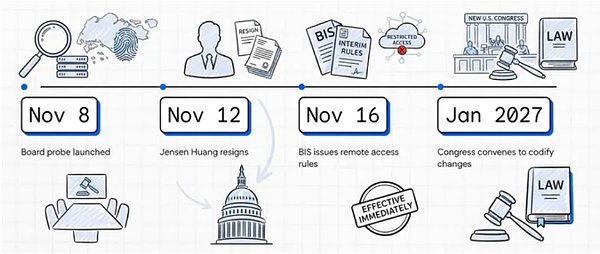
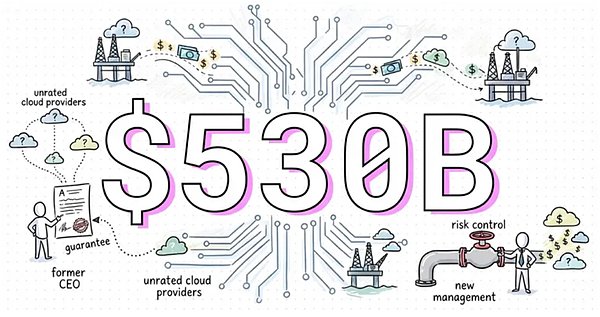
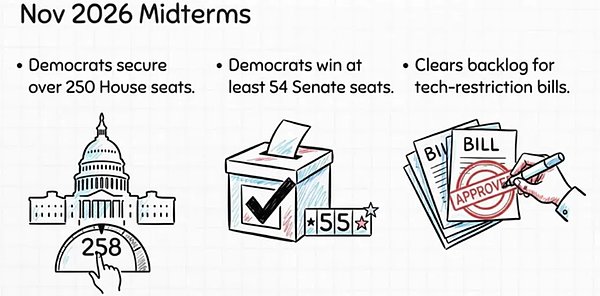
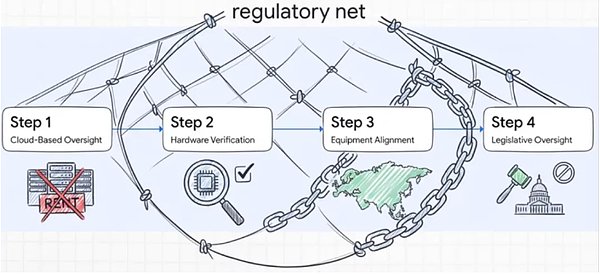
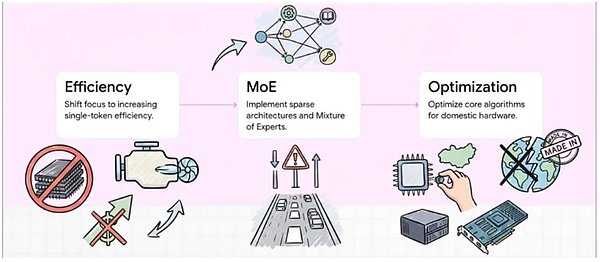
Author: Shanghai University of Science and Technology Think Tank On November 12, 2026, Jensen Huang, co-founder and President of NVIDIA for thirty-three years, resigned from his positions as President, CEO, and Director. Colette Kress, the CFO, has been appointed as the interim CEO, and senior director Harvey C. Jones has become the first Chairman of the Board in the company's history. The immediate trigger for this personnel change was the New York Times' reports since late October about Huang's private communications with former executives of the Singapore cloud computing service provider Megaspeed and an intelligence investigation by US intelligence agencies, compounded by disputes regarding senior executives within the company. Within two weeks, NVIDIA's market value fell by over $600 billion. From a corporate governance perspective, this appears to be a high-level executive cut to avoid compliance risks; however, within the framework of the global semiconductor industry and major power technological competition, Huang's departure represents the removal of the most critical coordinating point between national security hardliners in the US and cross-border commercial computing power supply over the past four years. Since the US escalated semiconductor export controls in 2022, the reason why a certain degree of commercial buffer still exists in the computing power field between China and the US largely stems from Huang's dual arrangement. On the industrial end, he utilized NVIDIA's ample cash flow and off-balance-sheet commitments totaling $530 billion to provide credit endorsement for emerging global cloud computing service providers, maintaining a massive third-party computing leasing market. On the policy side, he has long emphasized to Washington decision-makers the commercial value of maintaining Chinese AI developers' reliance on US software ecosystems, securing practical space for the sales of downgraded chips to China and the remote leasing of computing power from overseas data centers. With Huang's departure under the pressure of national security accountability, coupled with the Democratic Party regaining control of both chambers of Congress in the November 2026 midterm elections, US controls over Chinese computing power are transitioning from regulatory management with negotiated flexibility retained by the executive branch to statutory constraints led by Congress. Just four days after Huang's departure, on November 16, the US Department of Commerce's Bureau of Industry and Security (BIS) issued interim final rules on "Access to Advanced Semiconductor Remote Access," which first included reviews of permits for Chinese companies renting advanced computing power abroad and the admission of chips from Singapore and four other countries. The next phase of control will tighten around four directions: cloud remote access permissions, chip embedded location verification, alignment of ally equipment exports, and prior congressional approval. The hardening of external regulatory mechanisms will profoundly change the resource allocation patterns of China's AI industry. In the short term, compliant withdrawal from offshore computing leasing channels in Southeast Asia and the Middle East will raise the costs for domestic frontier large model teams to acquire large-scale training clusters, prompting research and development focus to further center on sparse architectures and single token generation efficiency. In the medium to long term, the narrowing of external computing access channels eliminates the expectations of leading domestic institutions to continue observing US hardware supplies, driving core algorithm engineering efforts into the domestic computing power system to complete joint iterations of software and hardware. Meanwhile, the collaborative relationship between Chinese and American engineers optimizing global open-source inference frameworks around general-purpose graphics processing units will also weaken, leading to a progressively clearer outlook where global computing infrastructure evolves into two interconnected yet independently evolving technological systems. Chapter One: Changes in the Political and Business Structure Behind NVIDIA's Power Transition 1.1 Counterintelligence Review Triggers Changes in NVIDIA's Management In the large tech firms with a market value exceeding four trillion dollars, NVIDIA has long maintained a distinct founder-led characteristic, with product route determinations, core supply chain lock-ins, and government relationship negotiations highly centralized around Jensen Huang. On November 8, 2026, when NVIDIA's board announced the initiation of an independent investigation into the private relationships of executives exposed by the media, the statement still emphasized confidence in Huang and his management team; however, just three days later, the board officially accepted his resignation effective immediately on November 11. The core factor prompting the board to change its stance in such a short time frame was not merely the internal ethical controversies but the intertwined risks of national security accountability resulting from personal scandals and cross-border computing flow investigations. The core party involved in this controversy, Singapore data center operator Megaspeed International, was spun off and restructured from a Chinese gaming company in 2023 and became an official cloud partner for NVIDIA. Between 2023 and 2025, it purchased at least $4.6 billion worth of NVIDIA hardware, building computing power clusters in Southeast Asia and leasing out computing power to customers, including large Chinese tech companies. Despite China's clear refutation of claims regarding the background of the personnel involved, and the involved companies denying any illegal physical transfer of chips, research institutions have estimated, based on global accelerator shipments and power consumption models, that a considerable scale of restricted NVIDIA chips has still entered the Chinese market through various channels in recent years. With the involvement of the US Department of Justice, the FBI, and related congressional committees simultaneously verifying the matters, if the founder continues to remain, NVIDIA not only faces a lengthy congressional hearing consumption, but its export licensing approvals for the global market may also encounter administrative freezes. The appointment of Kress, who has long been responsible for financial compliance, as the interim CEO and the establishment of an independent chairman position, essentially is a defensive institutional arrangement taken by the board to isolate political and regulatory impacts. 1.2 Founder’s credit tide recedes tightening global computing financing chain The direct effect of Jensen Huang's departure on the global computing supply structure is first reflected in the weakening of NVIDIA's function as an industry credit intermediary. Internally, NVIDIA has had about 60 executives reporting directly to Jensen Huang, and the company has neither set up a traditional second-in-command nor is it bound by short-term financial ratios. Relying on this decision-making mechanism, Jensen Huang transformed NVIDIA's enormous free cash flow and balance sheet into a financing lever for the expansion of downstream computing infrastructure. According to data disclosed in NVIDIA's Q2 fiscal year 2027 financial report, the total amount of off-balance guarantees has significantly increased from $184 billion in the previous quarter to $530 billion, which includes a $36 billion 'unconditional capacity guarantee' for emerging cloud service providers, and the company also holds about $99 billion in equity investments in the industry chain. From a financial mechanism perspective, this set of off-balance commitments is equivalent to NVIDIA using its own credit to enhance the credit of downstream customers. Numerous emerging computing cloud service providers and startup labs, lacking investment-grade ratings themselves, can raise funds at lower interest rates from the credit market, relying on minimum rent guarantees or data center lease guarantees issued by NVIDIA, which are then used to purchase NVIDIA's high-margin hardware. In the upstream manufacturing end, NVIDIA's quarterly commitments for supply chain and production capacity also rose from $119 billion to $279 billion, primarily directed towards high-bandwidth memory and advanced packaging capacity; leveraging long-term direct cooperation between Jensen Huang and leaders of South Korean memory manufacturers and Taiwanese foundries, NVIDIA has secured priority quotas and obtained procurement quotations about 20% lower than its industry peers. Once professional managers take over the operational authority, the focus of corporate governance naturally shifts towards risk control, cash flow safety, and stock buyback. Previously, Kress had adopted a cautious attitude towards high-risk guarantee schemes for large-scale customers in internal decision-making, and in the future, NVIDIA's credit guarantee standards for emerging computing cloud firms overseas will inevitably tighten, leading to financing contraction pressures for small and medium-sized computing operators that heavily rely on cash flow from cross-border Asian clients. 1.3 Washington's moderate business faction loses core policy support Beyond business adjustments, Jensen Huang's departure has disrupted the internal checks and balances surrounding the US chip policy towards China in Washington. Over the past four years, there have been two schools of thought in the US policy community regarding computing issues with China: security hardliners among both parties in Congress advocate for strict physical separation concerning advanced computing to prevent any cutting-edge chips or computing services from flowing to China; while the industry powers, represented by Jensen Huang, have repeatedly articulated to the administrative departments that moderately retaining compliant chip exports and overseas cloud computing services can keep China's AI R&D system within the US software and hardware architecture, thereby reducing Chinese enterprises' motivation to fully invest in domestic substitute chips. During the first half of Donald Trump's second term, this business logic gained considerable adoption within the White House and the Department of Commerce. Officials represented by Commerce Secretary Howard Lutnick tended to incorporate chip licensing into the framework of bilateral economic and trade negotiations. The U.S. government not only revoked the global AI diffusion tiered restrictions established by the previous administration in 2025 but also permitted Nvidia to apply on a case-by-case basis for selling certain high-performance chips to China in 2026, provided that a 25% revenue sharing was paid, while shelving multiple proposals for additional licensing rules and entity list additions targeting Southeast Asian data centers. However, as Jensen Huang resigned due to compliance issues related to China, Nvidia's lobbying credibility in Washington significantly suffered, prompting harsh criticism from the Treasury and congressional hardliners regarding the Commerce Department's leniency in export enforcement. American super-large cloud providers such as Microsoft and Amazon, who already supported restrictions on their competitors' overseas chip sales, found themselves in a more advantageous position in policy discussions. After the strongest voices from the industry opposing a blanket ban faded away, moderates advocating for policy flexibility within the executive branch found it increasingly difficult to resist tightening regulations. Chapter 2 Legislative Shift in U.S. Export Controls After Midterm Elections 2.1 Control of Both Houses Switches Hands, Clearing Backlogged Bill Schedules Nvidia's management disturbances coincided with the aftermath of the U.S. midterm elections in November 2026, further amplifying the certainty of policy shifts driven by overlapping political cycles. As of mid-November's vote counts, the Democratic Party secured over 250 seats in the House of Representatives and at least 54 seats in the Senate, taking full control of the legislative agenda and key committee chair positions in both chambers of the 120th Congress opening in January 2027. In terms of U.S. technology control issues concerning China, the basic positions of both parties are highly aligned. The delays in passing several chip and cloud computing restriction bills were primarily due to internal congressional scheduling and political maneuvering across issues, rather than any disagreement over the controls themselves. Looking back to mid-2026, when the Senate was drafting amendments to the National Defense Authorization Act for Fiscal Year 2027 (NDAA), there were plans to package four bills on chip and cloud computing controls concerning China together; however, due to dissatisfaction among Democratic members over the White House's military actions in the Middle East without congressional authorization and increased defense spending, they voted against the procedural vote in July, causing the bill to receive only 50 votes of support instead of the 60 votes needed to end debate. After the midterm election results were announced and the Nvidia incident evolved, two distinct time windows for legislative advancement emerged. The first window is the “lame-duck session” from November to December 2026, during which the leaders of the military and foreign affairs committees in both chambers were negotiating final coordination on the defense authorization bill, striving to retain the widely consensus-driven chip control provisions in the final version before the year-end recess. The second window will occur after the new Congress takes office in January 2027, when Chuck Schumer is expected to return to the position of Senate Majority Leader, while Elizabeth Warren, who has long advocated for strict regulation of chip exports, is likely to assume the chairmanship of the Senate Banking Committee overseeing export controls. Even if some provisions fail to be attached to the defense bill by the end of the year, they will gain priority scheduling next year and proceed rapidly through separate legislation. 2.2 Control Over Regulation Shifts from Executive Discretion to Congressional Legislation The most pronounced institutional feature of the next stage of U.S. controls on computing capability towards China will be the transfer of rule-making authority from administrative department regulation to Congressional statute. Under the existing system, the specific technical parameters and licensing policies for U.S. export controls are primarily executed by the Department of Commerce's Bureau of Industry and Security (BIS) through amendments to the Export Administration Regulations. This administratively driven model grants the President and Secretary of Commerce considerable discretionary power, enabling them to flexibly adjust the approval criteria based on changes in macroeconomic trade relations. For instance, throughout the second half of 2026, during the trade negotiations between the U.S. and China regarding the extension of trade agreements and the procurement of critical minerals and agricultural products, loosening or tightening specific chip export licenses was a negotiable tool in the hands of the U.S. negotiating team. A series of bills advancing in Congress aims to limit the administrative discretion in the national security technology sector. The most representative being the "AI Overwatch Act", which explicitly proposes to bring the approval process for exporting advanced AI chips to countries of concern under the congressional oversight framework similar to foreign weapon sales. It not only requires the cancellation of existing relevant export licenses but mandates that the Department of Commerce must submit specific licenses for congressional review before issuance, and may not arbitrarily lower the technical threshold for controlled chips within two years. In the face of an impending power shift in Congress and public pressure from the NVIDIA incident, the White House has recently shifted its previously negative stance towards limiting its discretionary power legislation, instead providing specific technical amendments to congressional committees. For the White House, actively participating in legislative coordination can help avoid excessive erosion of diplomatic authority in bill provisions, while also transforming Congress's stringent legislation into an external constraint excuse in bilateral economic and trade negotiations. Once core computing power restrictions are elevated from administrative regulations to congressional legislation, it will be difficult for the U.S. administration to unilaterally relax computing power export restrictions even if bilateral economic and trade relations experience a temporary thaw. Chapter 3 The Evolution of Four Mechanisms for the Next Phase of Computing Power Control on China 3.1 The Remote Access Act Will Include Cloud Computing Power in Export Licensing In terms of specific regulatory tools, the most far-reaching impact on existing cross-border computing power business models is the "Remote Access Security Act" (RASA, H.R. 2683). This act passed the House on January 2026 with 369 votes in favor and 22 against, and is now pending promotion by the Senate Banking Committee or incorporation into the Defense Authorization Act. Over the past two decades, U.S. export controls have followed the traditional principle of physical cross-border operations: as long as servers equipped with high-end accelerator cards are physically deployed in data centers in Singapore, Malaysia, the Middle East, or Europe, and there is no physical transfer of the hardware, it does not fall under the current regulations requiring a license for "export" if Chinese companies rent these servers remotely via the internet to train models. From the perspective of economic benefit and security monitoring, this offshore dollar market-like operation has been quite favorable to the U.S.: computing power rental income belongs to U.S. chipmakers and overseas cloud operators, while physical control of the servers remains overseas, allowing for immediate disconnection of services, and to some extent retaining control over the scale of customers' computing power usage. However, after cases like Megaspeed were exposed, the U.S. Congress widely believes that offshore cloud leasing has become the main channel for bypassing physical chip bans. The RASA Act formally authorizes the Department of Commerce's Bureau of Industry and Security to implement licensing management for remote access to controlled items in the cloud, requiring cloud computing service providers to establish a client identity verification system similar to the anti-money laundering compliance of financial institutions. This means that the regulatory boundary extends from traditional customs checks of physical goods to the network accounts and computing power allocation levels of global data centers. Once the law takes effect, emerging computing power cloud manufacturers across the Asia-Pacific, the Middle East, and Europe and America will face secondary sanctions and supply cut penalties if they continue to provide cutting-edge remote computing power to unlicensed Chinese entities. While Congress advances legislation, the administrative sector has already issued interim final rules on "Responding to Advanced Semiconductor Remote Access" on November 16, 2026, adding new sections 744.24 and 742.6 to the Export Administration Regulations, and formally abolishing the old "Artificial Intelligence Diffusion Framework". The new rules stipulate that any global data center (including networked data centers sharing underlying resources) that provides advanced computing power access exceeding 12 million aggregate total processing performance (TPP) to companies whose headquarter or ultimate parent company is located in mainland China and Macau (including those training via third-country subsidiaries or third-party intermediaries) must obtain case-by-case permission in advance; existing compliant services must obtain permission within 90 days of the rule's effectiveness, and only purely commercial recommendation systems may qualify for specific exclusions (excluding any generative models). Furthermore, the new rules have added export licensing for advanced computing items for Indonesia, Malaysia, Singapore, Thailand, and Brazil (U.S. parent companies may enjoy regional license exemptions based on monthly reporting, but computing power allocated to China is still subject to usage review), and have tightened the path for front-end wafer fabs and packaging testing companies to overturn unapproved design assumptions for chip classifications. 3.2 The Chip Security Act Enforces Mandatory Verification of Hardware Location. To address the gray trade chain of dismantling and transferring physical servers via third-country intermediaries, the US Congress has launched the Chip Security Act (S. 1705 / H.R. 3447), which has been unanimously approved by the House Foreign Affairs Committee with a vote of 42 to 0. In recent years, despite multiple enforcement actions taken by US law enforcement against illegal transfer cases—such as the US Department of Justice prosecuting a case involving about $2.5 billion worth of Nvidia chip servers in March 2026—relying on manual tracking of a global multi-level distribution network incurs extremely high enforcement costs, making it difficult to fundamentally block the flow of hardware. The solution provided by the Chip Security Act is to frontload law enforcement oversight into the chip hardware architecture, mandating that all exported advanced AI chips and servers integrate location verification technology to prevent tampering. It stipulates that once license holders discover that chips have deviated from approved locations or show signs of human disassembly, they must immediately report to the Department of Commerce. In engineering principles, this type of location verification mainly relies on the hardware security keys embedded in chips and the measurement of network communication delays: operating accelerator cards need to regularly communicate securely with designated verification nodes to determine the geographical range of the server based on the physical transmission delay of optical signals in fiber optics. Nvidia had previously launched a data center management telemetry tool called Fleet Intelligence, capable of monitoring cluster operational metrics and physical locations, but it was only voluntarily opened to officially certified cloud partners. The new legislation effectively transforms this voluntary commercial tool into a statutory factory condition, ensuring compliance checks throughout the entire lifecycle of chips from factory release to daily operations, significantly raising the technological entry barrier for obtaining large-scale usable clusters through physical smuggling. 3.3 The Multilateral Device Coordination Act Tightens Upstream Production Line Expansion In addition to blocking overseas cloud leasing and physical chip transfers, the AI OVERWATCH Act and the MATCH Act (S. 4281) respectively tighten constraints from the finished chip quotas and upstream manufacturing equipment. The AI OVERWATCH Act requires advanced computing chips to prioritize meeting domestic market demands in the US, abolishing existing licenses for concerned countries and preventing chip companies from designing reduced-performance special products specifically targeted at regulatory red lines through stringent congressional reviews. The MATCH Act focuses on the unification of multilateral rules for semiconductor manufacturing equipment. In recent times, due to the US conducting unilateral controls that are stricter than its allies' standards, Dutch and Japanese manufacturers have still been able to sell certain deep ultraviolet immersion lithography machines (DUV) and etching, deposition equipment to non-restricted wafer fabs in China and provide on-site maintenance and spare part support, which has opened a window for the local expansion of advanced logic chips and high-bandwidth memory capacity in China. The MATCH Act requires the administration to encourage allies, such as the Netherlands and Japan, to align their export restrictions on semiconductor manufacturing equipment fully with US standards, filling regulatory gaps in equipment categories and after-sales service. The Dutch government has conducted multiple rounds of discussions with the US on this issue, striving to minimize the impact of US extraterritorial jurisdiction on normal operations of its domestic equipment companies while cooperating with multilateral security coordination. The four acts work in tandem to form a comprehensive institutional framework covering manufacturing equipment, physical chips, cloud access, and administrative approvals. Chapter 4 The Impact of Upgraded Computing Power Controls on China's AI Industry 4.1 The Shrinking Offshore Computing Power Changes the Cost Structure of Large Model Training With NVIDIA's internal compliance restructuring and the accelerated legislative process in the US Congress, Chinese artificial intelligence companies are primarily facing a substantial narrowing of overseas computing power leasing channels. In order to reduce its own regulatory risks before formal legislation is implemented, NVIDIA has actively reduced more than half of its pre-approved buyer list in Asia over the past few months, and has guided global cloud partners to increase the service percentage of non-Chinese customers to over 51%, while requiring some cloud vendors to validate the identities of the ultimate users of computing power. After Jensen Huang's departure, emerging computing cloud operators in Southeast Asia, the Middle East, and Europe and the US are bound to hasten the cleanup of high-risk businesses related to China out of considerations for hardware supply and debt financing security. Past practices by some domestic R&D institutions that leveraged overseas distributed data centers to obtain the latest generation of accelerator card clusters will face higher compliance scrutiny thresholds and supply discontinuation uncertainties. Especially after the issuance of the new BIS remote computing power regulations on November 16, the arrival of equipment at data centers, signing of contracts, and prepayment of rent no longer guarantee the continuity of service. Existing services must obtain permission within 90 days, and leasing US-funded overseas data centers or sharing computing power with recommended businesses must also re-examine licensing conditions. Domestic companies that heavily rely on a single overseas cluster for training are recently compelled to prioritize arrangements for the refund of unused fees, export of training data and model checkpoints, and migration planning. The tightening of hardware acquisition channels has directly changed the cost function and technical selection preferences of domestic large model R&D. When solely relying on increasing the number of the latest process chips to elevate model scale becomes no longer economical or even feasible, the focus of engineering optimization naturally shifts to improving the token output efficiency per unit of computing power. In terms of model architecture, controlling the ratio of activated parameters in the mixture of experts model (MoE), compressing key-value caches (KV Cache) in long context scenarios, and improving sparse attention mechanisms have become the main methods to hedge against hardware memory bandwidth constraints; at the business implementation level, companies no longer blindly pursue the repeated training of an all-purpose super large parameter base but focus more on the cost-performance ratio of medium-scale models in vertical industry scenarios. While the constraints on computing power increase the difficulty of frontier exploration, they also accelerate the concentration of industry funds and computing power resources towards R&D teams with underlying system engineering capabilities. 4.2 External Channel Tightening Accelerates Domestic Computing Power Commercialization Verification From the perspective of the incentive mechanism of industrial evolution, the US's comprehensive blockade of offshore computing power leasing and reduction of chip supply has objectively produced another profound impact: it has eliminated Chinese AI companies' hesitance towards external computing channels and accelerated the commercialization integration of domestic computing power chips and local software stacks. In the semiconductor industry, whether an accelerator card can move from being "available" to "usable" depends on whether there are enough first-line algorithm teams continuously using it in real large-scale training and high-concurrency inference tasks, and continuously improving compilers, communication libraries, and underlying operators in practice. In recent years, as long as companies could still obtain NVIDIA's computing power through compliance reductions in hardware or overseas data center rentals, most teams still tended to prioritize the use of mature CUDA environments for short-term business considerations to save code migration and debugging time, making it difficult for domestic chips to enter the core frontier model pre-training phase. As external substitute channels gradually close, the long-term certainty of transitioning to local computing power architectures begins to outweigh the short-term engineering retrofit costs, leading to a significant enhancement in the collaborative depth between leading domestic model vendors and domestic chip companies. Since 2026, this shift has been validated on multiple benchmark models: in February, Zhipu released its flagship model GLM-5, which was fully trained based on a Huawei Ascend 910B cluster of 100,000 cards using the Ascend framework, and achieved inference support for multiple domestic accelerator cards; between April and August, DeepSeek launched a hybrid expert model V4 with a total of 1.6 trillion parameters while simultaneously open-sourcing inference operators and community plugins deeply optimized for Ascend processors; in June, Meituan released the LongCat 2.0 model, which also completed the pre-training process from scratch relying on domestic computing clusters. When leading commercial applications and foundational models continuously run on domestic hardware, the software ecosystem's shortcomings can gradually be made up through high-frequency engineering feedback, and funds originally flowing to overseas computing power leasing markets will also return to support the iteration of domestic wafer manufacturing, advanced packaging, and cluster interconnection technologies. 4.3 Hardware Foundation Differentiation Weakens Multinational Open Source Software Collaboration. Another structural spillover effect brought by the upgrade of computing power control is the dismantling of the symbiotic relationship between Chinese and American engineering circles in the field of open-source artificial intelligence software. In the past two years, a noteworthy phenomenon has emerged in the global open-source large model ecosystem: Chinese research teams, constrained by hardware performance and quantity, have developed and open-sourced a series of high-quality low-level communication and matrix computation libraries—such as DeepEP, DeepGEMM aimed at mixed expert architectures, and FlashKDA, an attention optimization kernel released by the Dark Side of the Moon—aimed at fully exploiting the computational efficiency of existing NVIDIA chips. These low-level software innovations have been widely integrated into international mainstream open-source inference frameworks like vLLM and SGLang, significantly reducing the computing power costs for small and medium-sized tech companies and startups globally. For NVIDIA, the thriving open-source model ecosystem was originally an important support for maintaining its market position. As North American hyperscale cloud service providers like Google, Amazon, and Microsoft increasingly deploy self-developed dedicated chips at scale, the long-term bargaining power of closed-source model giants over general-purpose graphics processors has been on the rise; only if open-source models maintain strong competitive advantages will enterprises globally continue to procure NVIDIA hardware for privatized deployments and regional cloud services. During Jensen Huang's tenure, he actively supported the open-source community, and NVIDIA's engineering team maintained close technical collaboration with Chinese open-source laboratories. Following Huang's departure and the advancement of remote access restrictions, NVIDIA, managed by professional managers, is expected to reduce collaboration on open-source technologies related to China due to compliance prudence and short-term financial return considerations. At the same time, as Chinese R&D teams shift their optimization focus to domestic heterogeneous chip architectures, the low-level operators and compilation tools they create will no longer directly adapt to American hardware, and some key performance optimizations may even become internal proprietary technologies. The slowdown of transnational open-source technology flows will objectively make it more challenging for Western startups to obtain low-cost open-source inference solutions. Chapter 5: Long-Term Evolution Trends in Global Computing Power Infrastructure 5.1 Gradual Easing of Single Hardware Architecture Dominance From a long-cycle perspective of the evolution of the global tech industry, Jensen Huang’s departure as CEO of NVIDIA marks the end of an era dominated by a single company, a single founder, and a single hardware-software ecosystem driving global computing power expansion. Over the past decade, global artificial intelligence computing has been built upon a highly integrated transnational division of labor: relying on advanced wafer foundries in Taiwan, high-bandwidth memory chips in South Korea, NVIDIA’s parallel computing architecture and CUDA software system, coupled with the vast technical talent reserves of both China and the United States, allowing the entire industry to rapidly iterate along unified technical standards. Huang managed to maintain the operation of this transnational commercial network amidst a complex geopolitical environment with the strategic vision and commercial acumen of a founder; his departure indicates that corporate-level commercial mediation can no longer offset the institutional divisions brought about by great power security competition. In the upcoming industrial cycle, the global computing power market will simultaneously experience horizontal competition diffusion and vertical regional differentiation. Within the Western market, NVIDIA, entering a phase of governance by professional managers, will pay more attention to capital expenditure discipline and shareholder returns. The past practice of locking upstream storage and foundry capacity on a large scale based on the founder’s personal commitment will become less pronounced. It is expected that by around 2028, a larger proportion of advanced manufacturing and storage capacity will flow toward cloud giants' self-developed dedicated chips and competitors like Broadcom and AMD. At the transnational level, if the U.S. Congress passes legislation to block remote cloud access and mandate chip location verification, the gray middle ground that previously connected the supply and demand of computing power between East and West will vanish, and the global computing power infrastructure is more likely to evolve into a binary structure of independent development between the American ecosystem and local autonomous ecosystems. 5.2 Systems Engineering Capability Becomes the Core Metric for Computing Power Competition The comprehensive upgrade of export control legislation will certainly create ongoing obstacles for China in obtaining cutting-edge semiconductor equipment and computing power hardware manufacturing over the next few years, but the long-term competitiveness of the computing power infrastructure is not solely determined by the process node of a single chip. As artificial intelligence applications gradually expand from early large-scale pre-training to high-frequency complex inference and industry-level deployment, the metrics for assessing the efficiency of computing power systems are shifting from peak floating-point computing power of a single card to encompass comprehensive system capabilities, including cluster high-speed interconnects, power energy supply, algorithm architecture efficiency, and industry scenario implementation. Under the constraints of external equipment limitations on the manufacturing process of single chips, system-level engineering innovations provide a clear path for breakthroughs. By using high-bandwidth optical interconnection and supernode technology to network large-scale domestically produced accelerator cards in a collaborative manner, and leveraging China's cost advantages in power generation capacity, grid allocation, and data center infrastructure construction to share cluster energy consumption, along with the continuous compression of computation and communication redundancy on the algorithmic level, it is entirely possible to compensate for the performance gap of a single card in overall cluster throughput and per-instance token inference cost. The upgrade of U.S. computing power control against China triggered by the resignation of Huang Renxun not only shuts down external convenient computing power channels but also encourages the Chinese artificial intelligence industry to focus resources more on underlying hardware manufacturing, system software compilation, and high-value industrial applications. In this new stage of parallel evolution of two technical systems, the key factor that will truly determine the long-term industrial landscape is which side can sustainably convert computing power into productivity gains for the real economy with better energy and capital investment.


Details compiled from public sources. Always do your own research.