
Trump Reveals Insider Details of Jensen Huang's Return in One Hour CNBC Interview
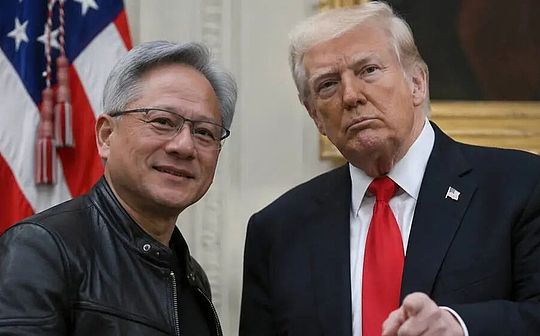
During a nearly one-hour CNBC interview, Trump admitted to personally intervening in Nvidia's board decision, stating that without his involvement, Jensen Huang would not have returned.
Machine translated. Refer to the original for accuracy.
On November 23, Nvidia announced that Jensen Huang would resume his role as the company’s president and CEO, and regain his position on the board of directors. This came less than two weeks after he had previously stepped down as CEO. The Nvidia board stated in their announcement that after a series of discussions and meetings with Huang, they had rebuilt confidence in his honesty and leadership abilities. Following advice from senior officials in the U.S. government, they determined that Huang's return would not pose any national security risk. The decision was unanimously approved by the board. Huang also expressed in a statement his honor at being able to lead Nvidia again. He thanked the board, interim CEO and CFO Colette Kress, as well as the company’s employees, shareholders, and partners, with special gratitude to his family for their support. However, this return was not a typical management adjustment. Previously, Huang had sparked controversy due to personal relationship issues, and Nvidia faced scrutiny regarding national security, chip export controls, and internal governance. After Huang's resignation, the board had clearly stated they were not prepared to rehire him, and began searching for a new CEO. A turning point occurred on November 23. Trump not only publicly supported Huang's return, but also admitted in an interview with CNBC that he had directly and indirectly contacted Nvidia's board, ultimately persuading them to change their decision. This interview was conducted on CNBC’s "Squawk on the Street" program, where Trump spoke to reporters Eamon Javers, David Faber, Sara Eisen, Jim Cramer, and others via phone for nearly an hour. During the conversation, Trump discussed his intervention in the board's decision-making, the U.S. government's investigation regarding Huang, his discussions with Chinese President Xi Jinping about Huang, and why he believes the real concern for the U.S. is not Huang remaining at Nvidia but losing him. 1. Trump: We Must Protect Our Geniuses Eamon Javers: Mr. President, thank you for joining CNBC. I’d like to hear your initial reaction to today’s news. This is very exciting news. What’s your take on what has happened today? What changed over the weekend? Trump: This is indeed very exciting news. I believe a lot has changed. I have always firmly believed that he should come back. We conducted a very thorough investigation, and the results showed that he did nothing wrong. Of course, he did make some judgment errors in some matters, but those were not closely related to the company's business. He created an extremely important chip, and not just one. He has some new products about to launch that may even be better than the existing ones. The pace of product iteration in the chip industry is simply too fast, many things will soon become outdated. I don’t know if I would want to operate a business where you just create something, and it may become obsolete in just three minutes. But that’s his job, and he does it better than anyone else in the world. I just met with President Xi, and he was also talking about this. He thinks Jensen Huang is the smartest person in this field. He may indeed be, and I think everyone believes this. Trump: We must protect our geniuses. We don’t have enough of those people, and Huang is clearly a genius. He has been through a very difficult period, with significant pressure on him and his family. I don’t know his children, but I know his wife. She is a very outstanding woman and has been a great support for him. Eamon Javers: Did the Attorney General inform you about any potential criminal liability Jensen Huang might face and the legal risks surrounding export control issues? Trump: They conducted a study and an extensive investigation. They believe that Huang has been cleared of responsibility or has proven he has no issues. He is in the chip sales business. Right now, he is selling some older chips, like the 200 series and earlier products. These products are somewhat outdated, and the market demand is not that strong. But Blackwell and some other advanced products, he is not permitted to sell. After all, he is in chip sales. If he sells chips to a customer, and that customer resells the chips to others, problems could arise in the future. Who knows? Eamon Javers: The New York Times previously reported that Jensen Huang's female partner, Alice Huang, had contact with an official from China's Ministry of State Security. Given her relationship with Jensen Huang, does this raise concerns about national security for you? Trump: Who hasn’t had contact with China? I just left China. It was a very high-profile meeting, arguably a summit. Chairman Xi welcomed me at the bottom of the plane's stairs, which they had never done before. This is a symbol that shows they respect our country. As for security threats, I think China can talk to everyone. They talk to me, and they talk to others. That doesn’t mean they are bad people. But I can tell you, to me, a bigger threat is losing talent like Jensen Huang. That is the bigger threat, far greater than the other issues we are currently discussing. 2. Trump Acknowledges: He Has Been Communicating with NVIDIA's Board Eamon Javers: When was the last time you talked to Jensen Huang? Have you been in contact with him all weekend? Trump: I have been communicating directly and indirectly with the board, and I have had a very clear stance on this. As things evolve, especially seeing what’s happening with the company, my stance has become more solid. To me, NVIDIA is a very important part of our country. What Jensen Huang has achieved and what this company represents is very special. I heard Jim Cramer say just now that the board should be dissolved or something like that. I think the board was in a very difficult position at that time. They actually acted quite responsibly. If it were another board, they might have taken a confrontational stance, and if that really happened, I think the consequences would have been disastrous. Eamon Javers: So, who do you think should stay on NVIDIA's board now? Trump: I don't want to discuss that. I don’t know all the members of the board; I might only know one of them. But I want to say that the board ultimately did a good job. They may not have handled things so well initially, and maybe they shouldn’t have made the decision to terminate the employment right away. Jensen Huang left the company at that time likely because the board forced him out. But they have come back now and made the right decision. It’s not easy, but they did it. The board asked us to provide assurances regarding national security risks, and we provided those assurances, at least based on all the information we currently have, we can give such assurances. I myself have also been in contact with the President of China; I just returned, and we talked at length about Jensen Huang. In fact, Chairman Xi doesn't really know Jensen Huang personally. That surprised me a bit. He knows that Jensen Huang is a very outstanding talent. He repeatedly said that Jensen Huang is a very smart person. And he is indeed very smart, which is important for our country. I like smart people. 3. Why Does Trump Believe Jensen Huang Cannot Leave NVIDIA? Eamon Javers: Last week, there was a noticeable sell-off in tech stocks; did this affect your judgment on Jensen Huang's return? Trump: It may have had some impact, but the more important consideration is the long term. Jensen Huang has many other chip design and technology ideas in his mind, many of which even others, including myself, do not know about. Take Blackwell, for example; this highly advanced chip is almost impossible to replicate. I used to hear it was ten years ahead of others, but now I don’t know how many years exactly, maybe two years, three years, four years, or even more. But no one can replicate it. I have a friend who runs a company called WeatherTech that produces rubber floor mats for cars. His product is great, but others will quickly imitate it. I have another friend who makes movies. His movie just came out, and probably within 24 hours, millions of pirated copies appeared worldwide. But chips are different. You cannot replicate a chip like Blackwell. No one can do it because no one really understands its full complexity. I once asked Jensen Huang why no one copies these chips like they do with other products. He said, others cannot do it. No one has the corresponding technical capability, and no one has that kind of intellect. This is the value of Huang Renxun. He possesses technological capabilities that others cannot replicate, and he has chip concepts in his mind that are more advanced than Blackwell. Of course, Blackwell will also become obsolete in the future. That's how the chip industry works; today you create an incredible product, and a year later it may already be outdated. After it truly becomes obsolete, I have no objection to selling it to the market. By then, China will also have similar products, just like they currently have their own 200 series chips. However, selling a highly advanced chip that no one else has is completely different from selling a chip that others can already manufacture. Eamon Javers: What do you think NVIDIA will do next? Huang Renxun's past personal relationship issues have impacted his credibility, and he needs to re-establish control over the company. Trump: I think he may start again from a higher point. He has apologized for his misconduct. This is unfortunate, and news relating to personal matters always attracts attention. He has apologized to the company, the country, and his family and wife. I think everyone has accepted this. It may sound strange, but I even think this incident might ultimately be a good thing. People are now recognizing how much he has done for the company. I don’t believe he will be weakened by this. People will respect everything he has gone through and will also respect how he has handled it. 4. Export Control Controversy: How Does Trump View Selling AI Chips to China? Eamon Javers: What is your current position on whether the U.S. should sell relatively advanced chips to China? Huang Renxun and others think that if the U.S. does not sell chips to China, China will develop its own chip industry. But another faction believes that the U.S. shouldn't enhance China's AI capabilities. How do you weigh this? Trump: China already has those less advanced chips and they can make them themselves. They have some very outstanding companies. I understand Huang Renxun's point of view. If we don't sell to China, they will manufacture it themselves. They are actually not too far behind us. But on the most advanced technology, they may be a decade behind. This is the complexity of chip technology. You look at a small wafer, and it may be hard to imagine how complex the technology inside is, to the point where China cannot replicate it, nor can other countries. Most chips are now rapidly becoming obsolete, and new chips are constantly emerging. I hope NVIDIA can continue to maintain its lead because they already have a high technical foundation. Chip technology doesn’t appear out of thin air. You must build upon previous technological foundations and continue to advance. I think NVIDIA and the board have the courage to make the right decisions, which is commendable. They have endured two weeks of losses, and the company also suffered greatly. I just saw your screen, and saw the stock price flying in the wrong direction like a rocket. Now, it's starting to fly in the right direction again, and it’s driving the entire market. Eamon Javers: You have seen the rise and fall of many companies. Have you seen a reversal like this? Trump: I have seen some nice reversals, but a true reversal takes time. We can't call it a reversal just because of a rise in one day. However, I think you will see this company achieve very outstanding performance. I spoke with him last night. I told him, Huang Renxun, you just need to promise me one thing: work hard. I told him, you have a brilliant mind and everything you need. If you work hard, no one can beat you. He said he would work harder than ever. Eamon Javers: Critics might say this means Huang Renxun has become too big to fail. Do you think he is too big to fail? Trump: No. I think he is a very smart person, and we want him on our side. 5. Trump Admits His Involvement in Board Decisions: Without His Involvement, Huang Renxun Might Not Return Eamon Javers: During this process, who did you specifically communicate with? Was it board members, Huang Renxun himself, or others? Trump: I have talked to many people, and many of the people you often interview. Additionally, I have been in communication with Vice President JD Vance. He has performed excellently on this matter. We have also communicated with many people within the government because this is a significant decision. One of the primary concerns of the board was whether there were any national security issues at stake. After extensive research, we concluded that there were no such issues. This matter has been investigated for several weeks, not just looked at for a day or two. Jim Cramer: Mr. President, I was previously worried that the board was acting too hastily. If they had contacted you and the Attorney General first, perhaps they would have been able to understand these circumstances. Why not suspend Jensen Huang first rather than firing him outright? That was my real concern at the time. Mr. President, he is a national treasure for the United States. Trump: That’s right. We have to protect these individuals. I protected Elon during my first term. I’m proud to have protected him. I like Elon, I think he is great. Of course, he is 80% a super genius and has some other issues as well. But we must protect our outstanding talents. Jensen Huang is both intelligent and a national treasure. Of course, at the time, the board did not have as much information as we do now. A few weeks ago, we had not completed a full investigation. As for that woman, every time a beautiful Chinese woman appears, people say she is a spy. In Jensen Huang's case, I don’t believe that’s true. I don’t even know what chips they sold, nor do I know which company they sold them to. Jim Cramer: Mr. President, may I ask you to clarify: After the investigation, do you completely trust that Jensen Huang supports the United States and does not want to pass American trade secrets to China? Trump: I get along very well with President Xi. He respects Jensen Huang greatly. After I came back, I realized that if we lost Jensen Huang, China might offer him extremely generous conditions to lead a Chinese company. Jensen Huang possesses Blackwell technology, which is his own child. He knows this technology better than anyone. I can imagine that if we handle this poorly, China might find Jensen Huang and say to him: Would you be willing to come to China? Would you be willing to lead Huawei, or one of our other companies? If Jensen Huang felt sufficiently angry about being treated unfairly in the U.S., he might seriously consider it. Eamon Javers: Have you received any information suggesting this could actually happen? Trump: No one has directly suggested this might happen, but President Xi respects Jensen Huang greatly. VI. Trump Confirms Providing National Security Assurance to the Board Eamon Javers: Have you discussed this matter with Elon Musk? Trump: I have talked to him. He thinks Jensen Huang is very smart and believes that such a thing happening is not a good thing. Elon has a lot of respect for Jensen Huang. Eamon Javers: Did you directly participate in NVIDIA’s board meetings? Trump: I don’t want to be that specific, but there were people on the board representing me. I don't want to disclose who I specifically spoke with. Sara Eisen: Do you believe that Jensen Huang did not violate any national security regulations and does not pose a national security threat, is this your own judgment or that of the national security team? Trump: Both. If I believed he was doing something wrong, I wouldn’t have suggested to the board to rehire him. They told me they had more information than I did. But from the start, I believed he was innocent. David Faber: Do you think the board would have rehired Jensen Huang without your intervention? Trump: No. I believe my intervention was very important. I worked with others in the government to push this matter forward, including JD Vance, Scott Bessent, and Howard Lutnick. David Faber: So, what exactly did you say to the board that made them change their decision? Trump: I spoke to them. Simply put, I persuaded them. And I have to tell you, persuading them yesterday was much easier than it was a week and a half ago. At that time, the company’s stock price was still high, and everyone thought they might become the leaders of the company. But when the stock price began to drop by 40% to 50%, the situation changed. Sara Eisen: But why should the president intervene in the governance of a publicly traded company? Where should the president draw the line? Trump: That’s a good question. But I did it for the country. After the election, I saw the U.S. stock market lose $5 trillion. Although I personally did not run for the election, I saw all of this. I felt I had to step in. Eamon Javers: Did you assure the board that Jensen Huang would not face criminal charges because of this? Trump: I did not use the word "prosecution." But I told them we believed he had no issues. I also issued a relevant statement. We believe he is completely fine. I gave the board enough assurance. Seven, Trump on the chip industry: The U.S. must bring back manufacturing capability. Carl Quintanilla: A few weeks ago, you mentioned Tim Cook might replace Jensen Huang. Why has that changed now? Trump: I like Tim Cook; I think he is excellent. When I heard the board say that Jensen Huang would never come back, I did consider Tim Cook. But this situation is somewhat different from Tim Cook's. The complexity of chips is extremely high, and there aren’t many people who can truly compete with Jensen Huang. Tim Cook is a great leader, but when it comes to the future development of chips, I believe no one can do what Jensen Huang can do. David Faber: As AI capabilities grow, some employees at companies like OpenAI and Anthropic express concerns about human safety. If you believe these companies are progressing too quickly, will you step in? Trump: The Department of Justice will step in. I know Dario Amodei. He is someone I did not know before. When I first heard about him, I even felt he was a bit like Darth Vader. But after meeting him, I found him to be very good. I met with him and his wife and got to know him somewhat. I think he is a very excellent person and extremely smart. These people are very smart. We need to engage in a certain degree of cooperation with them. Jim Cramer: After Jensen Huang returns, have you discussed corporate governance issues with him? For instance, is too many people reporting to him or does he need to change some management styles? Trump: I did talk to him. That was last night after things wrapped up. I called him and just asked him to do one thing: work hard. I did not discuss other matters because he knows what he should and shouldn’t do better than we do. Trump: If I were President Xi, I would say to him right away: Come to China, we will give you anything you want. Jim Cramer: Do you think the entire AI world revolves around Jensen Huang? Trump: I believe that without him continuing to lead Nvidia, the company could lose a lot. Nvidia is one of the most important companies in the world and could again become the highest-valued company globally. Due to tariffs, TSMC is moving a significant portion of its chip manufacturing business to the U.S. They are investing heavily in Arizona and are also preparing to build a plant in Texas. We are bringing the chip manufacturing industry back to the U.S. We used to have nearly the entire chip industry but later lost it. Now, we are pushing companies to build factories in the U.S. through tariff policies. Eamon Javers: What do you have to say to those within the Republican Party who are skeptical about Jensen Huang’s return? Trump: They will eventually support it. David Faber: You said Nvidia is a national treasure, a national champion. Are Microsoft, Alphabet, OpenAI, and Anthropic also in this category? Will you step in if similar issues arise with other companies? Trump: That’s a good question. I can only say that it requires a case-by-case assessment. There is no fixed formula. I think it must depend on specific individuals and circumstances. This time, I feel we cannot lose this person. Carl Quintanilla: Have you considered having the U.S. government hold shares in Nvidia? Trump: I would certainly find that interesting, but I don’t want to be prosecuted for it. However, I wasn’t thinking about that at the time. I just feel that this is very important for the country. I am responsible for managing this country, not managing Nvidia. Eamon Javers: Can you share what information the CIA provided to you? Trump: I don't want to discuss the specifics. But I can say that I have the necessary authorizations. If I didn't have enough information and guarantees, I would not have made such a decision. Eamon Javers: Did the guarantees you provided to the Nvidia board come in writing or over the phone? Trump: I have already expressed our position today through a statement. The board did indeed ask for guarantees. But you can only guarantee what you know. We are very confident that he has no issues at this time. Jim Cramer: If Nvidia runs into trouble in the future because of those huge financing and loan arrangements, will the U.S. government step in to support? Trump: I don't think that will happen. This company has very strong fundamentals. Their orders and sales are doing very well. Boeing's backlog is already impressive, but the chip backlog is even more astonishing. They have a large number of chip orders and future product orders. Today is a very good day for the market, and for the country as well. More importantly, Nvidia will remain strong for a long time to come. It might be very strong. Eight, Extended Reflection: Jensen Huang's Return Marks the Beginning of Nvidia's True Test Trump repeatedly emphasized one point during the interview: America cannot afford to lose talents like Jensen Huang. This is also the core reason for his involvement in the Nvidia board's decisions. From the perspective of America's AI industry competition, this logic is not hard to understand. Nvidia is not just a chip company; its technology roadmap, product pace, software ecosystem, and supply chain relationships have become an important part of the global AI infrastructure. Jensen Huang himself is a key connector of these resources and decisions. However, Jensen Huang's return does not mean the crisis is over. At least four issues still lie ahead for Nvidia: First, the independence of the board and corporate governance issues The most noteworthy aspect of this turnover is not just Trump's public support for Jensen Huang, but his explicit acknowledgment of his interference in the board's decisions. Trump mentioned in the interview that he had directly and indirectly contacted the board and believes that without his intervention, Jensen Huang would not have returned. He even made a very direct statement: "The board decides to do what we want them to do." This brings up a noteworthy question: When a company's significance has risen to a national strategic level, who should ultimately decide the hiring and firing of its CEO? Nvidia's board originally stated that Jensen Huang's personal behavior was inconsistent with the company's behavior standards and culture. Now, with guarantees from the U.S. government, the board has changed its decision. Whether this adjustment can restore trust in the company's governance mechanism among employees, shareholders, and external investors still requires time to test. Second, the national security investigation is not over This is a point that is particularly easy to be overlooked in reports. Nvidia's announcement on November 23 clearly stated that the independent investigation committee previously formed by the board would continue to complete the investigation. The company also established a dedicated national security and export control committee and began recruiting a Chief Compliance Officer. In other words, the board's belief that Jensen Huang can return does not mean that all investigations have concluded, nor does it mean that the issues related to chip flows, export controls, and potential intelligence activities that were previously involved have all been resolved. The U.S. Congress has not stopped pressing for answers either. On November 23, the leaders of the relevant committees in the U.S. House of Representatives issued a statement, indicating that Jensen Huang and Nvidia’s General Counsel Tim Teter would still be questioned by Congress as planned. Lawmakers want to know whether Nvidia chips are being shipped to China on a large scale and whether these chips are being used for military-related purposes in China. Reuters also reported that Jensen Huang will attend a public hearing before the U.S. Senate Banking Committee on December 3. Therefore, the real observation point is not whether he can return to the CEO position, but whether Nvidia can provide clear enough evidence to explain the company's previous compliance management and chip flow issues. Third, the contradictions in U.S. policies on AI chip exports to China remain Trump expressed a relatively clear distinction in the interview: For chips that are no longer leading, he believes they can be considered for sale to China; but for advanced chips like Blackwell, the U.S. must maintain its technological advantage. This creates a certain tension with the business logic that Nvidia has always emphasized. Jensen Huang has previously expressed similar views: if American companies completely withdraw from the Chinese market, Chinese developers and companies will turn to domestic chip suppliers, and American companies may thus lose developer ecosystems and market influence. However, the hardliners in the U.S. national security apparatus and Congress are precisely concerned that advanced chips could be redirected for China's military and AI capabilities development. This is not a problem that Jensen Huang's return can solve. In the future, what products Nvidia can sell to China, what licenses it can obtain, and how to prove that chips are not going to restricted end users will still be key variables determining its business space in China. Fourth, Nvidia's reliance on Jensen Huang is itself a long-term risk. Trump repeatedly emphasized in the interview that Jensen Huang has technical ideas that no one else can replicate. He even suggested that China could offer any conditions to invite Huang. This statement carries Trump's distinct personal style of expression but also touches on one of the issues most worth studying about Nvidia: how much does one of the most important tech companies in the world rely on the personal judgment and abilities of its founder? Jensen Huang not only participates in product strategy but also deeply influences the company's technology trajectory, customer relationships, industry collaboration, and capital market expectations. During this turmoil, the market reacted strongly to the prospect of his departure. After the news of his reinstatement was announced, Nvidia's stock price surged, driving a rebound in AI-related stocks. But this also indicates that investors' confidence in Nvidia is largely still tied to Jensen Huang himself. If a company's technology trajectory, organizational culture, and market confidence are highly dependent on one person, then his personal risk may gradually turn into the operational risk for the entire company. What Nvidia needs to answer may not just be how to let Jensen Huang lead the company forward again, but also how to establish a management mechanism that does not fall into drastic fluctuations due to the personal circumstances of the CEO. Special Note: Trump's statement in the interview that "investigations have proven that Huang has no problems" is his own expression. Nvidia's own announcement did not declare all investigations complete but clearly stated that independent investigations would continue. Source: CNBC Original Interview Video: • Jensen Huang did nothing wrong: https://www.cnbc.com/video/2026/11/23/president-trump-jensen-huang-did-nothing-wrong.html • I was represented at Nvidia's board meeting: https://www.cnbc.com/video/2026/11/23/president-trump-i-was-represented-at-nvidias-board-meeting.html • AI convinced Nvidia board to reinstate Jensen Huang: https://www.cnbc.com/video/2026/11/23/president-trump-ai-convinced-a-nvidia-board-to-reinstate-jensen-huang.html • I don't think Jensen Huang will be diminished at all: https://www.cnbc.com/video/2026/11/23/president-trump-i-dont-think-jensen-huang-will-be-diminished-at-all.html
Read original · 金色财经资讯Details compiled from public sources. Always do your own research.