
Is It a Once-in-a-Lifetime Buying Opportunity for Bitcoin? What Are the Reasons?

Is the crypto market coming to a complete end? Or is this a rare buying opportunity?
Machine translated. Refer to the original for accuracy.
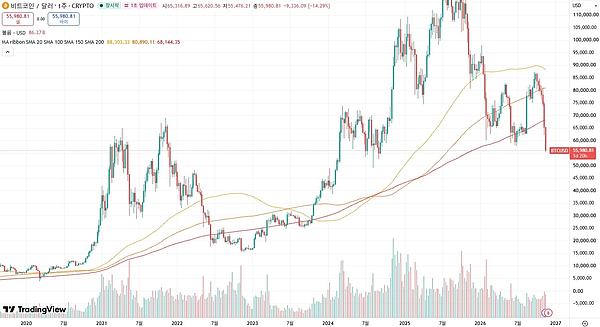
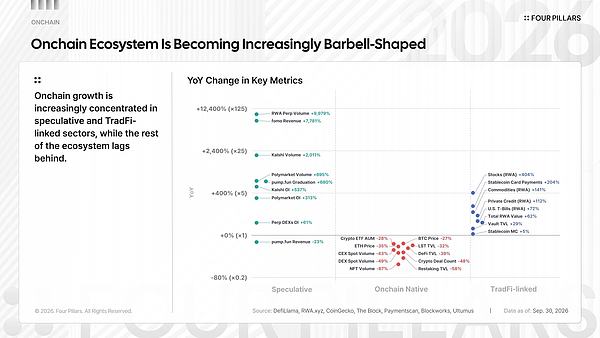
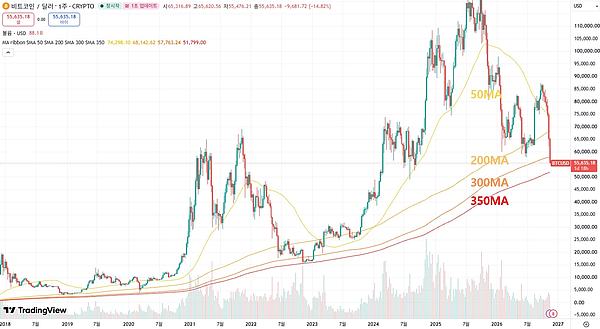
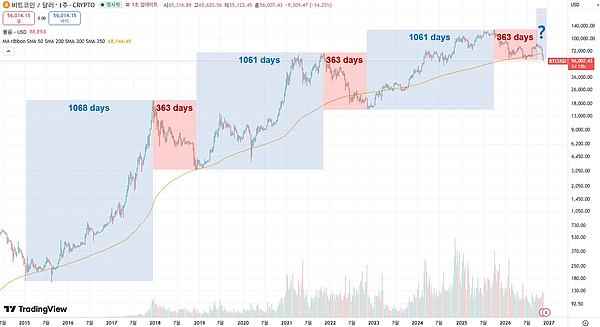
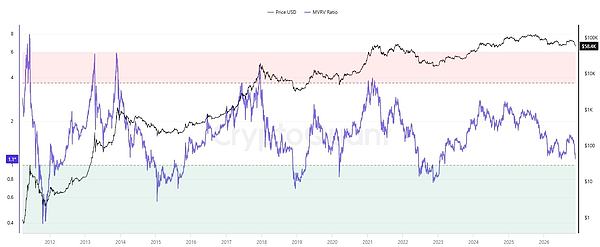
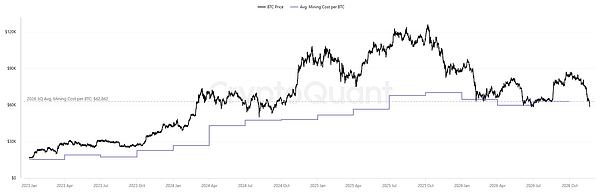
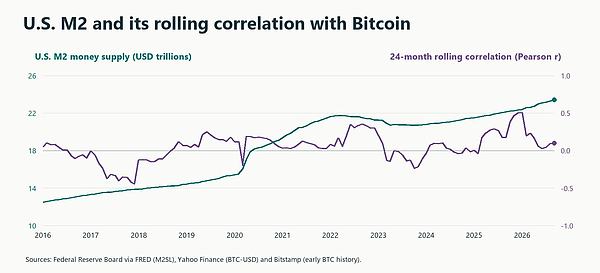
Author: 100y, Research Director at Four Pillars; Translated by: Shaw, Jinse Finance I woke up late on Saturday morning, made myself pasta with salmon, and then sat down at the computer. What I saw in front of me was unbelievable: Bitcoin had fallen to $55,000. Is the crypto market coming to a complete end? Or is this a rare buying opportunity? Here’s my viewpoint: Bitcoin is very close to the bottom-buying window. If Bitcoin can start a new bull market afterward, the $45,000–$55,000 range will be an attractive entry point. However, there is still a significant probability that we have not yet seen the bottom of this cycle. Technical indicators such as moving averages and MVRV, as well as on-chain indicators, show that there is still room for the price to decline further. Considering the current state of the AI industry, macro factors may also further push down Bitcoin’s price. My baseline scenario is: within the next year, a crisis in the AI industry will prompt Bitcoin to find its final drop to the bottom; subsequently, the U.S. will initiate credit expansion and monetary easing, driving a reversal in market trends. Here’s a brief explanation of why I believe this is the most probable script. 1. The crypto industry is more solid than ever Before diving into technical analysis, cyclical laws, and on-chain data, let’s step back and take a look at the entire crypto industry where Bitcoin is situated. I will elaborate later, but recently there has been an increasing number of opinions on the X platform suggesting that compared to the AI track, the crypto industry has virtually no substantial achievements, and the entire track has basically no value. I completely disagree with this statement. The above chart comes from the upcoming year-end report from Four Pillars. My current judgment on the crypto industry is that several sub-tracks have clearly found product-market fit (PMF), but the problem is that the implementation demand is highly concentrated in just a few directions. The first category is the speculative aspects of crypto, including meme coins, perpetual contracts, and prediction markets. Regardless of the overall market conditions, these sectors can continue to attract stable user activity. Especially with perpetual contracts and prediction markets, they have created an entirely new paradigm of financial transactions, with significant growth potential. This is also why Robinhood, Coinbase, and many traditional financial institutions are highly focused on these types of markets. The second category is that crypto is becoming the next generation of financial infrastructure, with stablecoins and real-world asset tokenization (RWA) as its core carriers. The fragmentation of traditional financial infrastructure is a serious problem, with different asset categories and business scenarios operating independent backend systems. Blockchain is gradually being regarded as one of the few technologies that can bridge these fragmented systems. Examples include the DTCC's tokenization project, the Intercontinental Exchange (ICE) and NYSE's plans for tokenized stock trading, as well as large banks like Bank of America working on stablecoin solutions. This is also the underlying logic driving numerous large and small financial institutions to continuously invest in stablecoins, RWAs, and blockchain infrastructure. Currently, Bitcoin may be trading between $55,000 and $56,000, but it can be said that the cryptocurrency industry has found more genuine product-market fit (PMF) than ever before, and is increasingly integrating into the existing financial system. Regardless of price highs or lows, or the warmth or coolness of market sentiment, the vitality of the crypto industry itself remains robust. From a long-term perspective of financial infrastructure, it is hard to imagine that this industry will not experience significant growth. 2. The 300-week moving average (300WMA) has been breached There is an old saying in the crypto circle: "The 200-week moving average is the bottom." In previous market crashes, including the 2018 bear market, the COVID-19 crash, the Terra collapse, and the FTX bankruptcy, the 200-week moving average has always been a very effective psychological reference point for judging Bitcoin’s bottom. However, this time it is different. This recent round of decline has not only broken through the 200-week moving average but has also pierced the 300-week moving average. Bitcoin is currently approaching the 350-week moving average, which has historically been a solid bottom. If Bitcoin touches the 350-week moving average in the short term, the corresponding price would be around $52,000. In any case, Bitcoin has broken below one of the most important psychological support levels in history—the 200-week moving average. This means that if a new bull market is to follow, we may already be quite close to the bottom. Historically, similar trends have occurred. In June 2022, Terra collapsed, and subsequently, Celsius and Three Arrows Capital (3AC) followed suit, with Bitcoin dropping about 20% below the 200-week moving average. It took Bitcoin approximately 9 months to reclaim the 200-week moving average, and another 14 months to completely break free from that position, initiating a new bullish market. Currently, Bitcoin's price is about 18% below the 200-week moving average, which is very similar to the situation back then. If history repeats itself, the price could very well see another drop; however, it may also enter a year-long consolidation phase, slowly rising along with the 200-week moving average before a new breakout. 3. A New Four-Year Cycle Begins Among various market narratives, the four-year cycle theory of Bitcoin is, in my opinion, the one that withstands the least scrutiny while having the strongest influence. I do not believe there is an underlying fundamental logic that explains why it continues to hold true. However, the time intervals between market tops and bottoms have been highly similar, sometimes even giving the impression that there are hidden forces manipulating Bitcoin's price. Since the bottom in 2015, Bitcoin has consistently followed this pattern: a rising cycle lasting about 1061–1068 days, followed by a decline lasting about 363 days. When combined with Bitcoin's halving cycle, this model has become a highly influential narrative that profoundly affects investor psychology. For assets like Bitcoin, which do not generate cash flow and are highly driven by macro environments and market sentiment, the role of narrative is particularly crucial. If historical patterns continue, we are currently approaching the end of the bear market, and a new rising phase is about to begin. However, there is a risk that cannot be ignored: since the last peak, the duration of the decline has already surpassed 363 days, exceeding historical ranges. I do not believe that this alone can determine the failure of the four-year cycle. However, if Bitcoin continues to deviate from this pattern, we need to reassess whether this theory still holds. 4. MVRV Indicator About to Drop Below 1 Source: CryptoQuant MVRV stands for Market Value to Realized Value. It is calculated by dividing Bitcoin's current market capitalization by its realized market capitalization; the latter is computed based on the price of each Bitcoin at its last on-chain transfer. In simple terms, a low MVRV indicates that Bitcoin's current market price is relatively low compared to the overall cost basis of investors' holdings. Historically, periods when MVRV drops below 1 have often presented good long-term buying windows. In past cycles, after MVRV dropped below 1, Bitcoin usually found its final bottom within 1–6 months; it then typically consolidated in the range where MVRV was less than 1 for 6–12 months before starting its upward trend again. Currently, MVRV has not yet dropped below 1, but it is very close. This makes me increasingly optimistic that a high-quality long-term investment opportunity is approaching. Another positive signal worth noting is that the MVRV bottoms in each cycle are gradually rising. Since 2011, historical lows have been approximately: 0.395 → 0.564 → 0.691 → 0.760. If this trend continues, the MVRV bottom in this cycle is unlikely to be as low as in previous cycles. Assuming the realized market capitalization remains unchanged, based on historical patterns, the MVRV bottom in this round is likely to settle around 0.8, which suggests that Bitcoin’s bottom could be around $43,000. 5. Bitcoin Price Approaching Mining Costs Source: CryptoQuant CryptoQuant analyzed financial data from major publicly listed Bitcoin mining company Marathon Holdings to estimate the mining cost of a single Bitcoin. As of the third quarter of 2026, the mining cost per Bitcoin is approximately $62,900. From historical experience, mining production costs serve as an effective signal for identifying potential market bottoms. When Bitcoin's price falls below production costs, miners' willingness to sell newly mined tokens and cover losses declines. Of course, the situation has changed. Halving events have reduced Bitcoin output, and many mining companies are diversifying into AI data centers. Therefore, I do not consider mining costs as an absolute support bottom line for coin prices. However, when judging the bottom range of the market, it remains a reference indicator. 6. Bitcoin and M2 Liquidity Have Decoupled Many investors view Bitcoin as a digital gold with a fixed supply. According to this logic, when the liquidity of the financial system expands, the price of Bitcoin, measured in dollars, usually benefits. Historically, during the expansion phase of the M2 money supply in the United States, Bitcoin has often experienced a significant surge. However, a notable phenomenon has recently emerged: throughout 2026, while M2 liquidity in the U.S. has expanded again, Bitcoin has continued to decline significantly, and the correlation between its price and M2 liquidity has approached zero. In my opinion, this suggests that Bitcoin may be significantly undervalued relative to the current scale of liquidity in the financial system. 7. Market Sentiment is Extremely Low Historical experience shows that extremely pessimistic market sentiment is often a signal that the market is nearing its bottom. Currently, sentiment in the crypto market has plummeted to critical lows. In the past few weeks, there has been an abundance of opinions on platform X: the crypto industry has not achieved any substantial results, the entire sector is meaningless, and almost all crypto tokens are worthless. What’s more concerning is that such remarks have garnered significant attention and endorsement from many investors. Google Trends data also corroborates this: the search popularity for Bitcoin has fallen back to levels seen around 2020, close to the lows of the subsequent years. Historically, when everyone has given up hope for the crypto market, it often turns out to be a superb buying opportunity. 8. Monetary Expansion is Inevitable When predicting market liquidity for the next three years, one thing I am very certain about is that AI will ultimately drive a significant expansion of U.S. dollar liquidity. This view is largely consistent with Arthur Hayes’ discussion. The logic is simple: If the AI bubble does not burst and the industry continues to expand, the creation of private credit, including bank credit, will continue to grow; If the AI bubble bursts, the U.S. government will inevitably launch credit expansion and monetary easing policies, just like during the 2008 financial crisis. In light of recent developments, I am increasingly inclined to the second scenario. Controversies regarding Jensen Huang, the resignation of NVIDIA’s CEO, coupled with the Democratic Party's significant victories in the midterm elections, have put pressure on AI data center construction and development, leading investors to begin questioning the financing framework supporting the entire AI industry. Whether these events will ultimately trigger a deep correction in the AI bubble remains to be seen. However, once the bubble bursts, I find it hard to believe that the U.S. government will stand by idly. AI is no longer a simple industry governed by supply and demand; it is becoming a national strategic asset. The current market generally believes that whichever country first achieves artificial general intelligence (AGI) or superintelligent AI (ASI) will likely dominate the next round of the global power structure. The U.S. cannot afford to lag behind China. In this context, I believe the U.S. has little choice but to support the AI industry through large-scale credit injection and monetary expansion. Looking back at the 2008 financial crisis and the COVID crash in 2020, the time interval from the implementation of quantitative easing policies to the market finding its bottom has significantly shortened. My understanding is that investors have already grasped the market’s response to monetary easing, which will lead them to price in easing expectations increasingly quickly. If the AI bubble bursts, and the U.S. government again launches large-scale credit expansion and monetary easing, I anticipate Bitcoin will witness a strong rebound. 9. Worst-case Scenario Up to this point, I have explained why a decent layout window for Bitcoin may appear in the next 6–12 months—provided that a new bull market opens subsequently. However, let’s look at it from another angle; almost all the arguments mentioned earlier can also be interpreted as bearish signals. The overall improvement of the crypto industry does not necessarily mean that Bitcoin prices will rise. Even if stablecoins, RWA tokenization of real assets, and blockchain technology were to replace most of the global financial backend infrastructure in the next 5–10 years, it cannot guarantee that Bitcoin will capture that value. The failure to hold the 200-week and 300-week moving averages may mean that Bitcoin has lost its upward momentum; previously reliable support levels may no longer hold any reference significance. The four-year cycle may also fail. According to historical patterns, bear markets last about 363 days, but this round of decline has lasted 411 days so far. MVRV falls below 1, and the fact that the price is below the production cost for miners does not guarantee that a bottom will be reached. Especially now, many Bitcoin mining firms are simultaneously operating AI data centers, which has changed the historical price logic. M2 liquidity is expanding, but Bitcoin continues to decline, which may be a structural warning signal: funds that would originally flow into Bitcoin are now being absorbed by the AI sector. The risks do not stop there. Companies related to digital asset treasuries (DAT) may experience collective panic selling, the long-term threat posed by quantum computing, and the continued outflow of historically stolen funds from platforms like Binance, all of which will exert tremendous pressure on Bitcoin's future market. There are many reasons to suggest that Bitcoin may not replicate the rebound path of historical cycles. 10. Buy Bitcoin, you will thank me later. Ultimately, buying Bitcoin is essentially betting that its future price will be higher. To solidify this judgment, you must answer a fundamental question: Where does the value of Bitcoin really come from? Some people view Bitcoin as the most representative asset of the digital asset industry's growth scale; others see it as digital gold, used to hedge against the long-term devaluation of fiat currencies; and still others value it for its properties as a decentralized currency—anyone in the world can freely hold and transfer it without relying on governments or centralized institutions. For me personally, the most important reason to remain long on Bitcoin is somewhat counterintuitive: the development of AI. AI will make a large number of previously scarce supplies abundant: software, content, knowledge work, and many things that used to require human labor will become increasingly cheap and readily available. I believe that when almost everything becomes abundant, assets that cannot be artificially increased or created out of thin air, as well as systems that do not require reliance on centralized entities, will see their relative value continue to rise. This is precisely why I believe that the technical value of blockchain, especially decentralization and verifiability, will become increasingly important in the AI era. And Bitcoin is the oldest asset operating based on these principles. It is not dependent on the profits of any one company, nor is it bound by the policies of any one government; no single entity can unilaterally increase its supply, and global participants can independently verify and adhere to the same set of rules. I believe that the next 6-12 months will be a critical period for testing this belief, and it may also be an excellent window of opportunity to bet on this logic. Buy Bitcoin, you will thank me later.
Details compiled from public sources. Always do your own research.