
Solana Launches solana.ai: A Systematic Introduction to AI
Unifies previously scattered AI products, open-source tools, and ecological teams into a single entry point.
Machine translated. Refer to the original for accuracy.
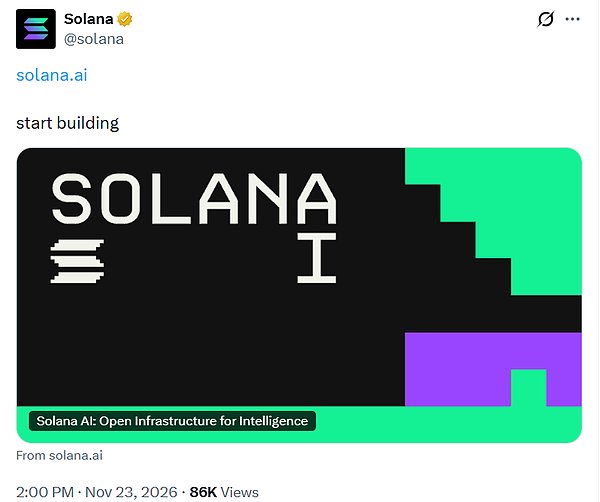
Written by: Shannon On November 23, 2026, Solana officially announced the launch of its AI portal: solana.ai on X. 1. Why Solana Launched solana.ai The page title of solana.ai is "Open Infrastructure for Intelligence," and the subtitle is "Build and scale finance at machine speed." The official website positions Solana as "the network for agent payments," providing a core argument: Solana's settlement time for a payment is around 200 milliseconds, and the cost is less than a cent, allowing agents to pay each time they call an API. The underlying logic is explained more comprehensively in the Solana Foundation article released on October 2, 2026, titled "Solana x AI: The Democratization Layer." The core judgment of the article is: Internet infrastructure is designed for humans and institutions. Agents cannot open bank accounts, nor can they pass CAPTCHA verification. The AI tech stack itself has multiple "barriers to entry." Computational power is locked in opaque cloud contracts, cutting-edge model training requires capital barriers that only a few laboratories can overcome, user data and memories are trapped on various platforms, and the existence of agents also depends on the platform that hosts them. Solana's high speed, low fees, and programmability allow anyone holding key pairs to participate in the AI economy across four dimensions: computation, models, coordination, and applications, without needing anyone's permission. Thus, the role of solana.ai is to consolidate the originally fragmented AI products, open-source tools, and ecological teams into a unified entry point, signaling to developers and the market that Solana aims to become "the native settlement and execution layer for AI agents." 2. Major Products and Ecological Projects on solana.ai solana.ai highlights six Solana AI products, built on the execution layer of the machine economy, where agents autonomously pay, own, trade, and deploy at machine speed. 1. Solana Confidential Compute This is the "new product" featured on the homepage, developed by Solana in collaboration with the Nito team, and launched on November 13. It provides an end-to-end encrypted AI chat, where requests are encrypted and sent to confidential hardware for processing. The official statement claims that the server does not retain prompts or responses, and the chat content remains encrypted on the user's device. The model showcased on the page is GPT-OSS 120B. The deeper significance lies in providing developers with an open-source foundation to verify confidential computing hardware on Solana, transforming "trusted service providers" into "verifying hardware." 2. Milo: Autonomous Trading Agent Milo is a 24/7 autonomous trading agent. It should be noted that the link to Milo points to a standalone site, andmilo.com, which appears more like a benchmark application recommended by the official rather than a product developed in-house by the Solana Foundation. 3. pay.sh: Pay Per Call, No Account Required Give any agent a Solana wallet, and it can access hundreds of internet services, paying per use in USDC without needing to register for an account or require API keys. The workflow showcased on the page is: the server returns "402 Payment Required," and the agent signs the payment with the wallet, subsequently receiving a normal 200 response. The source code and SDK for pay.sh have been open-sourced on GitHub. 4. Payment Channels Its philosophy is "one authorization, pay as you go, one settlement." Agents can stream massive micro payments through signed messages, with only a final settlement required on-chain. The official statement claims that settlement is just a "bill," no longer a performance bottleneck. This resolves the throughput and cost issues in high-frequency micropayment scenarios. 5. Solana Developer Platform This is the API layer behind products like pay.sh, allowing developers to create wallets, transfer funds, and issue tokens through a set of APIs without managing the Solana infrastructure themselves. The listed interfaces also include setting spending policies, address compliance screening, token whitelisting, minting, and cashing out to banks, covering three main categories: payment with wallets, issuance, and trading. 6. Solana AI Toolkit Includes Solana MCP, Solana Agent Kit (more than 60 on-chain operations), Agent Registry (agent registration and discovery), and Agent Skills. This toolkit enables agents to "read, act, and be discovered." Additionally, Soalna.ai lists over 20 ecosystem projects. 1. Agent Framework and Development Tools ElizaOS — An open-source agent framework for building autonomous agents that execute actions directly on-chain. It is one of the most widely used agent development bases in the Solana ecosystem. It integrates social accounts, wallets, and on-chain protocols into the same runtime in a plug-in manner, allowing developers to quickly create cross-platform agents on top of it. SendAI — Maintainers of the Solana Agent Kit, packaging over 60 on-chain actions into interfaces that agents can directly call. This allows any large model to complete transfers, trades, and staking without writing their own Solana interaction logic. Corbits — An agent operation platform for teams, completing agent creation, permission governance, and operational monitoring within one system. It addresses the visibility and accountability of agents in production environments: “who is running, what can be touched, and who to contact if something goes wrong.” Merit Systems — A tool layer for agentic commerce, allowing agents to autonomously discover services, complete payments, and facilitate transactions. It can be understood as providing a middleware layer of “service directory + settlement” for the agent economy. 2. Open Models and Training Networks Nous Research — An open-source AI research laboratory known for the Hermes series models, publishing results with open weights. It is one of the few research teams treating “open models” as a long-term route rather than a marketing slogan. Psyche — A distributed training network launched by Nous Research, coordinating the training processes of open models on Solana. The core idea is to incentivize distributed computing power to form a “virtual supercomputer,” eliminating reliance on a single data center. Lyber — Packages “decensored” models into APIs compatible with OpenAI and Anthropic interfaces, focusing on red team testing and security research. It supports direct integration with clients like Claude Code, Codex, with payments made through USDC on Solana. 3. Privacy Computing and Identity Trust Arcium — An encrypted computing network allowing applications and agents to perform calculations while keeping data encrypted at all times. For agents, private keys, policies, and user data do not need to be exposed in plaintext to the execution environment. Nito — An AI dialogue product running mainstream large models on confidential hardware (TEE), ensuring the server does not retain prompts or responses. It aligns with the new Confidential Compute direction promoted by Solana, with the selling point of “verifiable privacy.” very.org — Biometric-based identity verification used to prove “the other side is human,” authorizing AI agents to act on behalf of users. It undertakes the role of a trusted credential for “human authorization” in the agent payment chain. 4. Computing Power and Infrastructure Akash Network — An open cloud computing market where AI teams can rent GPUs from numerous suppliers. Compared to traditional cloud vendors, it prices idle computing power through bidding, resulting in lower costs. Render Network — A distributed GPU rendering and computing network serving clients from artists and studios to AI training and inference. It breaks down rendering tasks into pieces and distributes them globally, with settlement based on contributions. io.net - A decentralized GPU network that aggregates dispersed GPU resources for training and inference, settling costs in Solana. Its aim is to stitch together long-tail GPUs into a schedulable cluster. Nosana - A GPU marketplace for AI inference, with tasks settled on Solana. Compared to io.net, which is more focused on training, it targets high-frequency, low-cost inference workloads. Grass - A network that converts idle bandwidth into publicly available web data for AI training corpora. Users contribute bandwidth and get rewards, and the demand side purchases traceable data pipelines. BitRobot - An open robotics network that uses data collected from real robots to train embodied intelligence models. It targets the scarcest resource in the robotics field: real-world interaction data. V. Agent Payments and Wallets PayAI - An x402 payment facilitator that allows AI agents and applications to directly receive stablecoins on Solana. Developers don’t have to create their own settlement logic, and can support "pay-per-use" by integration. BlockRun - On one side, it offers testing capabilities for "money-spending agents," while on the other it provides an AI API paid with USDC. It validates agent payment behavior and API billing within the same product. PayBox by MoonPay - A wallet launched by MoonPay that AI applications can call to complete transactions, purchases, and payments, with private keys always held by the user. It reduces custodial risks while retaining agent operability. Crossmint - Provides a stablecoin wallet, payments, and fiat deposit channels, along with a dedicated payment skill for AI agents. For teams looking to integrate agents into real business processes, it fills in the gaps of "compliant deposits + wallets." Dexter - A self-custody account and x402 payment solution designed for agents, with settlement on Solana. It emphasizes "accounts belong to the agent itself," rather than being tied to a platform basket. VI. Trading and Financial AI Circuit - Users describe trading strategies in natural language, Circuit writes the agent, backtests, and runs it live. It compresses "strategy ideas to actual execution" into one sentence and one confirmation. Elfa - Provides real-time intelligence and data augmentation for financial agents, enabling them to obtain structured, usable market information before decision-making. Simply put, it is the "perception layer" for financial agents. Ramp - A corporate card and expense management platform that is embedding AI agents into every financial process. Its significance lies in providing real company accounts and approval chains for agent payments, rather than just on-chain transfers. VII. Agent Economy, Assetization, and Consumer Applications Virtuals Protocol - An economy composed of AI agents, where each agent has an independent identity, funding, and "work," and trades on-chain. It transforms agents from tools into economic entities that can be held and divided. ClawPump - A token issuance tool for AI agents that has no gas fees, zero upfront costs, and transaction fees flow back to the agents themselves. It allows agents to finance their operations using their own tokens. OpenLedger - Positioned as an "AI blockchain," it seeks to monetize data, models, and agents by releasing liquidity. It aims to address the pricing and revenue-sharing issues of AI production factors. Anuma - An online multi-user AI product that learns your preferences and recommends nearby people to connect with. It is a rare pure consumer application among this batch of projects, applying agent capabilities in social matching. It's important to note that these are showcases of ecosystem projects and not all are products of the Solana Foundation. III. Significance of Solana's Move and Future Plans The launch of the AI portal may have significant implications for Solana, including but not limited to: From the narrative upgrade of "chain" to "settlement layer of machine economy." Solana's past label has been a high-performance public chain, and now it positions itself as a network for payments, identities, and settlements for agents, binding the value of blockchain to the growth curve of AI. Pushing the implementation of machine-native payment protocols like x402. x402 reactivates the HTTP 402 status code, allowing agents to retry requests after paying with stablecoins, without the need for accounts, keys, or subscriptions. pay.sh and Payment Channels form a complete combination of "one-time payments + high-frequency micropayments." Integrating decentralized resources and lowering development thresholds. Official documentation, open-source repositories, developer APIs, hackathons, and bounty tasks are gathered at the same entry point, which is beneficial for attracting developers and project parties. Privacy and verifiability. Confidential Compute addresses the most sensitive data privacy issues in AI applications, making "verifiable private inference" a composable capability on-chain. In addition, solana.ai itself has not released a formal roadmap with a timeline; the following is speculation based on the vision and page content from the official blog. Computational Layer: Tokenizing GPU time and inference capability, forming a transparent computing power market on-chain, and achieving verifiable inference through TEE. Model Layer: Utilizing networks like Psyche for decentralized training, building an open reinforcement learning environment, and leveraging publicly available on-chain transaction data to train financial models. Coordination Layer: Perfecting x402 payments, escrow, wallet-based machine identities, and tokenized memories that are portable and can generate royalties. Application Layer: Creating a unified consumer-grade client as an entry point and exploring scenarios such as fund management for agents, machine credit, computing power hedging, pay-per-use research services, and autonomous treasuries. Community Layer: The official website shows that an online-first hackathon is held every month (in October, 128 projects have already been submitted for the Agent Hackathon), along with bounty challenges and offline meetups. Overall, solana.ai represents a systematic showcase of Solana's bet on the "AI agent economy." With low-latency, low-cost settlement capabilities, combined with open-source toolchains and ecological partners, it strives to become the default underlying layer for agent payments, identities, and cooperation.
Details compiled from public sources. Always do your own research.