
Three Security Incidents in Three Months: Chainflip Loses $12 Million in Another Theft
On November 21, 2026, the cross-chain exchange protocol Chainflip was attacked, and approximately $12 million worth of Bitcoin, Ethereum, and stablecoins were stolen from its treasury. This article summarizes the Chainflip theft incident.
Machine translated. Refer to the original for accuracy.
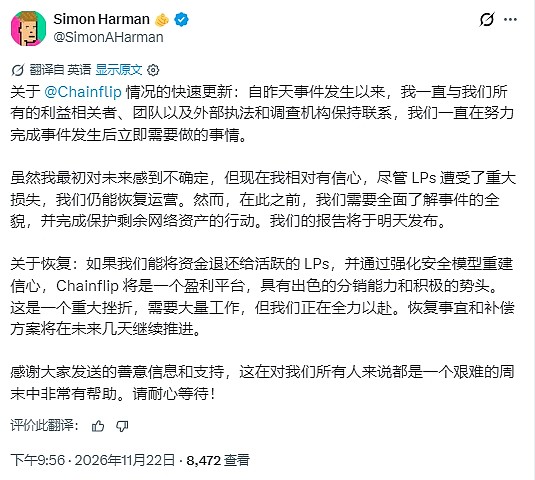
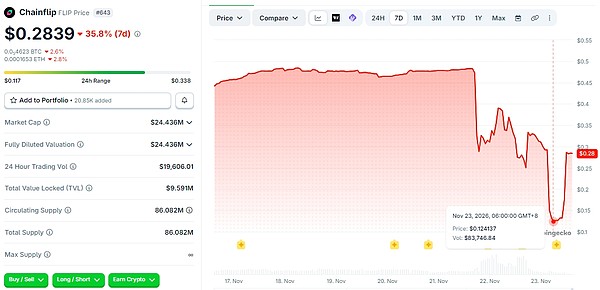
Tao Zhu, Golden Finance Summary: On November 21, 2026, attackers stole approximately $12 million worth of Bitcoin, Ethereum, and stablecoins from the treasury of the cross-chain exchange protocol Chainflip. This article provides an overview of the Chainflip theft incident. 1. Chainflip Attacked, Approximately $12 Million in Assets Stolen On November 21, Chainflip experienced a security attack, with attackers transferring a large amount of cryptocurrency from the protocol's treasury in a short period. When the attack was first discovered, the attackers had already transferred 520.22 ETH, 3.25 million USDC, and approximately 758,000 USDT from Chainflip's Ethereum treasury. Calculating the value at the time of the theft, this amounted to about $4.86 million. Subsequently, Chainflip confirmed that the Bitcoin treasury was also attacked, with another 122.86137042 BTC being transferred, valued at approximately $7.10 million. The total assets amounted to approximately $12 million. Chainflip Labs stated in a message sent on-chain that if the hacker returned 90% of the remaining assets before 1:38 PM Eastern Time on Monday, Chainflip Labs would allow them to keep 10% of the proceeds and halt the investigation by law enforcement. Chainflip also stated that they had identified and fixed the vulnerabilities exploited by the attacker and had information about the attackers, including the server used to register their validator accounts. We have traced the preparation process for this attack: including funds injected from Tornado Cash on November 11, the purchase of FLIP tokens, the registration of validator accounts on November 20, and the server behind those accounts. We have identified the mechanism of key leakage and have taken measures to prevent such attacks from happening again. In addition, we have information related to the identification of individuals associated with the implicated validators, as well as the network services used in this incident—law enforcement can use this to pinpoint your identity. You made some mistakes during this attack; we believe law enforcement could identify your real identity based on the metadata you left behind and the specific services you used. Your address has been flagged by major blockchain analysis firms, making it very difficult for you to cash out your illegal gains; simultaneously, every withdrawal from the Tornado Cash funds you used is under our surveillance. We will do everything possible, regardless of the time cost, to pursue the matter thoroughly. Every time you attempt to use these stolen assets, you will face the risk of arrest and conviction for serious felonies. Chainflip founder Simon Harman stated on Sunday that he had contacted law enforcement and investigators, “Although liquidity providers (LPs) have suffered significant losses, I am relatively confident that we can resume operations.” Flow of Stolen Funds The stolen funds ultimately flowed into Tornado Cash in the form of ETH. A third wallet received ETH from Uniswap trades and also received ETH from a second wallet. That wallet held less than 1 ETH, with the remaining funds transferred entirely to Tornado Cash. Additionally, the second wallet acquired 22 ETH from Titan, a “block builder” responsible for packaging transactions into Ethereum blocks; this funding appeared in the same block as transactions undertaken by that wallet and appears to be refunds for those transactions. This portion of ETH was subsequently also transferred to Tornado Cash along with other funds. As of November 22, the 122.86 BTC transferred by the attackers remained in the associated on-chain address, while most of the Ethereum assets had already entered Tornado Cash. Chainflip has not yet published the final loss compensation plan for this incident and stated that further investigation reports will be released. The Chainflip token FLIP plummeted due to the theft incident; prior to the theft, FLIP had hovered around $0.48 but dropped to a low of $0.1241, a decline of 74.15%. 2. Why Was Chainflip Stolen? In this Chainflip theft incident, the attackers may have obtained signature authority jointly controlled by validators. According to a report from Bitquery: Chainflip operates with a maximum of 150 validator nodes. These validator nodes collectively hold a shared signing key, which is the only key that can withdraw cryptocurrency from the treasury. The Ethereum treasury pays out only when a request includes a valid signature from that key. At least 100 of the 150 validators need to participate to initiate a request. The request on Saturday contained a valid signature, so the treasury paid out the cryptocurrency. The signature itself was valid, but the numbering was inconsistent. Chainflip generates an incrementing number for each signature created for Ethereum, which is one greater than the previous number. We checked all 299,677 signatures accepted by the Vault over the past three years. The signature involved in this fund loss is the only one with inconsistent numbering. Within minutes, the funds were transferred to the mixer Tornado Cash, which can sever links between the source and destination of the cryptocurrency. Less than two hours later, the Ethereum network switched to a new key, 13 hours earlier than the next regular key change. Since then, the Ethereum network has made no further signing transactions. Typically, Chainflip's transaction signatures are recorded with a continuously incrementing Nonce to prevent transactions from being executed multiple times. However, the Nonce used in this attack transaction was a 39-digit number, clearly different from the normal transaction sequence. This means that while the attacker provided a valid signature that could be validated, the transaction did not seem to have gone through Chainflip's normal authorization and signing process. Bitquery also found that approximately 1 hour and 42 minutes after the attack occurred, Chainflip changed the signing key. According to the normal design of the protocol, validators rotate keys every three days, and this premature change raised external speculation about a key leak. However, Bitquery specifically emphasized that the abnormal Nonce can only indicate that this transaction did not follow the normal process and cannot determine based solely on this whether it was a key leak or an issue with the internal validation mechanism of the signing system. What is Chainflip? Have there been previous security incidents? Chainflip is a decentralized cross-chain trading protocol aimed at allowing users to directly exchange native assets between different blockchains without the need for traditional cross-chain bridges. Chainflip does not require native assets to be locked up first before issuing wrapped tokens on the target chain. It accomplishes cross-chain asset settlement through multi-chain treasuries, validator networks, and liquidity pools. This is not the first time Chainflip has faced security issues. On September 12, 2026, an attacker exploited a logical flaw in Chainflip's processing of Tron transaction Memos (remark information) and attached a self-constructed abnormal Memo to a transaction already signed by validators. Chainflip's system recognized it as a separate independent transaction and executed a refund again after the original withdrawal had already been completed, resulting in double payments. The attacker attempted eight operations within about 90 minutes, of which six were successful, stealing a total of 736,442.17 USDT. On September 13, Chainflip announced preliminary investigation results, stating that the vulnerability had been analyzed and fixed. On September 15, the project team announced a recovery plan for the network. On September 18, Chainflip community proposal 008 was passed, deciding to use surplus funds from the protocol treasury to compensate affected liquidity providers (LPs). The proposal received support from 91 of the 128 validators, and affected users will be compensated for losses through recovered Tron USDT and a 1:1 USDC balance. On August 24, 2026, Chainflip discovered that someone attempted to exploit its Ethereum cross-chain messaging and refund logic to initiate an attack. The project team immediately activated a security mode, temporarily suspending some deposit and quoting features on Ethereum, Arbitrum, and Tron. After about 24 hours of investigation and repair, Chainflip deployed a patch through a network upgrade, gradually restoring services. This incident did not result in any loss of user funds. On September 3, 2026, Chainflip released community proposal 007, revealing that during the previous two rounds of validator key rotations, three validator accounts sent maliciously constructed anomaly key generation messages to network nodes. The project team believes this may have been an attempted attack on real-time vulnerabilities in the network. Chainflip subsequently suspended key rotation and required validators to upgrade to version 2.2.11 to address related issues. This incident also did not result in any financial loss or key leakage. Attached: Chainflip Major Event Review End of 2020 to February 2021: Chainflip completed its first round of financing, raising $3.81 million, led by Blockchain Capital, with participation from Mechanism Capital, Apollo Capital, and others. August 2021: Chainflip completed financing of $5.8 million, with participation from Framework Ventures, Coinbase Ventures, Delphi, and others. May 2022: Chainflip completed a $10 million equity financing round, with participation from Pantera Capital, Framework Ventures, and Blockchain Capital. August to September 2023: Chainflip conducted a public sale of FLIP tokens through CoinList, raising approximately $3.78 million. November 23, 2023: The FLIP token officially launched, and the Chainflip mainnet went live. December 2023: The Chainflip mainnet launched, and the source code repository was opened, with the number of validators reaching 150. From December 2023 to early 2024: Chainflip gradually opened cross-chain exchange functions on the mainnet, initially setting limits on single transaction amounts and then gradually increasing the limits. 2024: Chainflip's total transaction volume surpassed $1 billion, added support for Solana and Arbitrum, launched features like DCA (Dollar-Cost Averaging) and Boost, and integrated with projects like THORSwap, ShapeShift, Rango, and Squid. May 2025: Chainflip launched Automated Stablecoin Strategies to provide liquidity providers with automated market-making yield solutions and announced a proposal for reforming the FLIP 2.0 token economic model. July 2025: Chainflip's Polkadot Asset Hub integration officially launched, supporting exchanges between Polkadot ecosystem assets and native assets like BTC, ETH, SOL. August 24, 2026: Chainflip encountered an attempted attack targeting Ethereum cross-chain messaging and refund logic, prompting the project team to initiate a security mode and suspend some services. After approximately 24 hours of repairs, operations were restored without any user fund losses. September 3, 2026: Chainflip disclosed that three malicious validator accounts had sent anomalous key generation messages, suspected of attempting to exploit key rotation vulnerabilities. The project team suspended key rotation and upgraded validator software, without resulting in any financial losses. September 12, 2026: Chainflip's Tron USDT treasury was attacked, with 736,442.17 USDT stolen. The attacker exploited a Memo processing logic vulnerability to execute repeated withdrawals. October 2026: Chainflip announced its third-quarter performance, with total transaction volume surpassing $9 billion and third-quarter transaction volume reaching $1.3 billion, continuing to expand cross-chain exchanges and AI Agent applications. November 21, 2026: Chainflip was again attacked, with assets from BTC, ETH, USDC, and USDT treasuries transferred, resulting in losses of approximately $12 million.
Details compiled from public sources. Always do your own research.