
Economic Repricing and Outlook for 2026-2027 Under Normalized High Interest Rates
The global economy is transitioning from the old equilibrium of cheap capital and globalization to a new equilibrium characterized by high costs, fragmentation, and fiscal constraints. Growth is slowing but will not crash; cash flows and low-leverage assets are more resilient in this cycle.
Machine translated. Refer to the original for accuracy.
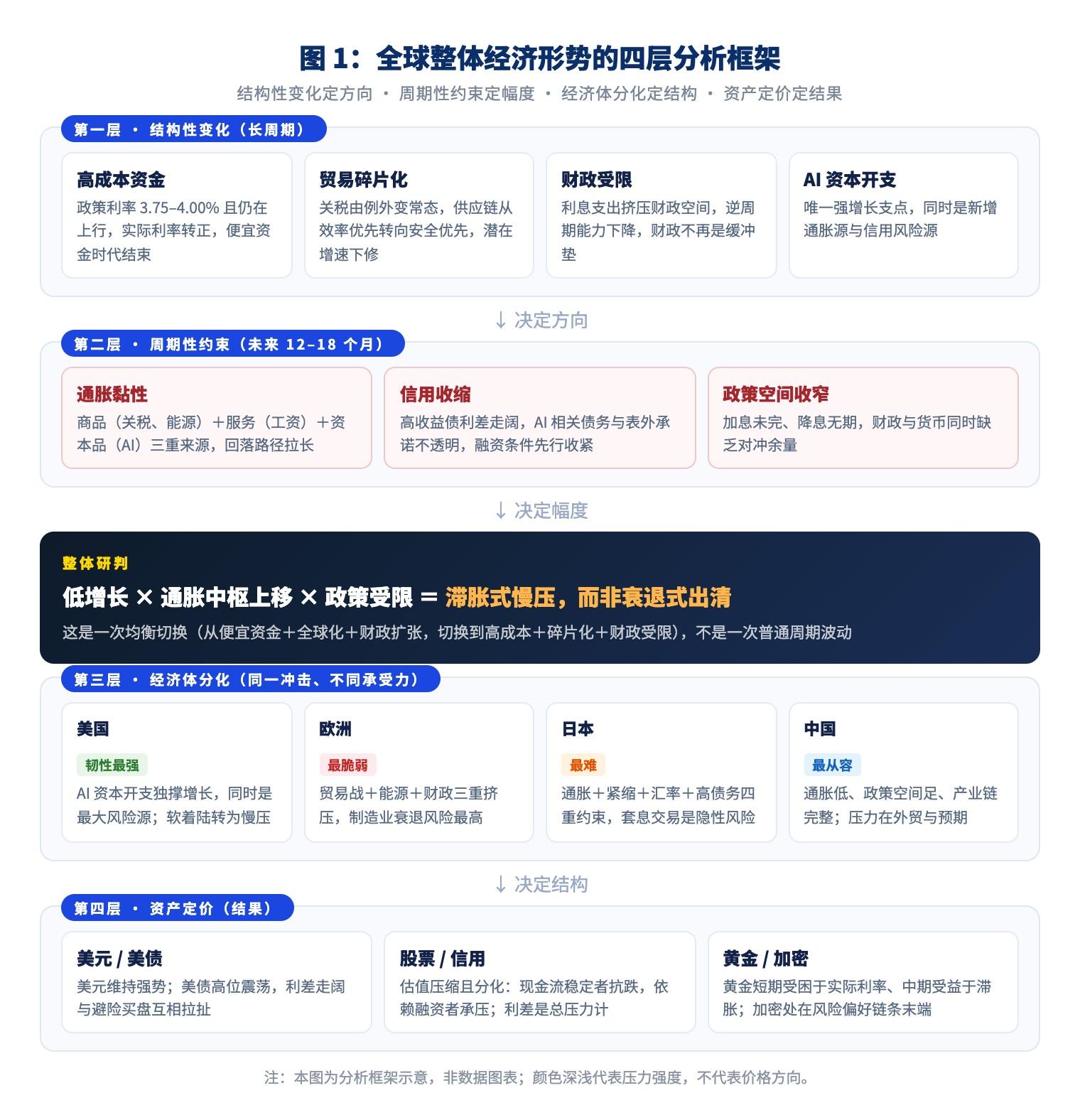
Huobi HTX's Chief Analyst Cloud recently published a global macro deep research report, hypothesizing that the Federal Reserve will continue raising interest rates and that trade frictions will escalate, analyzing the overall direction of the global economy from 2026 to 2027 to provide investors with a reference for understanding the current macro environment. The following are Huobi HTX's research viewpoints. In the past two years, the market has become accustomed to understanding macroeconomics through an 'event-driven' approach: a policy meeting, an inflation data release, or a geopolitical conflict, each priced and digested individually. However, what truly determines the economic landscape in the next twelve to eighteen months is not a single event but a set of characteristics that these events collectively confirm: the global cost of capital has systematically risen, while the three dimensions of growth, trade, and fiscal policy have simultaneously lost their previous buffers. The scenarios hypothesized in the report—continued interest rate hikes by the Federal Reserve, escalating US-EU trade frictions, and the protraction of the Russia-Ukraine conflict—are better understood as three confirmations of the same characteristic of our current era, rather than three independent risks. This article does not assess the impact of single events but instead provides a systematic judgment of the overall economic situation: where we stand, what the constraints are, where the economy is headed, how major economies will diverge, and how asset prices will be priced. 1. Current World Economic Coordinates: Three 'No Longer' To assess the overall situation, the first step is to accurately set the coordinates. The current state of the global economy can be summarized with three 'no longer' statements. First, cheap capital is no longer available. The report assumes in its baseline scenario that the target range for the federal funds rate is between 3.75% and 4.00%, the tightening cycle is not yet over, the yield on ten-year US treasury bonds is around 4.9%, and real interest rates have turned positive—this is a rare funding environment since the 2008 financial crisis. Over the past fifteen years, every slowdown in growth has been accompanied by a rescue through easing, leading the market to form a deep expectation of 'there will be someone to save us when we drop'; this expectation is now the weakest link in the entire pricing system. Second, globalization dividends are no longer present. Tariffs are shifting from negotiation tools to normalized instruments; the principles of supply chain layout have switched from prioritizing efficiency to prioritizing security, and the premium that multinational corporations pay for 'certainty' is continually increasing—this comes at the cost of systematic downgrades in global potential growth, a loss that will not reflect in any single quarter's data but will determine the growth center for the next decade. Third, fiscal buffers are no longer available. In a high-interest-rate environment, the government's debt service burden continues to rise, while the fiscal space of major economies is tightening, significantly weakening the ability for counter-cyclical hedging—this means that when the next downturn arrives, the strength of policy rescue will be noticeably less than historical experiences. The three 'no longers' combine to reach the same conclusion: the global economy is transitioning from the old equilibrium of 'cheap capital + globalization + fiscal expansion' to a new equilibrium of 'high costs + fragmentation + fiscal constraints.' This is a transition of equilibrium, not just a normal cyclical fluctuation—cyclical fluctuations have clear bottoms and rebounds, while an equilibrium transition changes the entire level at which the economy operates. All subsequent judgments are based on this coordinate. In summary: this is not a storm that will pass, but a change in climate—storms teach us to hide; climates teach us to migrate. 2. Slope of Constraint Conditions: How Three Premises Will Change the Future Within this overall framework, there are three emerging premises that, while not changing direction, will determine the slope and speed at which that direction is achieved. The first is the assumption that the Federal Reserve will continue raising interest rates: the market maintains a pricing above 90% for a 25 basis point hike in December 2026, with the divergence in paths only regarding rhythm—both a one-time increase of 50 basis points and a gradual tightening approach coexist, with many institutions including a potential peak rate of 4.75% and a tightening pathway extending to 2027 in their baselines. The significance lies not in the single amplitude but in confirming the 'long-term high interest rates': the market must abandon the obsession with rapid rate decreases and reprice all assets based on high-cost capital. The second is the escalation of trade frictions in Europe: both the implementation of tariffs itself is delayed until 2027, and new tariff lists are now targeting core export categories from Europe. The EU’s countermeasure tools have been filed, and carbon tariffs are entering the actual charging stage—this means that 'trade fragmentation' has turned from a trend judgment into an established fact, with the costs of supply chain reconstruction moving from expectations into balance sheets. The third is the continuation of the Russia-Ukraine conflict: the normalization of energy facility retaliatory attacks, and a lack of common prerequisites for a ceasefire—this means that 'security costs' are formally entering companies' cost structures, while energy risk premiums, shipping insurance, and supply chain redundancy have all become long-term expenditure items. The three directional premises are highly consistent: raising costs upward and compressing growth downward. Interest rates determine the price of capital, trade determines the price of goods, and conflict determines the price of security—when all three move upward simultaneously, the economy lacks cheap exports. The overall framework is illustrated in Figure 1: structural changes determine direction, cyclical constraints determine amplitude, economic differentiation determines structure, and asset pricing is the final outcome. Figure 1: Four-layer analytical framework of the global economic situation (Structural Change → Cyclical Constraints → Economic Differentiation → Asset Pricing) III. Overall Assessment: Four Main Lines of Growth, Inflation, Fiscal, and Financial Growth Line: Global growth is slowing but increasingly on the edge. The US economy still shows resilience—retail sales growth has slowed to 0.2% month-on-month, while core retail sales excluding automobiles is still at 0.6%. Consumption is exhibiting differentiation rather than a sharp decline; corporate investment is suppressed by financing costs, with AI capital expenditures being the only strong driver, but the realization of its returns is questionable, and the most vulnerable part is heavily reliant on capital market financing. Europe is facing the greatest growth pressure: external demand damage coupled with weak domestic demand, with manufacturing recession risks higher than in the US, and energy and defense spending further squeezing fiscal space. Japan’s situation is the most complex: rising inflation, tightening expectations from the central bank, and high government debt coexist, causing the yen exchange rate to come under repeated pressure at critical points—it is both a source of carry trade for global capital and a potential trigger for volatility. Pressure in China is concentrated around foreign trade and expectations, but with low inflation, ample policy space, and a complete industrial chain, it has relatively calm conditions even as the global environment tightens synchronously. Overall judgment: global growth is shifting from "US dominance" to "synchronous slowdown," with the slope of the slowdown determined by credit conditions rather than a collapse in demand. Inflation Line: Central tendency is rising, and the path to decline is lengthening. This round of inflation needs to be viewed in three layers: commodity inflation arises from tariffs and energy, being a direct product of policy and geopolitics; service inflation comes from wage stickiness, a byproduct of resilience in the labor market; capital goods inflation is driven by the AI investment frenzy affecting the prices of semiconductors, electricity, and other input factors, marking a new variable in this cycle—research reports indicate that officials within the Federal Reserve have already judged that AI is the most likely persistent driver of inflation in the future. The reports suggest that the core PCE remains above 3% and continues to rise, making the 2% policy target difficult to stabilize before 2027. The implication for the overall situation is that inflation will no longer be a cyclical phenomenon that disappears on its own, but rather a structural background coexisting with slowing growth in the long term—this is the crux of "stagflation-style slow pressure." Fiscal Line: Deterioration from counter-cyclical tools to constraints. High interest rates are pushing government interest expenditures to historic highs, and the fiscal expansion capacity of major economies is simultaneously limited—US constrained by the debt ceiling and interest burdens, Europe pressured by deficit discipline and defense spending squeezes, Japan restricted by the world’s highest government debt ratio. Fiscal policy can no longer offset monetary tightening, marking the biggest difference from the cycles of 2020-2021: when a downturn occurs, there is no second hand to catch it. Financial Line: Credit is a weak link, but not a crisis format. The banking system has reserves of about $3 trillion, and the money market is running smoothly—the system is not short of money; what is lacking is capital willing to take on risks: the spread on high-yield bonds has widened to 352 basis points, AI-related debt and off-balance-sheet leasing commitments are rapidly expanding, and there is insufficient transparency in private credit. The willingness to price risk capital is declining, financing conditions are tightening in advance, yet the banking system has not bled out—this is a typical form of "financial conditions tightening without an explosion of crisis." It determines that the downturn is a slow squeezing type: corporate financing terms tighten first, capital expenditure plans follow with delays, and profit expectations are ultimately adjusted downward. As a result, credit spreads have become the primary indicator for observing the overall situation—every widening of the spread requires a re-evaluation of all high-valuation assets. IV. Economic Differentiation: The Same Shock, Different Resilience. Under the new balance, the performance of various economies will be highly differentiated, and this differentiation itself will become a major source of future volatility. The U.S. is a combination of "the most resilient yet the most vulnerable": AI capital expenditure alone supports growth, but once the returns fall short of expectations or financing conditions continue to tighten, the supporting items could instantly turn into risk sources—valuation compression in U.S. stocks will be faster than earnings downgrades. Europe is the most vulnerable link: trade frictions, energy premiums, and fiscal crowding out are three external shocks superimposed on the existing weaknesses of manufacturing, leading to the highest recession risk among major economies, and the European Central Bank's policy stance is also the most passive. Japan is the "latent powder keg" of the global interest rate system: coexistence of inflation and tightening, the highest debt ratio globally, and a massive scale of yen carry trades—once the Bank of Japan's tightening rhythm deviates from market expectations, carry trade unwinding could transmit shocks to global risk assets, a dimension that most investors price in. China is relatively composed: low inflation, ample policy space, and a complete industrial chain, with pressure concentrated in foreign trade and expected recovery; in the global pattern of "differentiated tightening", the relative valuation advantage of RMB assets might attract medium- to long-term allocation funds. In one sentence: the global economy is transitioning from "synchronized easing" to "differentiated tightening", and investors can no longer treat "the global economy" as a whole for trading; pricing must be done separately by economy. V. Scenario Simulation and Asset Pricing Baseline scenario (highest probability): Rate hikes proceed at a pace of 25 basis points, and trade frictions escalate only moderately—lists are announced but execution is delayed, and conflicts remain deadlocked. The economy follows a stagflation-like slow compression path: growth declines quarter on quarter, inflation remains sticky, and policies remain inert; risk assets experience oscillations downward, with amplified volatility but not reaching a crisis. Deterioration scenario: Rate hikes exceed expectations (a one-time increase of 50 basis points or more frequent dot plot indications), trade countermeasures and new tariffs are mutually applied, and conflicts experience escalation events—these three reverberate to push credit spreads to crisis thresholds, and risk assets face a second bottoming process, at which point fiscal and monetary measures lack sufficient hedging space. Relaxation scenario: Inflation data unexpectedly declines, trade negotiations return to the right track, and a ceasefire achieves framework progress—valuation repair window opens, but constrained by a high-cost funding environment, the ceiling for repair is lower than historical cycles. Asset pricing then unfolds: the dollar maintains strength, non-dollar currencies and emerging market financing conditions remain under pressure; U.S. Treasury yields oscillate at high levels, with spreads widening and safe-haven buying pulling in opposite directions; stock valuations compress overall but with differentiated rhythms—companies with stable cash flows and controllable capital expenditures resist declines, while AI capital expenditure-intensive firms reliant on capital market financing or customer prepayments face the most pressure; gold is temporarily constrained by positive real rates and a strong dollar, but mid-term allocation value rises after the return of stagflation narratives; among commodities, energy is supported by geopolitics, while industrial metals are suppressed by demand; crypto assets are at the tail end of the risk preference chain—the first wave of risk release hits first, and the repair dividends rank last. The report provides allocation thoughts: compress duration and leverage, enhance asset quality, prioritize cash flow and physical assets, retain cash—cash has a cost, but the cost of leverage is higher. VI. Conclusion: Five Basic Judgments First, this is a balance switch rather than a cyclical fluctuation: the three pillars of the old balance—cheap capital, globalization, and fiscal expansion—are loosening simultaneously, permanently changing the economic operating level. It is dangerous to rely on old cyclical thinking that "what has fallen will rebound." Second, the upward movement of the inflation center is structural: tariffs, energy, and AI capital expenditures constitute new price sources, making it hard for the 2% target to stabilize and return in the visible future. Nominal interest rates will be sustained above the average of the past fifteen years for a long time. Third, fiscal policy is no longer a cushion: there will be no rescue team for the next downturn; market entities must bear the cycles on their own. Fourth, differentiation replaces synchronization: the U.S., Europe, Japan, and China take different paths under the same shock, and pricing by economy replaces globally unified trading, where volatility itself becomes the norm. Fifth, the core variable in asset pricing shifts from "growth" to "cost": the assets that will outperform in the future are not those with the best growth stories, but the ones with the highest tolerance for a high-cost environment—cash flow, low leverage, physical attributes, and policy protection are the four hard currencies in the new balance. Among these four hard currencies, cash's short-term price fluctuation is relatively limited, but it also faces the risk of being eroded in purchasing power—it does not generate returns, but it buys options; in a phase where direction is not yet clear, the option itself is the highest return.
Details compiled from public sources. Always do your own research.