
Anthropic CEO's Long Post Goes Viral: The Desktop App of the Superintelligent Era is Here
Early this morning, Anthropic CEO Dario Amodei posted a long thread on X. One of the main points he discussed is: To what extent can AI replace humans?
Machine translated. Refer to the original for accuracy.
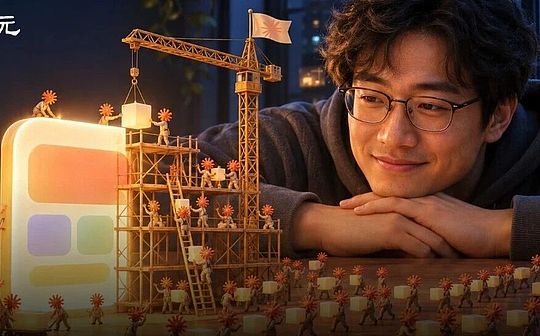
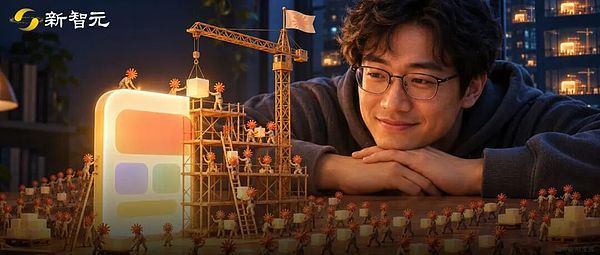
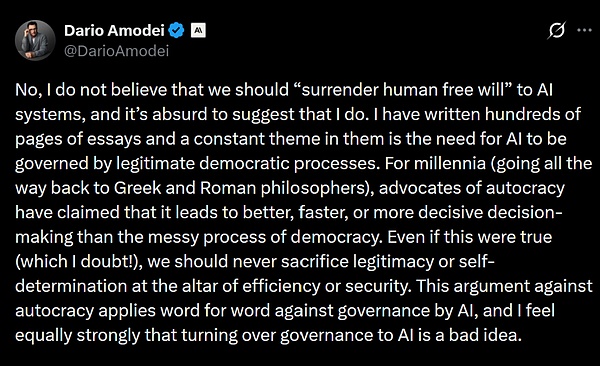
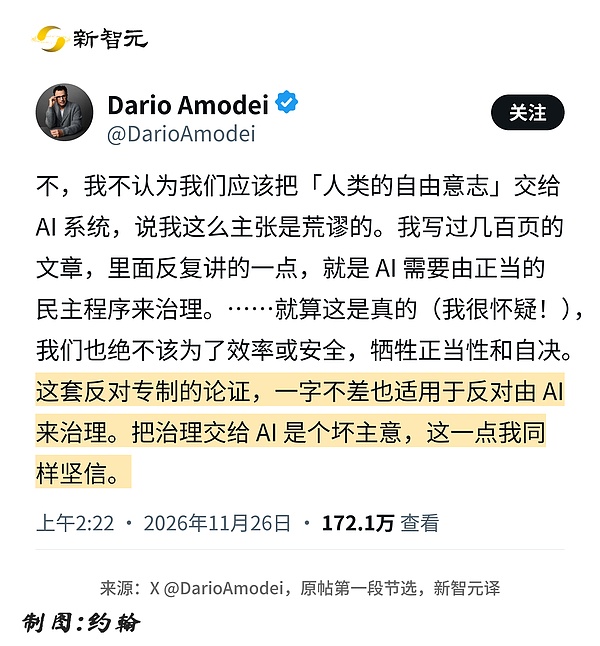
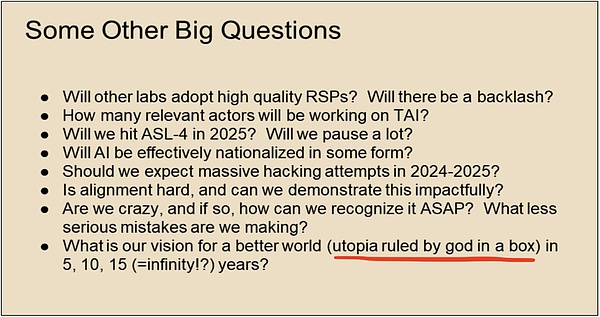
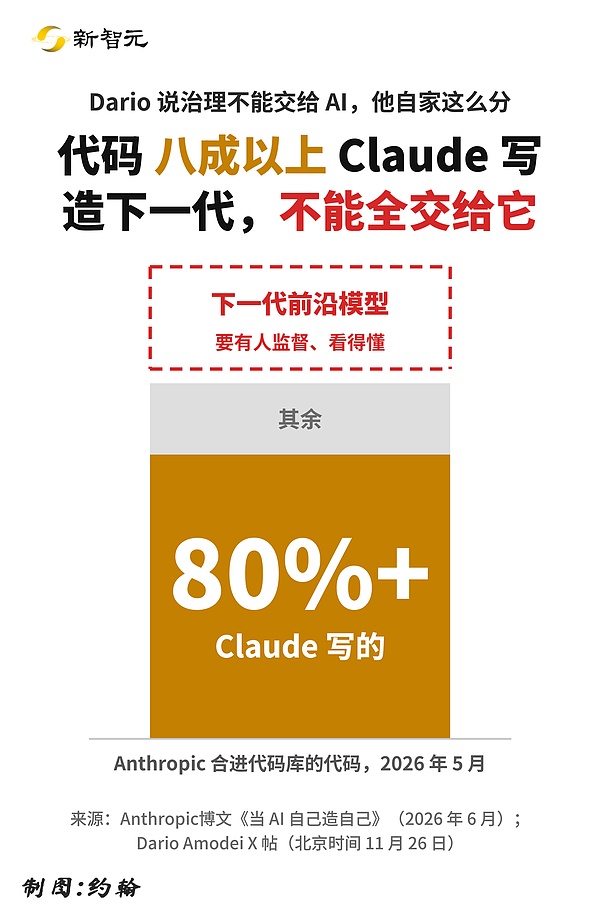
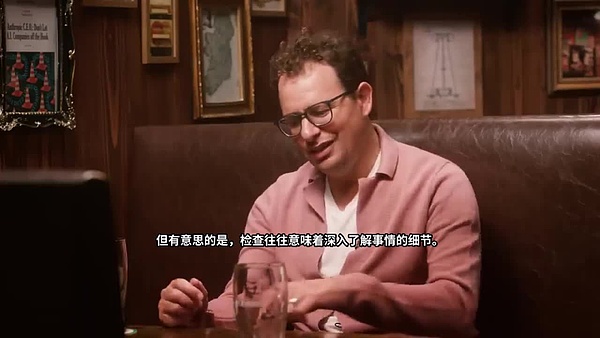
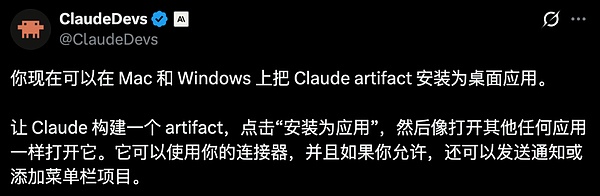
At 2:22 AM today, Anthropic CEO Dario Amodei posted a long thread on X. One focus of his discussion is: To what extent can AI replace humans? In the sci-fi classic "Dune", humanity destroyed all thinking machines, and a thousand years later, the universe's first absolute prohibition is: "You shall not create machines that imitate human thought." This scene is playing out now, with everyone debating the ultimate question: When machines are smarter than humans, should humanity obediently give way? Dario Amodei's first word typed was "No" — He stated that human free will must never be handed over to AI! However, over 80% of the code within Anthropic was written by Claude. He is willing to hand over such specific tasks, but he also drew two hard lines of things he will not surrender. Driving, designing cancer-fighting drugs, and writing software from beginning to end can all be handed over to AI. However, how the governance rules of human society are established, and allowing Claude to autonomously create the next generation of Claude, these absolutely cannot be handed over to AI! First line: The scepter that must not be surrendered Why draw the first line? Axios revealed a "public secret": In the AI safety circles, a "silent consensus" is spreading. This viewpoint believes that once AI can effectively cure terminal illnesses, prevent disasters more effectively than any human, and allocate resources with unprecedented precision, then humanity refusing to relinquish control is not only irrational but even immoral. They use autonomous driving as an analogy: as long as statistics prove machines drive safer than humans, humanity should no longer touch the steering wheel. Similarly, when a system becomes super-intelligent, the so-called "handing the world over to the God in the box" becomes a kind of Utopian redemption. Anthropic is seen as a representative of this "surrendering faction" and faces industry resistance. Dario feels that this slippery slope of logic is dangerous. Because letting AI run data, write code, and calculate molecular structures is task automation. This can save lives, drive energy revolutions, and create immense economic value. But handing global governance, political decision-making, and the direction of human will over to AI? That is a complete disaster. If an AI lab seizes power through technological monopoly, it’s already a great taboo; if this lab not only usurps power but also hands that power over to AI itself, it would be an irreparable catastrophe. Tools can replace human labor, but tools cannot replace human decision-making. The decision-making power must remain in the hands of humans who are rough, slow, full of disagreements, yet possess free will. Second line: No creation of gods, no loss of control Dario's second non-negotiable is RSI. If Claude can already write 80% of Anthropic's code, why not simply let it iterate to create the "next generation model"? Because of speed. When a system enters fully autonomous recursive evolution, its rate of becoming stronger would completely destroy humanity's reaction mechanisms. Humans won’t even have time to understand its current structure before it has completed its next transformation. On this exponential curve, there is no meaningful human oversight, no human-understandable intermediate process, everything is a black box. How does humanity interact with AI? Anthropic CEO: The chat box is just a transition. Within Anthropic, AI has long been used to write software. However, the way humans interact with AI has not changed much. Today at 12:13 AM, someone on X dug up an old video of Dario. It was from August last year, when Stripe co-founder John Collison asked him: Does he think AI still doesn’t have its own interface? Even today, we still type into text boxes, just like terminals from the 1970s. Dario said he basically agrees, "There’s something a bit off here". He recalled when the internet first started, websites were modeled after physical things, and you had to open a cabinet to enter. He continued, in the future, AI will be able to complete a task from start to finish, often correctly, and human roles will mainly be to check; but upon checking, they often have to dive into the details to see exactly what it did. Most of the time, there’s no need to monitor; if mistakes occur, humans have to jump back in. If every step is monitored, it might actually be faster to do it themselves. He stated: This requires a new product, a new interface, which currently no one has created. After the chat box, what interface does Anthropic's CEO envision? Dario's judgment is that: Users interacting with the model through the chat box is merely a transitional phase. The App of the superintelligent era is created by each individual. Just yesterday, Anthropic introduced a desktop App entry into Claude. You can say what you want in the conversation and, once satisfied, click "Install as App." Next time you use it, just click the desktop icon. Whenever you want to try a different approach, you can go back to Claude and ask, and the improved features will be updated in the original window. This is somewhat like a real-life version of "Minecraft": the blocks are ready-made, and everyone builds their own worlds. So, is the official App still available? Yes, it's just moved. Email, calendar, etc., have turned into blocks you import; the installed App can directly use the connectors you set up. In 1995, Stephenson wrote about such a world in his sci-fi novel "The Diamond Age": every family has a matter compiler in their wall that produces whatever is asked for with just a word. The most precious thing in the book is a book created solely for a girl; as she grows, the story changes with her. Thirty-one years later, software has evolved into this. In simple terms, there are only three steps: tell Claude what you want, test it in the conversation, and once satisfied, select "Install as App" from the sharing menu. This process does not require packaging, signing, nor an API key; it uses the personal quota of your Claude account. The installed App can send notifications, stay in the menu bar, adjust Claude, and use the connectors you set up; any changes made in the conversation will also update the desktop App, which can be shared with others. You need to be online and logged into Claude to access it. To prove how powerful this feature is, Anthropic’s own engineers have already been having fun with it internally. Layer-split photo editing software Linnet, a file manager Phosphor that looks like it came out of a movie set, Sift, which organizes your folders according to set rules, a terminal Tern that sits by your side for explanations from Claude, and Vitals, which stays in the menu bar to monitor computer performance. The book in "The Diamond Age" was made by machines, but the voice that grew up with the girl was read out by a real person, sentence by sentence. In the end, the desktop App is just the same: the code is written by Claude, but what to do and how much permission to grant is ultimately decided by humans. Everyone has their own set of Apps. In the past, a software was determined by the company functions, released to millions, and individual needs would have to wait for the next version. Now, a software can be created even if only one person needs it; you say, Claude write. The superintelligent era is a world where everyone has their own set of Apps. Today is Thanksgiving; early in the morning, Google's CEO posted a stacking pie game "One More Pie" created in just a few sentences. He said if your family tradition during the holiday is to see how many desserts can be stacked on one plate, then this game is for you; he also shared his high score to challenge others to beat him. In the future, if you want to create a Thanksgiving game for your family, all it takes is to speak a few words. Everyone having their own set of Apps, taking another step forward, means each family will have their own game for the holidays. From Alphago to the superintelligent era, thank you for always being there.
Details compiled from public sources. Always do your own research.