
Why is the ‘Next Stablecoin Moment’ Tokenized Stocks?

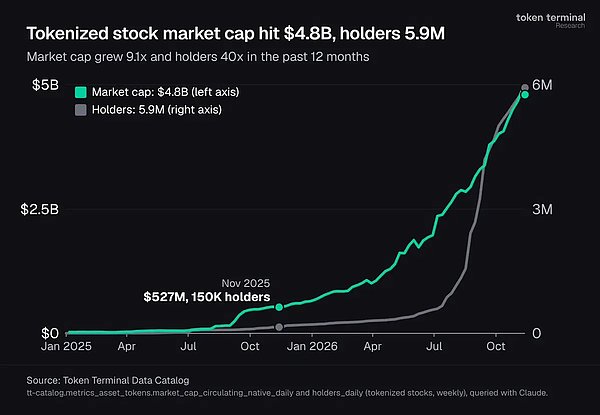
The market is growing rapidly. Over the past 12 months, the market capitalization of tokenized stocks has increased 9.1 times, and the number of holders has increased 40 times, reaching 5.9 million.
Machine translated. Refer to the original for accuracy.
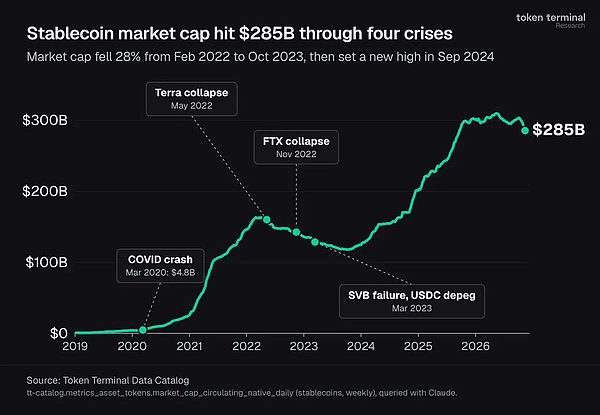
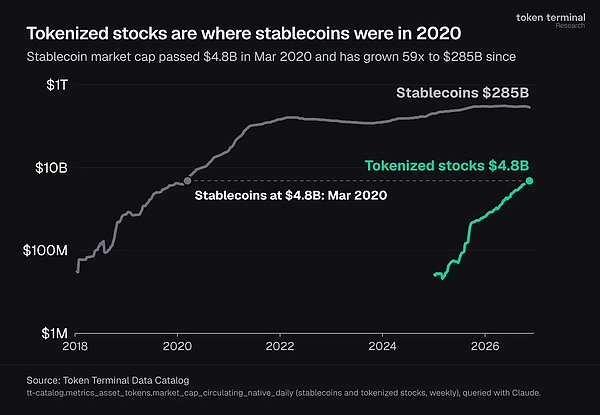
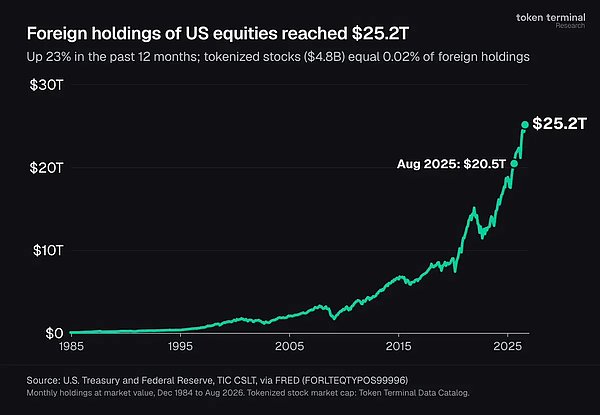
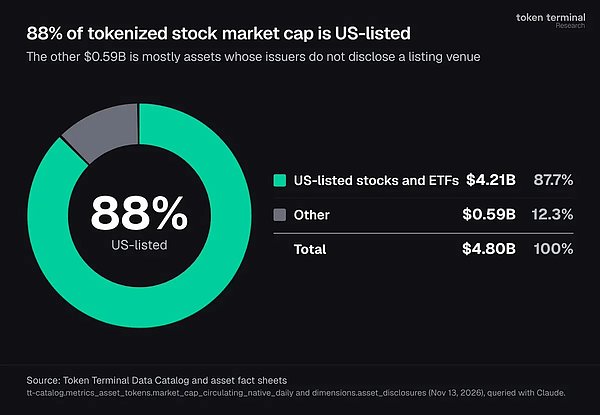
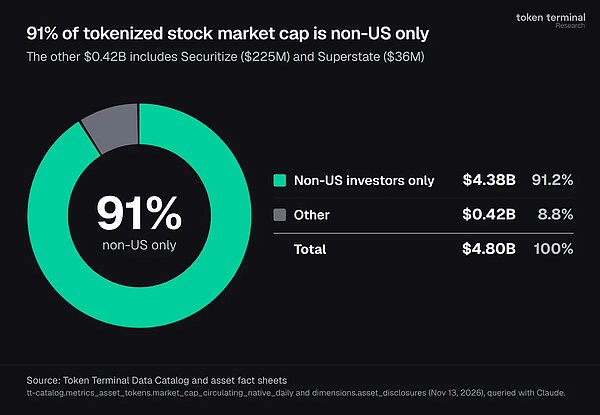
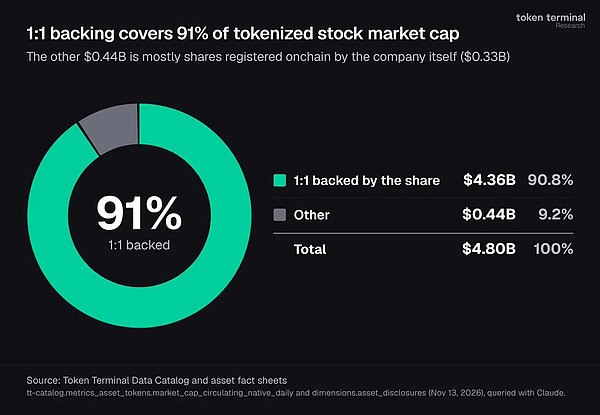
Author: Token Terminal, a stablecoin, tokenized asset, and on-chain financial data platform; Translated by: Gu Yu, ChainCatcher In March 2020, the market capitalization of stablecoins surpassed $4.8 billion. Since then, the market capitalization of stablecoins has grown 59 times, reaching $285 billion; with the passage of the federal stablecoin law GENIUS Act in July 2025, the U.S. is now regulating and supporting stablecoins as a means to expand the influence of the dollar. On November 13, 2026, the market capitalization of tokenized stocks also reached the same $4.8 billion. Tokenized stocks are blockchain tokens that track shares of publicly traded companies. Most tokenized stocks are backed 1:1 by shares held by custodians, who are regulated entities responsible for safeguarding the shares. These tokens can be traded around the clock and are usable in on-chain applications. The market is growing rapidly. Over the past 12 months, the market capitalization of tokenized stocks has grown 9.1 times, and the number of holders has increased 40 times, reaching 5.9 million. https://tokenterminal.com/explorer/tokenized-assets/stocks Tokenized stocks are following the path of stablecoins reaching a market capitalization of $285 billion, and the reasons the U.S. supports tokenized stocks are the same as those for supporting stablecoins. 1. A developing category at the level of stablecoins Stablecoins, which aim to maintain a value of $1, are the clearest precedent. Every crisis since 2020, from the COVID crash to the collapses of Terra and FTX, and the failure of SVB, has tested whether holders trust stablecoins, and the market capitalization of stablecoins has rebounded after each crisis. These crises also indicate which designs can withstand trials. The algorithm-dependent Terra UST collapsed, while the two major stablecoins USDT and USDC, primarily backed by cash and U.S. Treasury bonds, currently account for 86% of the stablecoin market capitalization. Most tokenized stocks adopt the same reserve-backed design. https://tokenterminal.com/explorer/tokenized-assets/stablecoins The market capitalization of tokenized stocks is currently comparable to the market capitalization of stablecoins in March 2020, and tokenized stocks reached this level more quickly. From the time their respective market capitalizations surpassed $1 billion, tokenized stocks took 8 months to reach $4.8 billion, while stablecoins took 11 months. Tokenized stocks are also appearing in a more mature market, where wallets, exchanges, and DeFi venues are already in place, and the regulations are clearer than the environment for stablecoins in 2020, including the SEC's exemption for trading tokenized stocks starting September 2026. https://tokenterminal.com/docs/mcp/introduction The demand scale served by tokenized stocks is substantial. Foreign investors hold $25.2 trillion of U.S. stocks, a 23% increase over the past 12 months, while the market capitalization of tokenized stocks accounts for only 0.02% of foreign holdings. If 1% of foreign-held U.S. stocks were transferred on-chain, the scale would reach $252 billion, about 50 times the current tokenized stock market. https://tokenterminal.com/docs/mcp/introduction 2. The U.S. interests in tokenized stocks are the same as those in stablecoins Treasury Secretary Scott Bessent has stated that stablecoins could become one of the largest buyers of U.S. Treasury securities and help expand the influence of the dollar overseas. Tokenized stocks can play the same role for U.S. stocks, with four characteristics of the tokenized stock market demonstrating this parallel: the assets are U.S. based, the buyers are foreign, the tokens are backed by real shares, and most shares are held by U.S. custodians. Most tokenized stocks track U.S. listed assets. U.S. listed stocks and exchange-traded funds (ETFs) account for 88% of the tokenized stock market capitalization. https://tokenterminal.com/explorer/fact-sheets?view=map Most buyers of tokenized stocks are outside the United States. Tokens sold exclusively to non-U.S. investors account for 91% of the market capitalization of tokenized stocks, indicating that the demand behind tokenized stocks is foreign capital purchasing U.S. assets. https://tokenterminal.com/explorer/fact-sheets?view=map Almost all tokenized stocks are backed by real shares. Tokens supported by underlying shares on a 1:1 basis account for 91% of the market capitalization of tokenized stocks, which is similar to the structure of stablecoins backed by the dollar; hence, one token sold overseas corresponds to one share bought in the U.S. market. https://tokenterminal.com/explorer/fact-sheets?view=map Most underlying shares are held by U.S. companies. Tokens listed with the U.S. broker Alpaca Securities as custodians account for 86% of the market capitalization of tokenized stocks, including $3.76 billion from the three major issuers Ondo, Binance, and xStocks. Out of this $3.03 billion in market capitalization, Alpaca is the only listed custodian, while xStocks also lists three European custodians. In summary, most tokens sold overseas bring foreign capital into U.S. shares held by U.S. companies and regulated by U.S. authorities. https://tokenterminal.com/explorer/fact-sheets?view=map Token demand has already been reflected in individual U.S. companies. The tokenized shares of Circle, the issuer of USDC, amount to $343 million, which is 2.1% of Circle's $16 billion market capitalization. https://tokenterminal.com/explorer/tokenized-assets/stocks?stocksReferenceAssets=crcl For companies financing through the sale of stocks, the token market is also a source of demand. Strategy funds its Bitcoin purchases by selling common stock (MSTR) and preferred stock (STRC), with the combined current market capitalization of tokenized MSTR and STRC at $413 million, thus increasing buyers for the same securities sold by Strategy to raise funds. https://tokenterminal.com/explorer/tokenized-assets/stocks?stocksReferenceAssets=mstr,strc 3. On-chain usage makes tokenized stocks harder to replace Every new use case for stablecoins, whether in exchanges, lending markets, or payments, makes stablecoins more useful to others and harder to replace. Tokenized stocks are beginning to follow the same usage pattern. DeFi TVL, the value of tokenized stocks deposited in on-chain applications like lending markets and trading pools, has grown 24-fold in the past year to $300 million. Current deposits represent 6.3% of the market capitalization of tokenized stocks, up from 2.4% a year ago, and each deposit increases liquidity for the next trader while earning returns for holders. https://tokenterminal.com/explorer/tokenized-assets/stocks?stocksMetric=asset_tvl Weekend trading provides another reason for holders to stay on chain, as U.S. exchanges are closed on Saturdays and Sundays. In October 2026, weekends accounted for 18% of the trading volume of DEX tokenized stocks, amounting to $2.4 billion, which is 83 times the level of a year ago. Holders can act on news before the market opens on Monday. https://tokenterminal.com/explorer/tokenized-assets/stocks?stocksMetric=asset_trading_volume 4. Restrictions on asset-backed tokens will push demand towards perpetual contract venues. A key risk of tokenized stocks comes from regulation. If U.S. regulators restrict tokenized stocks backed 1:1 by shares, demand for U.S. stocks in non-U.S. markets is likely to shift to perpetual contracts (perps, perpetual futures), which track prices, have no expiration dates, and do not have underlying stocks. The perpetual contract market for stocks has been growing. Trade.xyz is a perpetual contract exchange built on Hyperliquid, a blockchain designed for trading, which has launched U.S. stock and index contracts. The open interest in Trade.xyz's stock perpetual contracts, which represents the value of open positions, has grown 55 times over the past year to reach $1.54 billion. Each position in a perpetual contract does not require corresponding stocks, so the demand shifting to perpetual contracts ultimately leads to less demand for U.S. stocks and U.S. custodians, and perpetual contracts do not pay dividends subject to U.S. taxation. Supporting asset-backed tokens can keep more overseas demand in U.S. stocks. https://tokenterminal.com/explorer/projects/tradexyz/xyzspcx?metric1=open-interest Core Conclusion Today's tokenized stocks look like stablecoins did in 2020. Tokenized stocks adopt the same reserve-backed design, with market capitalization growing from $1 billion to $4.8 billion at a faster pace, relying on $25.2 trillion in foreign holdings of U.S. stocks. This gives U.S. supported tokenized stocks the same justification as stablecoins because restricting asset-backed tokens will push the same overseas demand towards perpetual contracts, where the demand reaching U.S. stocks is less.
Details compiled from public sources. Always do your own research.