
Riemann Hypothesis Proved, Is Bitcoin Still Safe?
Since the mathematical tools used in Bitcoin are related to prime numbers, will the distribution law of prime numbers studied in the Riemann Hypothesis affect the security of elliptic curves?
Machine translated. Refer to the original for accuracy.
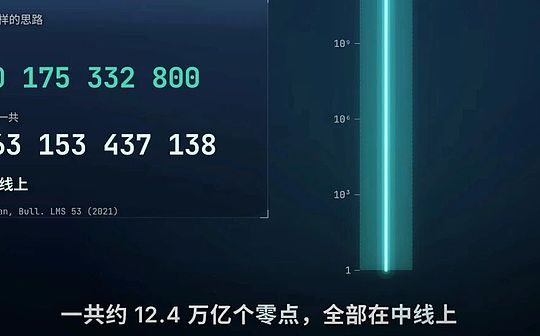
A breakthrough has occurred in the mathematical community regarding a century-old problem. On November 20, 2026, mathematician Levent Alpöge announced that with the help of artificial intelligence Claude, he has completed the proof of the Riemann Hypothesis and released approximately 17 million lines of Lean code. The significance of this event is substantial. The Riemann Hypothesis is listed as one of the seven millennium prize problems announced by the Clay Mathematics Institute, and many papers and theories are based on the premise that the Riemann Hypothesis holds. However, it should be noted that as of November 23, 2026, the official website of the Clay Mathematics Institute still lists the Riemann Hypothesis as an unresolved problem. Significant progress has been made in the formal verification of mathematical proofs, but the academic understanding of the proof's reasoning, as well as the formal evaluation of the millennium prize, each have their own processes. So, let the “bullet fly for a while” and everyone please be patient. However, many marketing accounts have started to scare people with headlines like “Riemann Hypothesis Proved, Bitcoin is in Danger.” I have no interest in opening these, but many members have privately messaged me asking if this truly has an impact. To help everyone avoid emotional investment decisions, I will explain in a roundabout way. Of course, I must clarify that I am not a mathematician, nor am I a cryptographer. I simply believe that if something cannot be verified, it should not be considered imminent. Many marketing accounts may not even understand what the Riemann Hypothesis is. So let's start by discussing a few basic points here, and I hope everyone will look for some related videos to supplement more details. Let's begin with a simple question. 2, 3, 5, 7, 11, 13, what do these numbers have in common? Answer: They are all prime numbers. A prime number is a positive integer that can only be divided by 1 and itself. For example, the number 7 mentioned above can only be divided by 1 and 7 and cannot be factored into two smaller integers. Prime numbers may seem ordinary, but they occupy a very special position in the whole world of mathematics. You can think of prime numbers as the basic building blocks of the world of integers; almost all integers greater than 1 can be factored into a product of primes. For instance, 12 can be factored into 2 multiplied by 2 multiplied by 3, and 30 can be factored into 2 multiplied by 3 multiplied by 5. No matter how large a number is, in principle, a corresponding prime factorization can always be found. This is very important because prime numbers form the foundation of the integer multiplication system, but issues arise. What is the pattern according to which prime numbers appear? Starting from 2, primes seem to appear relatively frequently, but as the numbers get larger, the frequency of prime occurrences decreases. In a long enough interval of numbers, you might encounter many primes or it might take a long time to find one. They seem to have a pattern, yet it is challenging to find a simple rule. Therefore, mathematicians are compelled to find some method or pattern. They want to understand how primes are distributed if numbers keep growing. Can we estimate in advance how many primes will appear before a large number? This leads to the prime number theorem, which gives an average rule for the overall distribution of primes. It helps mathematicians estimate how many primes there are within a very large range of numbers, but that is still not enough. Image from: Beyond the Spectrum (Bilibili Video) We know the average trend, but we still do not know how much the actual distribution will deviate from that trend. Let’s try to understand with an example from daily life. If you know that the annual average rainfall in a city is 900 millimeters, then you understand where the minimum flood prevention line for a reservoir should be, allowing you to establish an appropriate reservoir height. However, when it comes to you personally, whether you need to bring an umbrella tomorrow, that average rainfall of 900 mm becomes meaningless. Thus, the prime number theorem provides the average annual value, while the Riemann Hypothesis seeks to answer the fluctuation range. Moreover, as mentioned earlier, Riemann himself did not claim to have proven it; he merely stated “likely” and used this assumption as a stepping stone to derive a series of conclusions. In summary, the Riemann Hypothesis actually sets a very precise constraint on the distribution of prime numbers, further informing mathematicians about how much the actual distribution of primes deviates from the average rule. Why is this so important? Because prime numbers run through entire number theory systems. From integer factorization to various number theory functions, and to modern cryptography, a lot of mathematical research is inseparable from prime numbers. If the Riemann Hypothesis holds, it means that mathematicians can grasp a series of conclusions regarding prime distribution more accurately. So, after all the discussion earlier, many friends might be pulling their hair out in anxiety, perhaps just short of reaching through the internet to grab my hand and loudly asking: Does it really affect Bitcoin's security!!! I know you are anxious, but hold on for a bit, because we were just discussing data science, while Bitcoin is about cryptography, which you can understand as a set of mathematical rules. The set of rules for Bitcoin needs to solve a problem: how to allow others to verify that you have the right to use a certain asset, while at the same time making it impossible to deduce your private secrets solely from public information. This is the value of Bitcoin's system and the core that supports its future. The two key concepts here are private keys and public keys. You can think of a private key as a key that only you hold, while a public key is a piece of public information generated through mathematical operations. Wallets use the private key to generate the public key; others knowing your public key can verify the transactions you sign but cannot easily deduce the private key solely from the public key. The elliptic curve cryptography that Bitcoin uses primarily relies on a mathematical problem known as the elliptic curve discrete logarithm problem. The name sounds a bit complex, but it can actually be understood through a simple process: Suppose you have a secret number; by following a specific rule, you can easily calculate another public number from the secret number. The process of converting from the secret number to the public number is quick, but going the other way—finding the initial secret number from just knowing the public number—requires an enormous computational cost with currently known classical methods. This is the basic idea behind elliptic curve cryptography. The curve used by Bitcoin is called secp256k1, and the equation is quite simple, with all calculations occurring within the bounds of a 256-bit prime number. The private key is a large integer; the public key is obtained by "multiplying" the private key by a fixed point: Q = d × G In simple terms, all related calculations follow a fixed mathematical rule, and the result of the calculation is confined within a determined range. Don’t be fooled by the simple formula; despite its simplicity, this multiplication is not ordinary multiplication—it's repeatedly adding the fixed point G on the curve d times. The computer uses doubling techniques to compute the public key from a 256-bit private key in just a few hundred operations, making it efficient to the point of being negligible. Moreover, it's essential to note that the prime is very large, at a 256-bit scale. So, if we remain calm, we should rationally pose the question: Since the mathematical tools used by Bitcoin are related to prime numbers, will the distribution laws of primes studied by the Riemann Hypothesis affect the security of elliptic curves? Again, I know you are anxious, but please hold on! We still need to understand another critical technology behind Bitcoin, as Bitcoin has two locks regarding encryption. We just finished discussing the first lock, and now we move on to the second lock. This is SHA-256. If elliptic curves are primarily responsible for transaction authorization, then SHA-256 takes on tasks including hash calculations, linking blocks, and proof of work in the Bitcoin network, like the familiar mining process: Miners consistently alter the data within the block header, repeatedly compute hash values, until they find a result that meets the network's difficulty requirements. This process employs a double SHA-256. Hash algorithms have an interesting property: if there's a slight change in the input data, the final hash result could be entirely different. You can think of it as a special number blender; no matter whether the input is a sentence, an image, or a complete block, it will yield a fixed-length result, and deducing the original data from this result is computationally very challenging. Here, we should add an interesting detail. The SHA-256 algorithm, during its design, indeed used numbers related to primes as part of its initial constants. These numbers come from the decimal fractions of the square roots and cube roots of the first few primes, suggesting a potential connection to the Riemann Hypothesis. However, these are simply fixed numbers selected during the algorithm's design; SHA-256 does not require the Riemann Hypothesis to function, and its security does not depend on whether the Riemann Hypothesis holds. Thus, we now understand that Bitcoin's security framework involves two categories of important tools: Elliptic curve cryptography, used for keys and transaction authorization. SHA-256 hash algorithm, used for data integrity, block linking, and proof of work. They solve different problems. So, returning once more to the original title: If the Riemann Hypothesis is proved, is Bitcoin still safe? The answer is somewhat unexpected; there is indeed a mathematical connection between the two, but this connection is not as direct as people imagine. The Riemann Hypothesis studies the distribution of prime numbers within the entire sequence of natural numbers. One uses prime numbers, and one studies prime numbers. It seems like there is a deep connection. However, there is an important distinction: the elliptic curves used by Big Coin only require one predetermined prime that meets the criteria, along with a set of designed and validated mathematical operations. It does not need to know how all prime numbers will be distributed in the future and does not rely on the Riemann Hypothesis to determine that prime. The difference between the two is somewhat like how you cannot classify nail clipping as surgery, even though it seems to have a slight relatedness. So, you can remember one thing: The cryptography used by Big Coin employs mathematical tools related to prime numbers, but its security does not rely on the validity of the Riemann Hypothesis. Or from a discussion perspective, what would happen to Big Coin if the Riemann Hypothesis were formally proven or overturned one day? First, let's assume the Riemann Hypothesis is ultimately proven. This would mean mathematicians have a more solid theoretical foundation regarding the distribution of prime numbers, leading to significant advances in mathematical research, and some algorithmic analyses that rely on relevant conclusions from number theory may also see further refinement. However, for Big Coin, this would not automatically result in enhanced security. Your private key would not become longer, your public key would not change, and SHA-256 would not suddenly become more secure just because the Riemann Hypothesis is proven. The consensus rules, cryptographic parameters, and transaction verification methods that existed within the Big Coin network would not automatically change due to this mathematical proof. Now, what if the situation is reversed? What if mathematicians ultimately discover that the Riemann Hypothesis is incorrect and find a counterexample that does not conform to the original conjecture? This would indeed become a significant event in the history of mathematics. Many theoretical conclusions dependent on the Riemann Hypothesis would need to be reexamined, and some mathematicians' research directions could also change as a result. However, this still does not directly lead to the conclusion that the cryptographic system of Big Coin would be compromised, as proving the Riemann Hypothesis wrong is not the same as finding an algorithm that can quickly break the elliptic curve discrete logarithm problem. Only if subsequent research indeed discovers a new algorithm that can effectively attack existing cryptographic systems under realistic computational conditions would there be an actual security threat. As of now, the progress in proving the Riemann Hypothesis has not led to such a conclusion, so whether the Riemann Hypothesis is proven true or ultimately overturned, we cannot judge that the security of Big Coin will change based solely on that. I may have written a bit too much, so let me make a final reminder: whether you are a friend like me who has been in the space since 2017 or a newbie who has just entered not long ago, you need to understand one thing—cryptographic security and asset management security are two separate issues that need to be viewed independently. Looking back, the Riemann Hypothesis itself remains an extremely great mathematical problem; it studies the laws behind prime numbers and helps humanity further understand the digital world. Big Coin, on the other hand, is a system that combines mathematics, cryptography, computer networks, and economic incentives. There are mathematical intersections between the two, but each also has its own independent research issues. We should indeed pay attention to advancements in mathematics and technology, especially breakthroughs that might change the existing boundaries of cryptographic security. However, there is no need to panic if we hear of progress on a mathematical challenge, wondering if our wallets will still open tomorrow; understanding the boundaries of technology is much more important than panicking upon hearing a new term. Please verify, do not believe. This statement applies in investment and is equally applicable in the technology field. 1 BTC = 1 BTC. At least today, the progress in proving the Riemann Hypothesis has not changed that fact. The sense of security should come from understanding the assumptions, not from name associations. Wishing everyone a good mindset to navigate through the cycles.
Details compiled from public sources. Always do your own research.